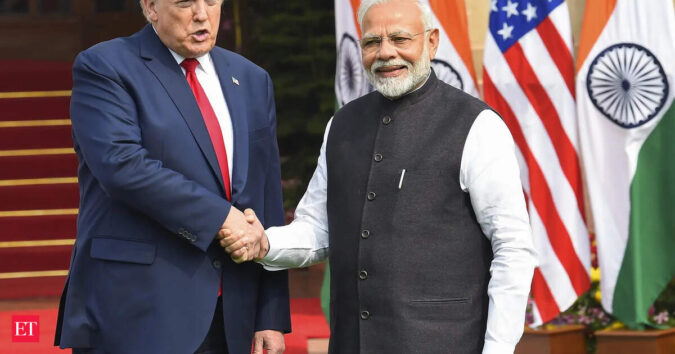
Speaking at the Global Business Summit, the minister also sought to allay fears of artificial intelligence displacing jobs. AI will not replace humans, it’s only going to change the nature of work, and “that is what we have to be prepared for,” he said. “The nation today is moving forward on a fast track. Prime Minister Narendra Modi has taken forward the reform express in mission mode,” Goyal said, citing various reforms and a series of free trade agreements (FTAs). India has firmed up FTAs with New Zealand, the UK, Oman, the EU and finalised an interim trade agreement with the US in the last few months.
ALSO READ: India must strive for reciprocity in trade deal with US, says American economist Ann E Harrison
Emphasising that India’s global engagement today is from a position of strength and self-confidence, Goyal said: “Never before did we ever see a time where India engaged with the developed world and got our terms. We finalised deals which were good for the country, for all sections of society. We have had path-breaking new initiatives.” He cited the example of India’s trade deal with the European Free Trade Association (EFTA) where the four countries – Switzerland, Lichtenstein, Norway and Iceland – gave legally binding commitment to invest in India $100 billion as FDI with a condition that if they do not invest that money in a defined time frame, India can claw back the concessions given under the deal. “Now, that’s a first for the world. The world has never seen this before,” Goyal said.
ALSO READ: India-US trade deal: Forging a new economic era
Goyal stressed on the need to bring balance in every agreement and that it’s fair and equitable so both sides stand to gain. “Today, when we engage with the world, we ensure that we respect their sensitivities, and they respect our sensitivities,” he said. “Therefore, when we did the United States agreement, it was very clear that we needed to protect our farmers.”
All the main areas in which India’s farmers have high production or helped the country become self-sufficient, “we were able to keep out of the free trade agreement,” such as rice, wheat, corn, soya meal, millets, all GM food products, spices and potato, he said.
‘Maintaining Sensitive Interests’
“Even in this era of change, we are able to maintain our sensitive interests and focus on areas which are of mutual benefit and will benefit both nations,” Goyal said, adding that New Delhi has kept farmers paramount “in our trade negotiations, while ensuring that we also open up large market for our farm produce in the US.”
Farmers, fishermen and the MSMEs are “always at the forefront of change,” Goyal stated, adding that many opportunities will open up for the country’s labour-intensive sectors, providing jobs, investments and economic activity.
AI oppurtunities
Ahead of the India AI Impact Summit next week, Goyal said India can help the world adopt AI as Indian companies increasingly engage with these modern technologies.
“Artificial intelligence is not going to replace the human being. It is only going to change the nature of work that we are doing, and that is what the last decade of disruption has taught us, and that is what we have to be prepared for,” he said.
Often, people worry that AI will cause job losses, but it means reorienting the kind of jobs and possibly it will create more job opportunities. “When we talk of artificial intelligence, one must bear in mind it will need a lot of data crunching,” the minister said, and cautioned never to entirely trust what one gets out of AI.
“You may get a document out of your ChatGPT or Perplexity, but I’m sure each one of you checks to make sure that it’s not some junk or garbage that has come out of bots or corrupt data, or data which has been wrongly fed into the system,” he said. “We’ve seen that on social media. We’ve seen the increasing use of bots, increasing use of the misuse of numbers or statistics, and the same thing is going to happen with AI.”
This will need cyber security experts to protect databases and new jobs to clean up the data and need human beings to validate the output that comes out, Goyal said.
“So…the conclusive part of (AI) will always be in our control,” he said.
FTA Negotiations
Goyal said the concessions to EFTA countries in the trade deal will not hurt India because the kind of products from these countries “aren’t going to hurt the Indian domestic manufacturing or farmers or anybody whatsoever.”
Their per capita income is upward of $100,000, while India’s is $3,000. “They cannot produce or provide us anything which we require at competitive prices to hurt our industry,” he insisted.
But India will benefit by opening up to their high precision tools or machinery areas where the country does not have the capabilities as yet, he added.
Highlighting that in a free trade deal, one is crystal gazing into the future, the minister said: “When we did the free trade deal with the UK, I was faced with the same dilemma… We are both $4 trillion economies but come 2047…I am offering a $30 trillion growth at the minimum. On the other side, I’m not seeing that kind of a growth – at best to $8-10 trillion.”
He said India secured a double contribution convention, under which Indians working in the UK for short periods will no longer lose 25% of their salary to the UK exchequer towards social security contributions. Instead, the money will now be paid in their provident fund accounts in India.
“This has been the story (of FTAs)…one after another, where India has been able to get the best and protect the interests of our farmers, MSMEs, fisherfolk, artisans, handloom and handicraft sector,” the minister said.
Gone are the days when India had a 2-3% market share in textile, leather, handloom and handicraft sector of global trade, or was dependent on imported automobiles, he said. “Today, while we import some $900 million of automobiles, we export $9 billion of automobiles.”
Similarly, India is self-sufficient in “most of our food grain requirements” and exports nearly $55 billion worth of food, food products and fish products across the world, while the import bill is under $30 billion.
The consumer also has to get a fair deal and high quality products, the minister noted.
“In whatever we need to import, we are happy to encourage more competition, so that our consumers get more choice, we get better quality and more competitive prices,” he said.
“That is the calibrated opening that India has done in its international engagements. This is the market access that we are opening up around the world with very good, fair and advantageous agreements,” Goyal said.
“Along with this, we are…protecting our sensitive sectors, fishermen, farmers, MSMEs, GI type products or handlooms or handicrafts, but yet opening the doors both for goods and services and mobility to serve the best interest of 140 crore Indians,” he said.
The minister said India’s $30 trillion-plus economy in 2047 will be powered by technology, manufacturing and service sector skills.
He noted that India is already the fourth largest economy. “Maybe, a couple of years down the road, when I come to the Global Business Summit, it should be the third-largest global GDP.”