A three-day meeting between Indian and American officials to finalise the legal text for the deal is meanwhile slated to commence in the US on February 23.
Speaking at an event at the India AI Impact Summit during the day, US Ambassador Sergio Gor said the deal would be inked soon. He didn’t elaborate.
Earlier this month, the Trump administration scrapped a 25% punitive tariff on India for buying Russian oil and also announced it will reduce the reciprocal tariffs on Indian goods to 18% from 25%. Goyal expressed hope that an executive order lowering the reciprocal tariffs to 18% would be issued by the US this month, pointing out that India’s labour-intensive sectors were suffering due to the high tariffs.
India on Friday joined the US-led strategic alliance Pax Silica aimed at building a resilient supply chain for critical minerals. “From the trade deal to Pax Silica to defence cooperation, the potential for our two nations to work together is truly limitless,” Gor said in his remarks. The two sides had earlier issued a joint statement laying down the contours of the trade deal. These now need to be translated into a legal agreement, for which the two sides will meet next week.
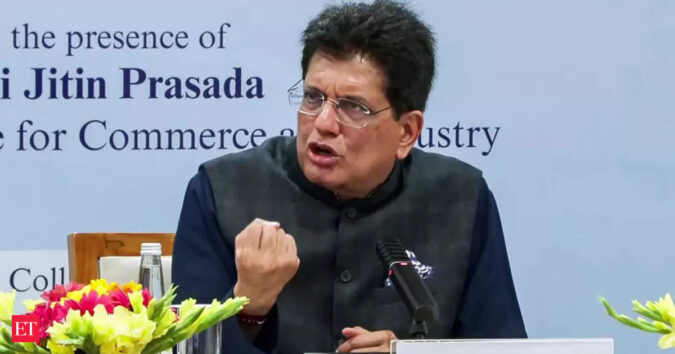
At the launch of seven components of the Rs 25,060 crore export promotion mission (EPM), Goyal emphasised that the Centre has ensured protection for all sensitive sectors, including agriculture, and that the trade deal has opened huge business opportunities for Indian exporters. “Now, once that rate (50% tariff) comes out to lower than any of our competitors, we are lower than anybody else who is an emerging market or a developing economy, and plus having safeguarded all the sensitive sectors, it’s a great win-win solution for both countries,” said Goyal.
The minister insisted that businesses will prosper at the new 18% tariff rate negotiated with the US, and that the deal would boost exports of gems and jewellery and spices.On imports from the US, Goyal said India needs high-tech devices like graphics processing units (GPUs), besides coking coal and aircraft. “We need airplanes in India,” he said. “As our steel production doubles and is slated to double from 140 million to 300 million tonnes in the next 5-6 years, huge investments, almost ₹10 lakh crore investments are in the pipeline in the steel industry. That steel will need coking coal,” he said.
As per the framework, New Delhi intends to buy $500 billion of American technology, coking coal and aircraft, among others in five years.
Goyal said India needs these products from trusted partners, emphasising that exports will play a vital role in driving economic growth. “…very clearly, India is on the right track,” the minister said.