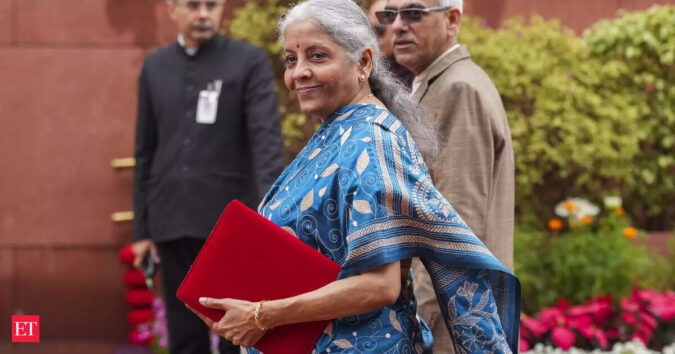
The Lok Sabha had passed the bill on March 25, along with 32 amendments. The Rajya Sabha returned the bill after a brief discussion, and Finance Minister Nirmala Sitharaman‘s reply to queries raised by Parliament members.
The Union Budget 2026-27 outlined a total expenditure of Rs 53.47 lakh crore, an increase of 7.7 per cent over the current fiscal ending March 31.
Also read: India mandates export tax on refineries selling petrol and diesel overseas
The government proposed the total capital expenditure at Rs 12.2 lakh crore for the next fiscal year. It proposed a gross tax revenue collection of Rs 44.04 lakh crore and a gross borrowing of Rs 17.2 lakh crore.
The fiscal deficit for FY27 was projected at 4.3 per cent of GDP, lower than 4.4 per cent in the current fiscal year.
A Finance Bill is a key legislative step that gives legal backing to the proposals announced in the Union Budget. The Finance Bill, soon to become the Finance Act, will bring into force changes in income tax rates, duties and other levies, directly affecting how much individuals and businesses pay to the exchequer. The Budget provisions are expected to shape citizens’ disposable income, savings and investment returns, among other measures.
In her earlier address in the Lok Sabha, Sitharaman said, “Finance Bill 2026-27 rests on five clear principles; trust- based tax administration is being improved; members mocking ease of living for common citizens and ease of doing business, we should continue on that process.”
Referring to the West Asia crisis, she said that the government shall be on its toes and keep its fiscal stance carefully managed.
Key proposals under Finance Bill 2026:
- The government did not announce any changes in the Income Tax system. ITR filing date for non-audit businesses was proposed to be extended by a month till August 31.
- For stock markets, the government proposed a hike in Securities Transaction Tax (STT) on futures to 0.05% from 0.02%. It also proposed STT on Options Premium to be increased from 0.10% to 0.15%. There were no announcements related to STCG & LTCG capital gains tax.
- Under Budget 2026, the finance minister proposed seven high-speed and one dedicated freight corridors, namely 1. Mumbai-Pune, Pune- Hyderabad, Hyderabad- Bengaluru, Hyderabad-Chennai, Chennai-Bengaluru, Delhi-Varanasi, and Varanasi -Siliguri.
- Another budget proposal mentioned deduction of TDS on the sale of immovable property by the NRIs. It also announced a foreign investment disclosure scheme, along with permission to invest in equity instruments, listed indian companies through Portfolio Investment Scheme.
- Under infrastructure development proposals, the government proposed a new freight corridor in Dankuni, West Bengal. Sitharaman also said that Coastal Cargo Promotion Scheme will double modal share by 2047.
- Under industrial development, the government announced ₹40,000 crore for electronics manufacturing, Rs 40,000 crore semiconductor push (ISM 2.0) and Rs 10,000 crore bio-pharma support to boost domestic production.
- The government proposed a Rs 10,000 crore SME Growth Fund for MSME support and provided a Rs 2,000 crore top-up to the Self-Reliant India Fund to improve credit access and scale enterprises.
- Under defence allocation, the government earmarked about Rs 5.95 lakh crore to strengthen military capability and domestic defence manufacturing.
- Under healthcare proposals, the government allocated about Rs 1.05 lakh crore and announced duty relief on critical medicines and pharma inputs.
- Under energy transition, the government earmarked Rs 20,000 crore for carbon reduction programmes and supported clean energy supply chains and renewables.