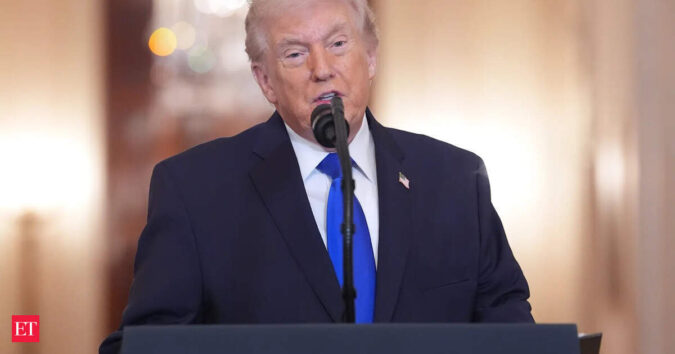
Trump signed an executive order last Friday authorising the 10% import tax under Section 122 of the 1974 Trade Act. The provision allows the president to impose tariffs for 150 days without congressional approval. He had earlier threatened to raise the rate to 15%, but no formal directive was issued before the 10% levy came into force.
Also Read: Trump eyes new trade probes to revive tariffs after court defeat
According to an administration official, the White House is preparing a formal order to increase the global tariff rate to 15%, with the timeline for implementing the higher levy has not been finalised.
The latest action follows the Supreme Court’s ruling that Trump violated an emergency-powers law when he imposed his earlier “reciprocal” tariffs on goods from countries worldwide. The court decision forced the administration to shift its legal route.
The new order retains certain exemptions. Goods compliant with the North American trade pact between the US, Canada and Mexico remain exempt. Meanwhile, some agricultural products that were excluded under the earlier tariffs also continue to receive relief.
The tariffs came into force hours before Trump’s State of the Union address to Congress. The speech is expected to focus on his economic agenda as Republicans prepare for midterm elections. Polls show growing public concern over the impact of tariffs on prices. A Washington Post/ABC/Ipsos survey found that 64% of Americans disapproved of Trump’s handling of tariffs, while 34% approved.
Trump, tariffs and tumult
The administration has said tariffs will remain central to Trump’s trade agenda. However, alternative legal tools such as Section 301 and Section 232 do not offer the same flexibility as the emergency powers he previously used. The White House has not yet announced new trade investigations, which can take months to conclude.
As confusion spreads, several countries are reassessing their positions. Major trading partners, including the European Union and India, have paused ongoing trade negotiations with Washington amid the uncertainty.
In New Delhi, officials postponed talks scheduled in the US this week to finalise an interim trade deal. The decision reflects concerns over the lack of clarity on the US tariff structure and the possible impact of a higher baseline duty.
US Trade Representative Jamieson Greer urged partners to honour previously negotiated agreements. “We want them to understand these deals are going to be good deals,” he said on CBS’s Face the Nation on Sunday. “We’re going to stand by them. We expect our partners to stand by them.”
The world acts on SCOTUS ruling
With trade talks paused and legal limits reshaping Washington’s approach, India and other major economies now await clarity on whether the 10% rate will hold or rise further in the coming weeks.
The European Union froze ratification of its agreement with the US until Trump clarifies his tariff plans. European Central Bank President Christine Lagarde also stressed the need for certainty. She said it is “critically important” for global trade to “have clarity” from the US administration.
Trump on Monday warned that he could impose even higher tariffs on partners that “play games” with existing agreements. “Any Country that wants to ‘play games’ with the ridiculous supreme court decision, especially those that have ‘Ripped Off’ the U.S.A. for years, and even decades, will be met with a much higher Tariff, and worse, than that which they just recently agreed to. BUYER BEWARE!!!” Trump posted Monday on social media.
The proposed increase to 15% has also unsettled traditional allies. The UK had negotiated a 10% rate with the US last year. A higher baseline could weaken the position of British exporters.
For India, the evolving tariff framework creates fresh challenges. The US is one of India’s largest export markets, covering sectors such as pharmaceuticals, engineering goods, textiles and services. A higher across-the-board US tariff could raise costs for Indian exporters and slow momentum in bilateral trade discussions.
At the same time, the curbs on Trump’s emergency powers may reshape negotiations with countries like China. Trump is scheduled to visit Beijing next month for a meeting with President Xi Jinping.
(With inputs from Bloomberg)