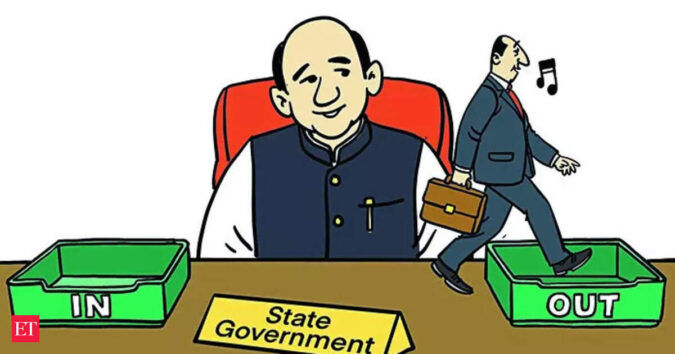
Coming up across several states, as part of Deregulation 2.0, are an omnibus Ease of Doing Business Bill (EoDB), a Right to Business Act with an ‘Affidavit-Based Clearance System‘, and a Right to Services Act with automated appeals, ET has learnt.
ET gathers that the Centre has asked all states to usher in a series of shifts to implement 28 Priority Area reforms as part of Deregulation 2.0. It has also asked state governments to examine every sectoral law, regulation, and circular against six “principles” of deregulation and amend or repeal them accordingly.
The Deregulation Cell of the Cabinet Secretariat, ET gathers, will soon share the omnibus EoDB draft bill with all states. The reason: it is assessed that several Priority Areas identified under the Deregulation exercise may require states to approach their legislative assemblies multiple times. It is proposed instead that an omnibus EoDB bill be introduced to facilitate the time-bound implementation of these Priority Areas. To accelerate the “speed of doing business”, the Centre has proposed bringing in a Right to Business Act that ushers in an ‘Affidavit-Based Clearance System’ in place of the NoC regime. Incidentally, Karnataka introduced a similar mechanism in 2020, and Punjab has also incorporated similar elements.
The new Right to Business framework will allow a self-declared Certificate of In-Principle Approval (CIPA) within days for eligible new or expanding MSMEs, along with a prescribed moratorium on inspections. The Act will also establish state and district nodal agencies to streamline approvals, ET has learnt.
States have further been asked to re-examine all laws, rules, orders, circulars, notifications, and policies, including municipal-level documents, and assess them on six key principles.
Principle One: Only high-risk activities should require licences/approvals; others should move to self-registration.Two: All licences should have lifetime validity.
Three: Processes should be streamlined and outcome-based, with clear expectations in permits.
Four: Qualified independent third parties may conduct inspections.
Five: All inspections should be risk-based, randomly assigned, transparent, and, where possible, joint or third-party led.
Six: Outdated or redundant laws, rules, and circulars should be repealed or withdrawn. This has been clearly conveyed to all state governments.
The Centre has asked each state to create a comprehensive, sector-wise repository of all such regulations, with last updated dates, and then repeal or amend them in line with the six principles outlined. Similarly, all states have been asked to introduce a Right to Public Services Act – or amend the existing one – to incorporate an online ‘auto-escalation appeal system’ (similar to Haryana’s Auto Appeal System). The idea is that any missed service timeline automatically triggers appeals without any action or application from the business entity. This is to be supported by a public dashboard for real-time monitoring.
Deregulation 2.0 is focused on seven broad categories: land; building and construction; utilities and permissions; environment; education; health; labour; and overarching priorities.
Steered by a task force, led by cabinet secretary TV Somanathan, the compliance-reduction and deregulation mission is aimed at aligning national and state-level reforms to facilitate a “seamless and enabling business environment“, and to ensure that these are not one-off exercises but inform a “sustained governance process”.