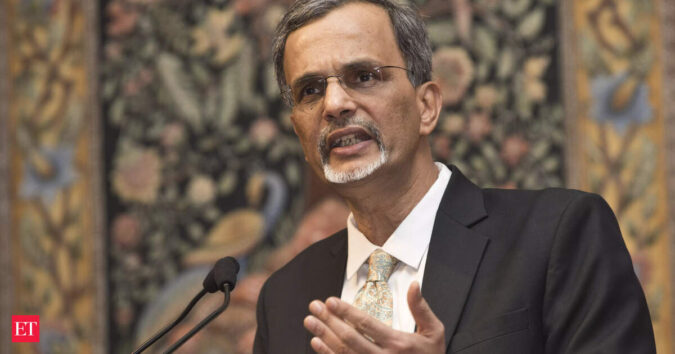
He underscored the need to create an “entrepreneurial state” that is willing to innovate, take informed risks and focus relentlessly on outcomes rather than mere processes, to counter shocks stemming from these external headwinds.
Building such a state requires a shift from a historical “extraction mindset to a development orientation”, he added.
Nageswaran made the remarks virtually at an award ceremony, organised by the Civic Innovation Foundation in the national capital.
India has remained the world’s fastest-growing major economy since FY22 and is projected to stay so at least for the next two years. But the ongoing war in West Asia, on top of the other headwinds such as the Ukraine war and fragmented supply chains, has caused a spike in oil prices and threatened to impact economic growth, capital and trade flows across nations, especially the emerging markets.
“India today stands at the pivotal juncture. Our economic journey is no longer defined just by managing the present, but by building the ‘entrepreneurial state’,” he said.
Participatory governance
The CEA said India needs all its agencies–the public sector, the private sector and the citizens–to pull their weight to turn unpredictability and uncertainty over the coming decades into opportunities for fulfilling aspirations of its people.
An entrepreneurial state, he stressed, cannot function in a vacuum and must move away from top-down approaches.
Bolstering state capacity today means sharpening our focus on facilitation, promotion and coordination, he said. Of course, enforcement cannot be wished away.
But this requires a new approach of “viewing governance not as a monologue, but as a sophisticated feedback loop”, he said.
“Public consultation enables policymakers to put places in the shoes of the public who will be evaluating the policy from a different lens. And consultation, therefore, is a very good exercise in pre-mortem rather than post-mortem,” he said.
He said when policies are grounded in the lived experiences of citizens, they increase trust and accelerate impact.
“A trust based governance system is what enables the Indian economy to scale. And scale is important for a country of our size,” he said.
The state must act as an enabler, nudging behavioural changes and inviting ideas.
“The question before us is no longer whether we should embrace participatory governance, but how deeply we can embed that into the very architecture of our decision-making framework and apparatus,” he said.