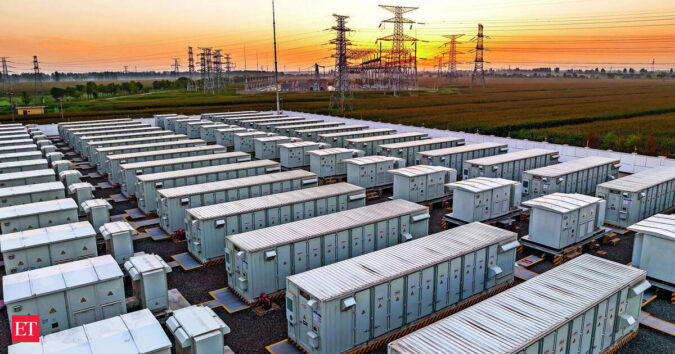
The Survey, which was tabled in Parliament on Thursday, further said by 2031-32, 411 GWh of energy storage would be required to support the reliable integration of renewable energy sources.
“To enable this scale-up, a coordinated set of policy, regulatory, demand-side, and supply-side measures is being implemented,” as per the document.
Energy storage systems are formally recognised under the Electricity Rules as an integral part of the power system and are included in the Harmonised Master List of Infrastructure improving access to long-tenure, lower-cost finance.
Storage has been embedded in the Resource Adequacy Planning Guidelines and supported through a National Framework for the Promotion of Energy Storage Systems.
Market and regulatory measures have been introduced to expand revenue streams for storage, including the waiver of inter-state transmission charges for co-located battery storage energy system (BESS) and pumped storage projects until June 2028, eligibility of storage for ancillary services, participation in the High-Price Day-Ahead Market, and tariff-based competitive bidding guidelines for BESS procurement.
To accelerate deployment, the government has launched two Viability Gap Funding (VGF) schemes supporting approximately 43 GWh of BESS (March 2024 and June 2025). Further, manufacturing is supported through a Rs 18,100 crore Production-Linked Incentive (PLI) scheme for 50 GWh of Advanced Chemistry Cell capacity, in which 10 GWh is earmarked for grid-scale storage.
For pumped storage projects, a grant based support is provided to enable infrastructure. Regulatory clearances have been streamlined for closed-loop projects, and ownership of storage has been liberalised to include consumers.
Additional measures include advisory norms for co-locating storage of at least 10 per cent of installed solar capacity to improve the dispatchability of solar power.