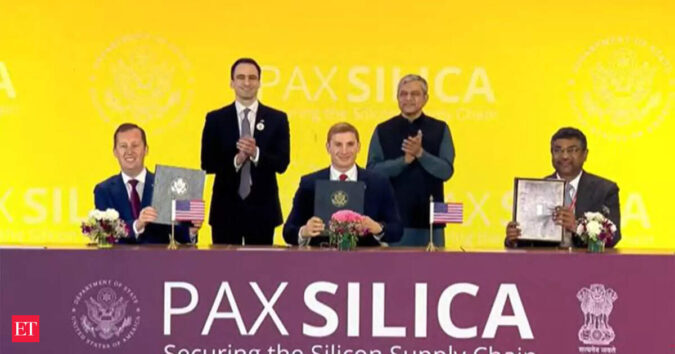
The declaration underscores the importance of resilient supply chains for economic security and positions artificial intelligence as a transformative force for long-term global prosperity. Pax Silica is the US Department of State’s flagship framework aimed at building a trusted network of partners across the technology and industrial ecosystem.
Also Read: Inside America’s Pax Silica strategy and why India’s entry is pivotal for AI supply chain
India bets on semiconductor scale
Union IT minister Ashwini Vaishnaw used the occasion to emphasise India’s long-term ambitions in semiconductors and electronics manufacturing, framing the current push as the beginning of a compounding growth cycle.
“If this spirit had persisted since 1947, we can imagine the scale of compounding. No problem — even if it starts now. The next generation will reap the benefits,” Vaishnaw said.
He highlighted India’s growing capabilities in advanced chip design, noting that Indian engineers are already working on cutting-edge 2-nanometer chips. With the global semiconductor industry expected to require around one million additional skilled workers, he positioned India as a key talent hub.
“Students now have access to the world’s best semiconductor design tools — free of cost — and it is yielding results,” he said, adding that India aims to take global leadership in semiconductors and electronics.
Strategic alignment gains momentum
Speaking at the summit, US Ambassador to India Sergio Gor described India’s entry as a pivotal moment in the evolving global technology order.
“We welcome India into Paxilica. Just over a month ago, I arrived in this extraordinary nation as the US Ambassador. In my first weeks, I’ve walked the halls of South Block, met with innovators in Bangalore, and broken bread with entrepreneurs who are building the future. What struck me most wasn’t just India’s scale — although that is breathtaking — it’s India’s resolve, the determination to chart its own course.”
He linked the initiative to broader cooperation across trade, defence and technology.
“I keep talking about the limitless potential between our two nations, and I truly mean it. From the trade deal to Paxilica to defense cooperation, the potential for our two countries to work together is truly limitless. I aim to fulfill that over the next three years that I’m here.”
Also Read: India-EU FTA to open new avenues for trade, investment: PM Modi, Greek counterpart
“No to weaponised dependency”
US Under Secretary of State Jacob Helberg framed the initiative in sharper geopolitical terms, calling for a break from over-concentrated and coercive supply chains.
“As we sign the Pax Silica Declaration, we say no to weaponised dependency and no to blackmail,” Helberg said, adding that economic security must be treated as national security.
He outlined a vision of a “full-stack” technology coalition — spanning critical minerals, semiconductor fabrication and AI deployment—designed to distribute technological power across trusted partners. “We are securing the full stack of the future — from minerals deep in the earth to the intelligence that will unleash human potential,” he said.
Trade deal lays groundwork
The signing follows an interim trade agreement between the two countries earlier this month, which officials said helped resolve long-standing friction points and laid the foundation for deeper economic integration.
“Earlier this month, we concluded the interim trade agreement — a deal that shapes the economic contours of the Indo-Pacific. We overcame friction points that had held us back for far too long. That agreement wasn’t just about trade flows or tariff schedules. It was about two great democracies saying: we will build together, not just buy from one another.”
Full-stack tech coalition
Gor described Pax Silica as a coalition spanning the entire technology supply chain — from critical mineral extraction to chip manufacturing and AI deployment — aimed at reducing reliance on adversarial systems.
“And now today, we take the next step. India joins Paxilica, the coalition that will define the 21st-century economic and technological order. The US leads a strategic coalition designed to secure an entire silicon stack — from the mines where we extract critical minerals, to the fabs where we manufacture chips, to the data centers where we deploy frontier AI. It’s a coalition of capabilities that replaces coercive dependencies with a positive-sum alliance of trusted industrial bases.”
He added that the grouping would bring together nations committed to open markets and democratic values.
“Paxilica will be a group of nations that believe technology should empower free people and free markets.
India’s entry into Paxilica isn’t just symbolic — it’s strategic. It’s essential. India is a nation with deep talent, deep enough to rival any challenger. India’s engineering depth offers critical capabilities for this vital coalition.”
Framework and participation
The Pax Silica Declaration includes signatories such as Australia, Greece, Israel, Japan, Qatar, South Korea, Singapore, the UAE and the UK. Non-signatory participants include Canada, the Netherlands, the European Union, the OECD and Taiwan.
US Under Secretary of State for Economic Affairs Jacob Helberg is visiting India from February 20–21 as part of the American delegation led by White House Office of Science and Technology Policy Director Michael Kratsios. The visit includes bilateral meetings and discussions on expanding cooperation in emerging technologies and advancing the next phase of the US AI Exports Program.
The agreement comes shortly after India’s participation in the Critical Minerals Ministerial in Washington, where External Affairs Minister S Jaishankar called for structured international cooperation to “de-risk” supply chains and reduce excessive concentration risks.