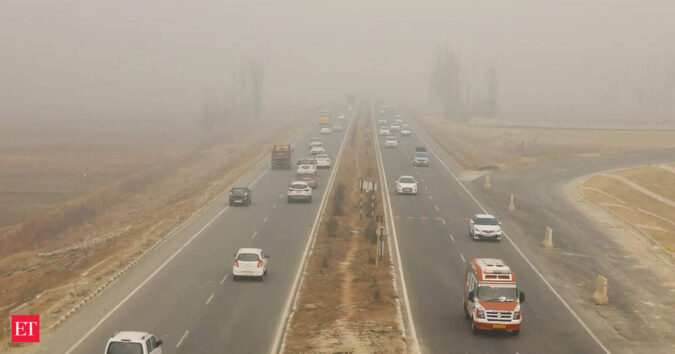
At the heart of the agenda are two long-term goals: rolling out seamless, barrier-free tolling across national highways and pushing through a new Road Safety Bill, as the country continues to grapple with alarmingly high accident fatalities.
The policy push is being matched by an aggressive infrastructure rollout, with several high-profile expressways and strategic projects scheduled to be completed over the next year.
Expressway completions to redefine long-distance travel
A series of marquee highway projects, many of them years in the making, are now nearing the finish line. The 1,362-km Delhi-Mumbai Expressway, one of India’s most ambitious road projects, is expected to be fully completed by November 2026.
Other major corridors lined up for completion include the Amritsar-Jamnagar highway by December 2026, the Bengaluru-Chennai Expressway by June 2026, the Ahmedabad-Dholera Expressway by March 2026, the Indore-Hyderabad highway by May 2026 and the Delhi-Dehradun Expressway by January 2026. Together, these routes are expected to significantly reduce travel time, improve logistics efficiency and ease congestion on existing arterial roads.
In addition, the government plans to inaugurate the 13-km Zojila tunnel in April next year. Once opened, the tunnel, described as Asia’s longest, will provide all-weather connectivity between Srinagar and Leh. Officials have said travel time across the Zojila pass, which can stretch to three hours in harsh conditions, will come down to about 20 minutes.
‘Savings could go up to Rs 8,000 crore’: Gadkari on toll overhaul
Alongside construction milestones, the ministry is preparing to overhaul toll collection through a nationwide rollout of seamless, barrier-free tolling. Road Transport and Highways Minister Nitin Gadkari said tenders for the first phase have already been floated. “We plan to put up several seamless barrier-free tolling systems on national highways across the country. Initially, we have come out with 10 tenders for that. The cost of tolling will significantly come down from around 15 per cent currently to 3 per cent of the total toll collection,” Gadkari told PTI in an interview.
He said the shift could deliver substantial savings. “For instance, on a toll collection of Rs 50,000-60,000 crore in a year, savings could go up to Rs 8,000 crore in a year. Besides, it will also plug the loopholes and reduce waiting time on toll plazas,” he said.
The new system will rely on a combination of Automatic Number Plate Recognition cameras with AI-based analytics and RFID-enabled FASTag readers. Vehicles will be charged without stopping at toll plazas, based on digital identification. Officials said violations will trigger e-notices, and persistent non-payment could lead to suspension of FASTag accounts and penalties linked to VAHAN records.
The ministry had already offered relief to private vehicle owners in 2025 through the introduction of annual FASTag passes, allowing cars to cross up to 200 toll plazas for Rs 3,000 a year, a sharp drop from the earlier cost of around Rs 15,000.
‘This is terrible’: Road safety bill revived amid grim fatality data
Even as highways expand, road safety remains a stubborn challenge. Gadkari said the ministry is preparing a fresh Road Safety Bill after earlier attempts failed to clear Parliament.
“We are constantly focusing on road safety. There are several problems with that. We will try again and will come out with a new Road Safety Bill, and our endeavour will be to place it before Parliament in the next session itself,” he said.
India continues to record around five lakh road accidents every year. “In our country, there are 5 lakh road accidents annually, causing around 1.8 lakh deaths,” Gadkari said, noting that about 66 per cent of those killed fall in the 18–34 age group.
“This is terrible. We are trying hard (to reduce fatalities), but we have not been successful,” he said.
Latest government figures show that road accident deaths rose by 2.3 per cent in 2024 to more than 1.77 lakh, averaging 485 fatalities a day.
Looking ahead, the highways ministry plans to accelerate project awards. Gadkari said road projects covering 12,000 km are expected to be awarded in 2025–26, with a higher target of 13,000 to 13,500 km in 2026–27.
He also said a Public Infrastructure Investment Trust will be launched before March next year. The NHAI-sponsored Raajmarg Infra Investment Trust has already received regulatory approval as an InvIT, aimed at unlocking value from national highway assets while offering a long-term investment avenue for retail and domestic investors.
Despite reforms such as changes to the build-operate-transfer model to attract private investment, the sector continues to face execution hurdles. Government data shows 649 highway projects worth Rs 4.2 lakh crore are delayed, with land acquisition, contractor issues, forest and environmental clearances and utility shifting among the key reasons.
(With inputs from PTI)