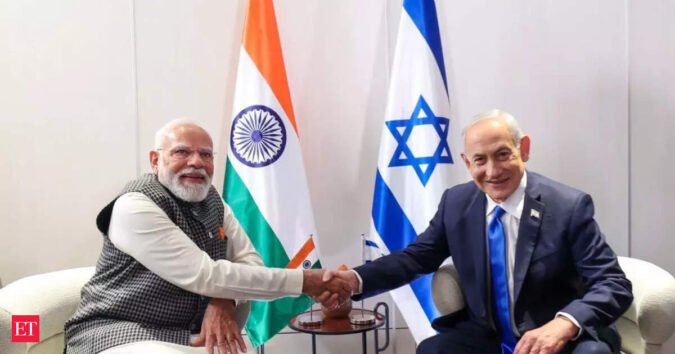
Addressing a joint press briefing, PM Modi said, “We have taken a historic decision to give our time-tested relationship the status of special strategic partnership. This is a reflection of the aspirations of both the nations.”
Joint initiatives and strategic deals
According to the joint statement, India and Israel will:
Develop and manufacture weapons jointly, strengthening defense cooperation.
Finalise a bilateral trade deal in the near term.
Expand cooperation under the UPI digital payments system.
Extend I2U2 collaboration between the two nations.Drive partnerships in critical energy sectors, including nuclear energy.
Collaborate on space initiatives and emerging technologies.
Israeli PM Netanyahu highlighted the depth of government-to-government collaboration, saying, “You have an amazingly efficient government. What you can do with one minister and one ambassador… The meeting of minds and hearts that we have had here will also continue in this remarkable G2G that is long overdue and will create an even greater boost to the enormous benefits that we can bring to each other.”
He confirmed plans for a G2G meeting in India, noting, “As soon as we can arrange it, we would like to take the distinguished ministers who are here.”
On innovation, Netanyahu added, “…When we talk about precision in education, we now have the software and the AI to reach every young student and enable them to reach their full potential. The limitations that were constraining us in previous times no longer constrain us… The future belongs to those who innovate. And Israel and India are bent on innovation. We are proud ancient civilisations, very proud of our past but absolutely determined to seize the future and we can do it better together.”
Advancing innovation, technology, and education
During the visit, PM Modi also met President Isaac Herzog. Modi praised Israel’s expertise in science, innovation, and education, particularly in water management and agriculture, and highlighted India’s successful implementation of Israeli best practices.
The discussions also focused on youth and student exchanges. Herzog emphasized the role of Indian students globally in driving innovation, calling it a “golden opportunity” to strengthen collaboration between Indian and Israeli institutions.
Modi’s visit included a poignant trip to Yad Vashem, the World Holocaust Remembrance Center, where he laid a wreath and visited the Book of Names Hall. The Knesset conferred the Speaker’s Medal on Modi, symbolizing mutual trust and forward-looking cooperation. Modi also participated in the ‘Ek Ped Maa Ke Naam’ initiative, planting a tree in the Presidential Gardens and inviting Herzog to India.
Showcasing Technological Collaboration
A key focus was an exhibition of Israeli innovations. Demonstrations included AI, healthcare, quantum computing, smart mobility, cybersecurity, water technology, and climate-focused biotech.
Highlights included:
Quantum and deep tech solutions from Quantum Machines and Classiq.
AI-powered health technologies, including point-of-care ultrasound systems.
Smart mobility and threat prevention solutions from Mobileye and Check Point.
Water and agricultural technologies such as WaterGen, N-Drip, and Natural Offset Farming.
Climate and biotech initiatives, including lab-produced milk proteins, microalgae cultivation, and plastic waste bioconversion.
Space and energy technologies, including miniaturized satellites and SAR systems by Israel Aerospace Industries.