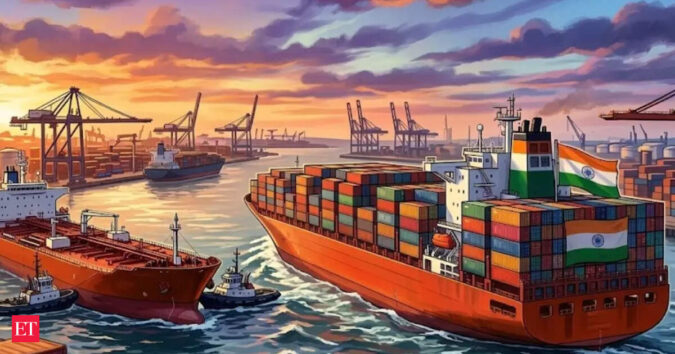
The latest escalation in West Asia — triggered after Iran’s Supreme Leader Ayatollah Ali Khamenei was killed in US–Israeli strikes and followed by Tehran’s decision to elevate his son, Mojtaba Khamenei, as the country’s new Supreme Leader — has injected fresh uncertainty into one of the busiest trade corridors linking India to global markets.
ALSO READ: The Iran war puts India’s dosa and AI dreams on ice
India’s export pipeline through the region is starting to feel the strain. Speaking to ET Online, Ajay Sahai, Director General & CEO of the Federation of Indian Export Organisations (FIEO), said that logistics disruptions along key maritime routes could stall as much as $4 billion of India’s monthly exports if the situation persists for a month.
Exporters are meanwhile scrambling to reroute cargo, explore alternative shipping corridors, and tap new markets to cushion the impact.
ALSO READ: Packaged food companies slash production amid LPG crunch
West Asia sits at the heart of India’s external trade network — not only as a major energy supplier but also as a fast-growing destination for Indian goods.
Sahai said the region remains one of India’s most vital economic partners. “West Asia continues to remain one of India’s most significant economic and strategic partners. The region plays a critical role in India’s external trade architecture, both as a major source of energy supplies and as a growing destination for Indian exports,” he said.
A major trade corridor for India
India’s merchandise trade with West Asia has grown rapidly over the past few years and now stands at roughly around $180 billion annually, making it one of the country’s most important regional trade corridors, as per FIEO data.
Of this, Indian exports account for about $60–65 billion, while imports total roughly $120–125 billion, leaving India with a trade deficit of about $65 billion with the region, Sahai told ET.
The export basket is broad and diversified.
Indian companies ship everything from engineering goods, automobiles and auto components, electrical machinery and chemicals to textiles, garments, pharmaceuticals, plastics and petroleum products.
Agricultural exports also play a crucial role, with strong demand for rice, meat, spices, fruits, vegetables and processed food across Gulf markets.
Food shipments are particularly important because Gulf countries rely heavily on imports to meet domestic consumption needs. Long-standing consumption patterns and a large Indian diaspora have further strengthened these trade ties.
UAE and Saudi Arabia dominate export flows
In West Asia, the United Arab Emirates (UAE) is India’s largest trading partner, accounting for a major share of the region’s trade.
“The United Arab Emirates remains India’s largest trading partner in West Asia, with bilateral trade exceeding $85–90 billion, including exports of about $36–37 billion from India,” Sahai said.
The UAE’s role goes beyond that of a consumption market, functioning as a major re-export hub that channels Indian goods to Africa, Europe and Central Asia.
Saudi Arabia is another major partner, with bilateral trade worth roughly $40–42 billion, including Indian exports of about $11–12 billion. Other important markets include Qatar, Oman, Kuwait, Iraq and Israel, which collectively contribute significantly to India’s regional trade flows.
These markets are important not only for energy supplies but also for growing demand for Indian products ranging from construction materials and machinery to consumer goods and food products.
Certain sectors depend heavily on Gulf demand
While India’s export base to West Asia is diversified, some sectors depend heavily on the region.
According to Sahai, food and agriculture exports are among the most exposed. The similarity in food preferences across the region and the presence of a large Indian diaspora have made West Asia a dominant market for these goods.
“India’s exports to West Asia are diversified. The strong presence of Indian diaspora and similar taste as of India (mean that) food and agriculture including meat, fruits, vegetables and cereals are most dependent on the Middle East (West Asia),” Sahai said.
The reliance is especially noticeable in some categories:
- More than 80% of India’s basmati rice exports go to West Asia
- Around 30% of gems and jewellery exports are destined for the region
- Roughly 25% of vehicle exports are shipped to West Asian markets
With disruptions affecting both sea and air logistics, nearly all sectors are feeling the strain.
Perishable goods are the hardest hit because of their limited shelf life. Delays at ports have forced exporters to keep containers plugged into power supplies while waiting for vessels, pushing up costs.
“They are incurring heavy plug-in charges at the ports waiting for sailings and the Emergency Contingency Surcharge on them is also the highest, about $4,000 per container,” Sahai said.
Air freight has also surged sharply. With limited flights operating, air cargo costs have jumped by more than 100%, adding to the financial burden on exporters.
Trade agreements offer some resilience
Despite the disruption risks, trade agreements with Gulf countries have strengthened India’s export foothold in the region.
Over the past five years, bilateral trade between India and West Asia has grown significantly, increasing from around $120 billion in 2020–21 to nearly $180 billion in 2024–25, according to FIEO.
Part of this expansion has been driven by agreements such as the India–UAE Comprehensive Economic Partnership Agreement (CEPA), which has eliminated tariffs on almost all Indian exports to the UAE.
“All the sectors have benefitted as we have got duty free access on approximately 100% of our exports,” Sahai said.
India has also finalised a trade deal with Oman and is negotiating a broader trade agreement with the Gulf Cooperation Council (GCC), which could further deepen trade ties with the region.
Up to $4 billion in exports at risk in a month
Even short-term disruptions could have a measurable impact on trade flows.
As per Sahai, India exports roughly $5–6 billion worth of goods to West Asia each month. If logistics disruptions last 15 days, about $2 billion of shipments could be affected, while a month-long disruption could stall around $4 billion in exports, he informed.
“So far shipments have been delayed but they have not yet been cancelled. Exports have been deferred and they may pick up if peace is quickly brought to the region,” he informed.
Still, he warned that the delays could drag down India’s export numbers for the month of March if shipments cannot be executed on schedule.
Some cargo movement has resumed, with a few flights restarting operations and certain shipping lines proposing sailings from March 8, which may partially ease the backlog.
Exporters exploring alternative markets
If disruptions persist, exporters may attempt to redirect shipments to other regions, although replacing Gulf demand in the short term would be difficult.
West Asia — particularly the UAE, Saudi Arabia, Iran, Iraq and Qatar — represents a deeply entrenched market for Indian exporters. Still, companies are exploring alternatives depending on the product category.
The CEO of the apex body of all export promotion councils said that for basmati rice, exporters could divert part of the supply to West and East African markets, including Benin, Côte d’Ivoire, Kenya, and Tanzania, where Indian rice already has a presence. Additional demand may also come from Southeast Asian markets such as Malaysia and Indonesia.
Engineering goods exporters have greater flexibility, with potential demand in the United States, the United Kingdom and Germany, as well as in Southeast Asian economies such as Vietnam and Thailand. African markets like Nigeria and South Africa could also absorb additional shipments.
Chemical exports are relatively diversified and could be redirected to European Union markets, as well as Brazil and Mexico in Latin America. In Africa, Egypt and South Africa may provide alternative demand.
The gems and jewellery sector, however, faces greater challenges. Dubai functions not just as a consumer market but as a global trading hub for diamonds and gold jewellery, making it difficult to replicate elsewhere.
“If shipments to the Gulf are disrupted, exporters may try to redirect goods to established markets such as the United States and Canada, as well as Asian trading centres like Hong Kong and manufacturing hubs in China. However, in the short term, the capacity of these markets to absorb additional supply may be limited,” he said.
Logistics pressures building for exporters
If disruptions in West Asian shipping corridors continue for several weeks, exporters warn that it could impact both logistics and financing.
A significant portion of India’s trade to Europe, the Mediterranean and parts of Africa passes through the Red Sea–Suez Canal corridor. Any disruption forces vessels to reroute around the Cape of Good Hope, adding 10–20 days to transit times, Sahai said.
Longer routes slow container rotation, create scheduling uncertainty and increase freight and insurance costs. Shipping lines often impose additional risk and fuel surcharges when navigating volatile regions.
This is particularly damaging for low-margin sectors such as textiles, leather, engineering goods and agricultural commodities, where higher freight costs can quickly erode profitability.
“In the short term, export demand may remain stable, but shipment execution could slow as exporters face delays in vessel availability and longer transit times. Over a few weeks, this may temporarily reduce the pace of shipments rather than actual export orders, especially for cargo headed to Europe and West Asia.”
The biggest pressure point may be working capital. Longer transit times delay payments, stretching the cash conversion cycle by two to four weeks. At the same time, exporters must absorb higher freight bills and carry more inventory while waiting for shipping space.
The result, Sahai said, is likely to be slower shipment flows, higher logistics costs and tighter liquidity across the export sector — rather than an immediate collapse in demand.
For now, much depends on how long the disruption lasts. A quick stabilisation could allow shipments to resume and delayed cargo to move through the system. But if tensions linger, India’s exporters may face a difficult few weeks navigating one of their most critical trade corridors.