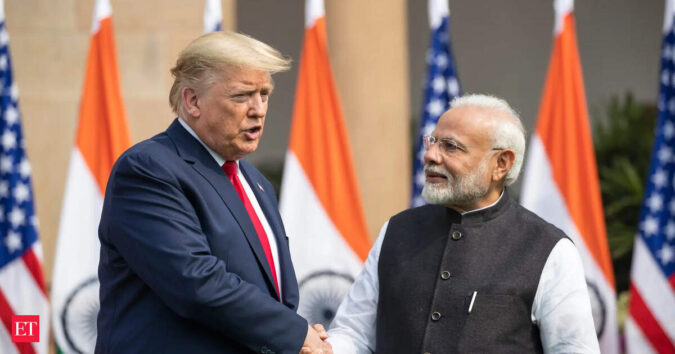
Against this backdrop, India’s year-long, deliberate and non-reactive approach — a strategic patience — to negotiating a bilateral trade deal now appears astute. Far from being caught off guard, as many countries which had signed final deals with the US are, India finds itself with additional space to reassess and potentially secure more favourable terms.
The diplomatic pause
The immediate consequence of the court verdict was procedural caution. According to PTI, India and the US have decided to reschedule the proposed meeting of their chief negotiators in Washington that was meant to finalise the text of the interim trade pact. The Indian delegation had been scheduled to begin a three-day meeting on February 23.
As PTI reported, both sides agreed that the visit should be deferred until each country has had time to evaluate the latest developments and their implications. The postponement doesn’t seem a breakdown but a recognition that the legal and policy environment has fundamentally shifted.
Also Read |India sees more options on US trade deal after tariff ruling
Meanwhile, Bloomberg reported that India is studying the implications of the US Supreme Court’s decision for its bilateral trade engagement. While India is not considering backing away from the framework agreement signed earlier this month, it is likely to seek safeguards to protect itself from similar legal or executive reversals in the future, sources told Bloomberg. The ruling has significantly reduced Trump’s leverage.The Framework Agreement clause that can get triggered
India’s decision to sign only a framework agreement on February 7, 2026 — after nearly a year of negotiations — rather than rushing into a final legally binding pact, now looks prescient. The agreement still requires detailed negotiations before it can be formalised.
Crucially, the framework includes a clause stating that if either country alters agreed tariffs, the other may modify its commitments accordingly. The scrapping of Trump-era tariffs by the Supreme Court, followed by the imposition of a universal 15 per cent tariff, constitutes precisely the kind of change mentioned in that clause.
This provision effectively reopens negotiating space without India having to formally withdraw. It provides legal and diplomatic room to reassess concessions, revise expectations and demand reciprocal adjustments. While Trump has publicly claimed that nothing has changed in the India-US deal, the new 15 per cent tariff baseline inevitably alters the economic arithmetic of any future agreement. The earlier 18% tariffs seemed favourable when compared to the 50% tariffs imposed by Trump. But with those 50% tariffs now declared illegal by the court, the baseline has moved to flat 15% tariffs on all countries Trump has announced.
Also Read |India, China among winners after US court blocked Trump tariffs
Strategic patience versus strategic haste
India’s negotiating style stands in contrast to the experiences of others, particularly the European Commission representing the European Union. The EU, which had finalised a trade arrangement with the US, now finds itself in a difficult position after the universal 15% tariff announcement.
In a sharply worded statement, the European Commission emphasised that “a deal is a deal” and expressed its expectation that the US would honour its commitments. The unusually strong language reflects the discomfort of having locked in terms under one tariff regime, only to see that regime abruptly altered.
India, by contrast, avoided the trap of a hurried deal. Despite facing steep tariffs of 50 per cent and sustained pressure to sign teh deal quickly, India resisted the temptation to secure a quick diplomatic win. It recognised early that agreements reached under deadlines or coercive threats may produce short-term optics but offer limited long-term certainty.
The Supreme Court’s intervention has validated that assessment. Countries that rushed now face ambiguity. India, having stopped short of a final deal, retains flexibility now.
Trump’s diminished leverage: what lies ahead
The US Supreme Court ruling has materially altered the leverage equation. Trump’s bargaining position has been weakened by the judicial setback. The move from differentiated tariffs to a universal 15 per cent structure changes the baseline against which concessions were measured.
For India, this creates both opportunity and complexity. Any comprehensive deal must now account for the flat 15 per cent tariff environment. If that becomes the new default, India can justifiably argue that additional concessions are necessary to deliver meaningful preferential access.
At the same time, India seems to be treading carefully. As Bloomberg noted, India is not planning to withdraw from the agreement. Instead, it aims to secure more favourable terms while maintaining a stable relationship with the US administration.
Several factors will shape the next phase of negotiations. Legal durability will likely become a priority. India may push for clearer safeguards against abrupt policy reversals, including stronger dispute resolution mechanisms or automatic adjustment clauses triggered by tariff changes.
The broader geopolitical context will influence the tone of talks. The US has urged partner nations to honour signed commitments, and India is unlikely to risk reputational damage by appearing unreliable. However, the framework agreement’s built-in flexibility gives India room to seek adjustments without abandoning the process.
India’s measured approach has yielded tangible dividends. It avoided being locked into an agreement vulnerable to sudden policy shifts. It maintained strategic composure under tariff pressure. It preserved diplomatic channels without compromising core interests. Now, it needs to assess how it makes full use of the altered situation.
The court intervention and the subsequent 15 per cent tariff announcement have injected uncertainty into global trade diplomacy. But uncertainty can favour India because it did not fully commit to a trade deal. The coming negotiations will determine whether India can convert this advantage into concrete gains.
(With inputs from agencies)