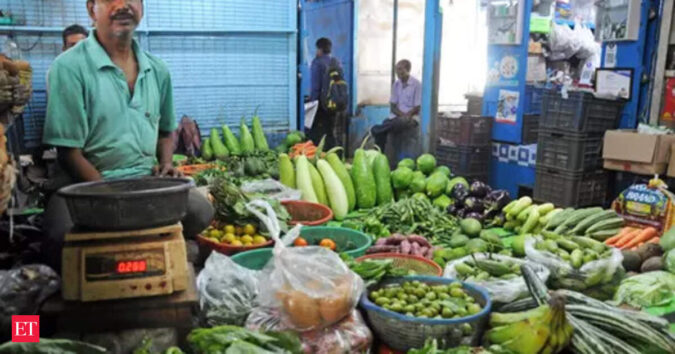
Despite the increase, inflation has remained below the Reserve Bank of India’s 4% medium-term target — set within a tolerance band of ±2 percentage points (2%–6%) — for 12 consecutive months under the revised CPI series.
Also Read: India January CPI: FAQs on what has changed
A Reuters survey of economists indicated that annual retail inflation is expected to have risen for the third consecutive month, reaching 2.4% in January.
In December 2025, under the previous 2012-base series, retail inflation stood at 1.33%.
Food prices (excluding beverages) — which now carry a weight of 34.77% in the CPI basket under the revised series — rose 2.13%. Corresponding inflation rates for rural and urban are 1.96% and 2.44%.
Together with beverages, they now account for 36.75% of the basket.Under the earlier series, food and beverages together accounted for 45.9% of the CPI basket, representing nearly half of the overall index. Food inflation had contracted 2.71% year-on-year in December.
Housing inflation came in at 2.05% under the new series, with corresponding rates for rural and urban areas at 2.39% and 1.92%. Under the old series, housing inflation stood at 2.86% year-on-year in December.
Clothing and footwear inflation stands at 2.98% for January 2026, while restaurants and accommodation services record an inflation rate of 2.87%. Health inflation is at 2.19%, and information and communication services show minimal inflation at 0.16%. In contrast, personal care, social protection, and miscellaneous goods and services see a significant surge, with inflation reaching 19.0%.
Upasna Bhardwaj, Chief Economist, Kotak Mahindra Bank said, “The CPI inflation came in line with expectations. While details are still awaited the core inflation looks significantly lower than our expectations. While inflation trajectory remains fairly benign, we believe RBI’s rate cutting cycle has come to an end, with the RBI likely to continue to hold rates on pause for an extended period through CY26 at least.”
Also Read: India’s inflation revamp may give Reserve Bank a reason to stay on hold
CPI base year updated to 2024
The revised CPI series updates the base year to 2024 from 2012 and incorporates a reworked consumption basket to better reflect shifts in household spending patterns. The overhaul is intended to provide a more accurate measure of price trends in the economy.
The Ministry of Statistics and Programme Implementation (MoSPI), which revised the series, has also updated the base year for other key macroeconomic indicators.
The base year for both Gross Domestic Product (GDP) and the Index of Industrial Production (IIP) has been proposed to be updated to 2022‑23.
These indicators are closely tracked by the RBI while framing monetary policy.
Inside the revised CPI basket
The updated weight distribution is based entirely on the Household Consumption Expenditure Survey (HCES) 2023–24, similar to how the 2012 basket was constructed from an earlier survey, Ministry of Statistics and Programme Implementation Secretary Saurabh Garg told Financial Express.
These weights reflect genuine shifts in consumer behavior over the past decade. Overall household consumption has nearly doubled, underscoring rising incomes and improved living standards.
Within food and beverages, the largest decline is in basic cereals such as rice and wheat, which now account for roughly half of their previous share. In contrast, spending on items like fruits, fresh vegetables, dairy products, fish, and meat has grown significantly. This trend is evident in both rural and urban areas, highlighting a nationwide change in consumption habits.
A major revision in the new CPI series is the recalibration of food and beverage weights. The combined weight of food and beverages has dropped to 36.75% from 45.9%, with food alone falling to 34.77% from 39.1%.
Historically, food prices have been among the most volatile components of the CPI. With a reduced weight for food, headline inflation could show material shifts.
The lower weighting is also expected to moderate volatility, potentially helping the RBI in meeting its inflation-targeting mandate.
The revised CPI further includes several new items to better capture modern household spending, while removing outdated goods.
New additions include rural housing, online media service providers/streaming services (OTT subscriptions), value-added dairy products, barley and its products, pen-drives and external hard disks, and attendants, babysitters, and exercise equipment.
Removed items include VCR/VCD/DVD players and hiring charges, radios, tape recorders, second-hand clothing, CD/DVD audio/video cassettes, and coir/rope.
At the all-India level, the number of weighted items increased from 299 to 358, with goods items rising from 259 to 308 and services items from 40 to 50, strengthening the representation of the services sector.
Coverage has also improved for rural house rent, modern fuels (CNG/PNG), telephone charges, rail and air fares, postal services, and OTT subscriptions. While the share of food & beverages has declined, it remains the largest component of the CPI basket.
Source: MoSPI
The structural classification has also been expanded.
While the earlier series comprised six groups and 23 sub-groups, the new series features 12 divisions, 43 groups, 92 classes, and 162 sub-classes, bringing India’s inflation basket closer to global standards.
Geographical coverage has widened as well. Rural coverage now spans 1,465 villages across 686 districts, compared with 1,181 villages across 582 districts earlier. Urban coverage has increased to 1,395 markets in 434 towns, up from 1,114 markets in 310 towns.
With food weights reduced, the share of core components — including transport, information and communication, health, and household goods and services — has increased.
“Restaurants and Accommodation” has been introduced as a new category.
While the revised CPI series is designed to provide a more accurate reflection of household spending, markets and policymakers are expected to closely monitor the initial readings to assess how the changes reshape India’s inflation trajectory.