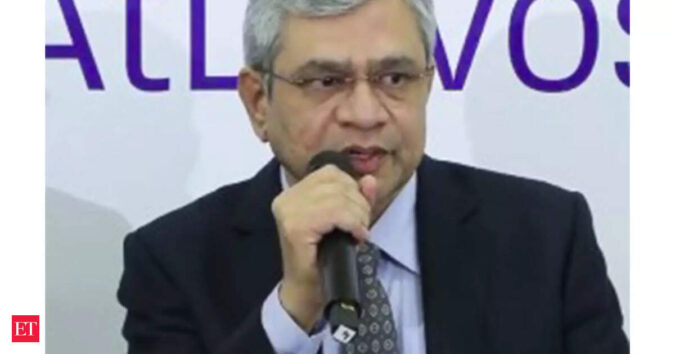
Speaking here in a session on ‘Bet on India – Bank on the Future’ organised by CII in association with EY on the sidelines of the World Economic Forum (WEF) Annual Meeting, Vaishnaw highlighted the importance of simplification of permissions and affirmed that the average time for installation of telecom tower has decreased from 270 days to 7 days, with 89 per cent permissions coming in zero time.
Also Read: Deja vu at Davos- Is the world seeing the 1920s again?
He underlined a need to bridge the gap between the intent and the functioning, and said that as political leaders, there is a need to make sure that the bureaucracy aligns with political power.
He further highlighted the importance of communicating challenges amongst the industry members, mentioning the standardisation of data localisation norms across the US and Europe.
Rajiv Memani, CII President and Regional Managing Partner of EY Africa India region, Chair – EY Growth Markets Council, said India’s per-capita income is amongst the lowest, suggesting that there is a need to increase per-capita income by at least five times by 2047.
In this context, he highlighted India’s strategy to diversify its trade relationships, noting that agreements with regions such as the Middle East, the Asia Pacific, and the United Kingdom are becoming increasingly important.Also Read: Davos 2026- US-based Sargad signs MOU with Telangana, to invest Rs 1,000 Cr over 3-5 years
He also pointed out the significant reforms undertaken domestically, such as labour reforms and the implementation of GST, which lowered tax rates on consumer food products.
CII Director General Chandrajit Banerjee said, “This discussion is particularly timely. As the global economy navigates uncertainty, fragmentation, and rapid technological change, India stands out as a market of scale, stability, and long-term opportunity.”
A highly diverse group representing global finance and banking, insurance and reinsurance, technology and digital platforms, industrial automation, mobility and transportation, telecommunications, cybersecurity, medical technology, life sciences, food and beverages, chemicals and consumer goods, smart infrastructure, clean energy solutions, and cross-border payments, among others were present at the roundtable.