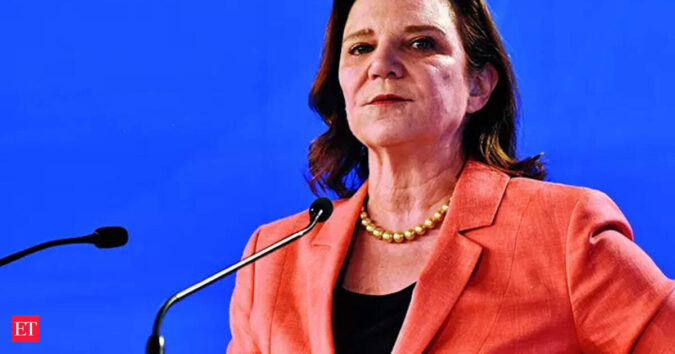
“The US isn’t reliable under President Trump… I would argue for a containment strategy and careful negotiation (by India) for reciprocity at all times,” Harrison, former dean of the Haas School of Business, University of California, Berkeley, said at summit here on Friday. “Although Trump’s tariffs are called ‘reciprocal’, they are not. India should demand reciprocity.”
Mexico had offered significant farm market access to the US under the North American Free Trade Agreement for lower American tariffs but a large number of Mexican farmers were deeply hurt by that strategy, she said, pointing at possible lessons for India.
Harrison was speaking in a session titled ‘Walls in a Wired World: Tariffs, Technology and the Future of Globalisation’.
The final contours of the India-US trade deal are expected to be out by March. However, as per the announcement made earlier this month, the US would cut the tariffs for India to 18% from 50%.
Harrison said India needs to find a way to control its record goods trade deficit with China, which stood at $116 billion in 2025. “Any agreement must be contingent on China restricting that enormous trade surplus in the direction of India,” she said.
Priorities for IndiaIndia’s top priority, Harrison said, should be to further deepen ties with friends for a resilient supply chain, and its free trade agreement (FTA) with the EU last month is “very exciting and strategic”.
New Delhi need not worry as much about efficiency as the safety of its supply chains in the current global context, she said.
India and the EU, together, account for about a quarter of the global gross domestic product (GDP). More than 99% of Indian exports would gain preferential entry into the EU once the FTA is operational, likely in a year, as per an Indian official statement.
In return, the EU would be granted greater access to the Indian market on a broad range of products, particularly automobiles, olive oil and wine. The bilateral goods trade stood at $136.5 billion last fiscal, while services trade was to the tune of $83 billion in 2024.
“This (FTA with the EU) is a tremendous opportunity for both regions that are not strictly part of the US, China and Russia groups now. So this is very exciting and very strategic,” Harrison said.
India’s second priority should be to tackle pollution and climate change, and put in place a robust green industrial policy, she said.
A differential pricing mechanism for coal could reduce its consumption and help clean up the air, she said. Pricing mechanisms can be combined with command and control policies. These include the steps endorsed by the Supreme Court and encouraging smaller enterprises, on top of the larger ones, to cut down consumption of dirty fuels.
Third priority for India, according to Harrison, would be to spur domestic competition by eliminating the maze of licence raj, and create world-class corporations.
The size of India’s domestic market is an asset, she underscored. It’s so large that India can use domestic competition to create performance levels that many smaller countries can’t. “China has used fierce domestic competition to its advantage to force domestic enterprises to become world class,” she said. “So using tariffs to promote, for example, solar energy would be the absolute worst strategy. Competition is your friend.”
World trade and investment
Global trade is unlikely to rise at the same fast pace as it used to over the last century, especially given the current tariff situation and other headwinds, Harrison reckoned. India, she said, has undergone a major transformation in recent decades, with the share of its goods and services exports in its GDP beating many countries, including the US.