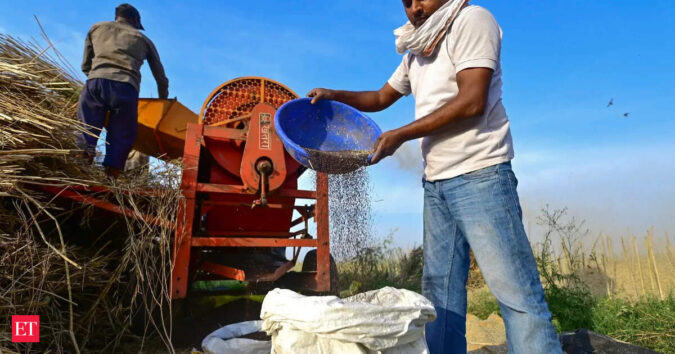
“India has enough seed stock available for the upcoming sowing season,” Additional Secretary, Agriculture and Farmer Welfare, Maninder Kaur Dwivedi said during the government’s inter-ministerial briefing on recent developments in West Asia.
Also read: Tanker carrying Iran crude signals India after 7-year import gap
The country has a self-reliant seed system backed by ICAR and public sector in addition to private sector for production and distribution of seeds. A robust pipeline with adequate seed and breeding materials at all stages (certified, foundation, hybrid seeds) is also present in order to cater to any possible disruptions.
For Kharif Season 2026, the government reported a comfortable seed availability situation with a surplus of around 19.29 lakh quintals. Dwivedi highlighted that the country’s agriculture sector requires 166.46 lakh quintals, while the country has 185.74 lakh quintals available. In addition to this, Rabi season seed inputs are also in place.
“The price situation is also being monitored for the wholesale prices for all agro commodities. By and large, they are within the normal range as they have been in the past few years. The prices of the top crops, tomato, onion, and potato, are in the range and are showing an improvement, with an improving trend at the wholesale level,” Dwivedi said.
Amid the ongoing war between US-Israel war with Iran, the government has prioritised the allocation of LPG/PNG for seed drying for maize, and also ensured uninterrupted fuel supply to Oil Marketing Companies (OMCs).
Fertiliser situation stable
The government asserted that the country has ample fertiliser as opening stock for the upcoming kharif season. India’s fertilizers requirement assessed in consultation with states for Kharif 2026 stands at 390.54 LMT, against which 180 LMT (46%) is available as opening stock.
The Centre held a meeting of Department of Agriculture & Farmers Welfare, Department of Fisheries and State Secretaries on March 30 for inspecting judicious use of fertilizers, and ensuring timely & orderly last mile delivery.
To continue strict vigil on diversion of fertilizer for non agricultural use, hoarding etc., the ministry has launched a nationwide enforcement drive in coordination with the states.
Amid the escalating conflict in the Middle East, the government is promoting use of alternative fertilisers such as Nano Fertilizers, bio fertilizer and Bio-stimulants. Numerous states like Madhya Pradesh, Haryana and Telangana have implemented models of integrating fertiliser sale with farmer databases/ land records. 19 States have initiated generating Farmer IDs.
Apart from fertilisers, India also has adequate availability of pesticides and other agrochemicals essential for the upcoming farming season. The Centre is engaged in continuous dialogue with states and UTs and conducting weekly monitoring for the same, the government official said.
During April-Feb 2026, 2,61,099, MT of pesticides was produced in the country. The total estimated demand stands at 74,266 MT out of which 42,000 MT is required in Kharif 2026.
Observing rumours and unfair practices, the Centre has also taken up efforts on crackdown on fake or spurious pesticides in multi-stakeholder coordination approach. It is also focusing on Integrated Pest Management (IPM) in collaboration with States.
The government is encouraging biopesticides & sustainable practices, and making efforts to strengthen farmer awareness & surveillance, heightened pest surveillance and precision advisory.
Dwivedi highlighted that the prices of agro commodities are by and large stable and it is being closely monitored. The prices of tomato, onion & potato crops is in range and all three are showing slight improvement in prices, she said.