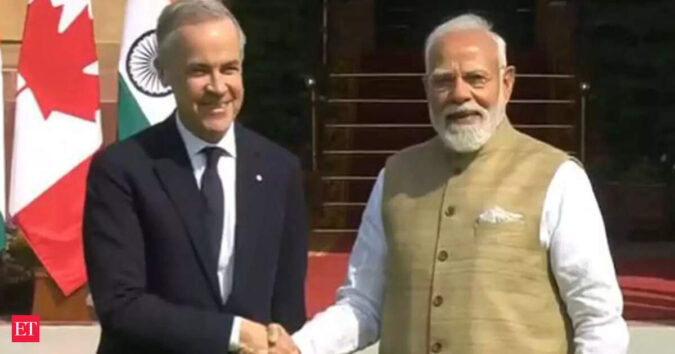
The uranium deal is aimed at ensuring long-term fuel supply for India’s civil nuclear energy programme. Carney said both sides are targeting conclusion of the broader CEPA trade pact by the end of 2026.
Also Read: Israel-Iran war’s ‘Strait’ fight can damage one of India’s well-built firewalls
“We have reached a landmark deal for long-term uranium supply. We will also work together on small modular reactors and advanced reactors,” Modi said in a joint statement after the talks.
The two countries also signed multiple Memorandums of Understanding (MoUs), including agreements on critical minerals cooperation, renewable energy promotion and cultural exchange. The documents were exchanged between External Affairs Minister S. Jaishankar and Canadian Foreign Affairs Minister Anita Anand in the presence of the two Prime Ministers.
In addition, India and Canada agreed to terms of reference for the Comprehensive Economic Partnership and inked an agreement to strengthen cooperation in the critical minerals sector, aimed at building resilient supply chains.
Modi credited Carney for injecting momentum into bilateral ties. “India and Canada have unwavering faith in democratic values. We celebrate diversity. The well-being of humanity is our shared vision. Today, we discussed transforming this vision into a next-level partnership,” he said.Setting an ambitious economic target, Modi said both countries aim to reach $50 billion in bilateral trade by 2030. “Unlocking the full potential of economic cooperation is our priority. Therefore, we have decided to finalise the Comprehensive Economic Partnership Agreement soon. This will create new investment and employment opportunities in both countries,” he said.
Carney described the uranium pact as a major step forward and reaffirmed Ottawa’s intent to conclude the CEPA negotiations by 2026.
Also Read: Govt cautions states against possible violence in India amid Israel-US strikes on Iran
The leaders also expanded cooperation in renewable energy and climate initiatives. Modi welcomed Canada’s decision to join the International Solar Alliance and the Global Biofuel Alliance, and announced that the two sides will hold an India-Canada Renewable Energy and Storage Summit this year.
On technology and innovation, Modi said both countries are “natural partners”, highlighting collaboration in artificial intelligence, quantum technologies, supercomputing and semiconductors.
People-to-people ties and education partnerships also featured prominently. Modi announced new university collaborations in AI, healthcare, agriculture and innovation, and said both sides agreed on Canadian universities opening campuses in India. An MoU was also signed to enhance cultural exchange, including engagement between Indigenous and tribal communities.
Carney, who arrived in India on February 27 at the invitation of Modi, is on his first official visit to the country. He began his trip in Mumbai before travelling to New Delhi for delegation-level talks. He is scheduled to depart later on Monday after concluding his engagements.
The bilateral discussions focused on reviewing progress under the India-Canada Strategic Partnership across key pillars, including trade and investment, energy, critical minerals, agriculture, education, research and innovation, and people-to-people ties. The two leaders also exchanged views on regional and global developments.
In addition to formal talks, Modi and Carney attended the India-Canada CEOs Forum, underlining efforts to deepen business and investment engagement.