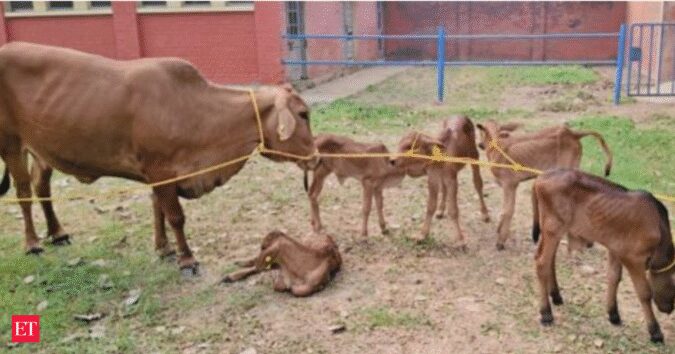
The journey toward this began in 2022–23, when ICAR–IVRI initiated a focused programme aimed at strengthening the genetic potential of India’s prized dairy breeds. The scientists set out to standardize OPU–IVF–ET protocols under both farm and field conditions, targeting key indigenous breeds such as Sahiwal cattle, Tharparkar cattle, and Murrah buffalo.
Through sustained research, precision, and innovation, the team steadily refined their techniques. Their efforts culminated in an achievement, within five days starting 28 February 2026, five healthy Sahiwal calves were born using OPU–IVF–ET technology. These calves were not just a scientific success but a genetic leap forward, produced from superior germplasm. The donor was a high-yielding Sahiwal cow producing over 12 litres of milk per day, while semen from a proven bull with an impressive maternal lineage (approximately 3,320 kg lactation yield) ensured strong genetic merit.
The scientists demonstrated the ability to recover oocytes even under non-stimulated conditions, achieving impressive averages across breeds around 14.5 in Tharparkar, 13.14 in Sahiwal, and 4.5–5.5 in Murrah buffalo. The efficiency of embryo development was equally noteworthy, with blastocyst production rates exceeding 47% in cattle and over 42% in buffalo benchmarks comparable to leading global laboratories.
This achievement represents a scalable model for the future. ICAR–IVRI now aims to expand the application of OPU–IVF–ET technology on a larger scale to accelerate the production of elite indigenous cattle and buffalo. Such efforts are expected to significantly strengthen genetic improvement programmes while ensuring the conservation of India’s valuable indigenous germplasm, say scientists.
Commenting on the results, Dr M L Jat, Director General, Indian Council of Agricultural Research (ICAR) and Secretary, Department of Agricultural Research and Education (DARE), said,“ICAR continues to focus on science and innovations which are the highest priority of India. This success case of our scientists of ICAR-IVRI stands as a testament to how innovation, dedication, team work and shared vision can transform the future of India’s livestock sector by breaking productivity barriers while conserving indigenous heritage, and contributing to a more sustainable and self-reliant agricultural economy.”
These efforts were led by a team of scientists led by Dr Brijesh Kumar, working in close collaboration with experts across divisions, supported by research scholars. The programme was guided by Dr S. K. Singh, Joint Director (Research). Raghavendra Bhatta, Deputy Director General (Animal Science), ICAR, and Director, ICAR-IVRI, expressed confidence that this breakthrough will pave the way for many more milestones in the field of Assisted Reproductive Technologies.