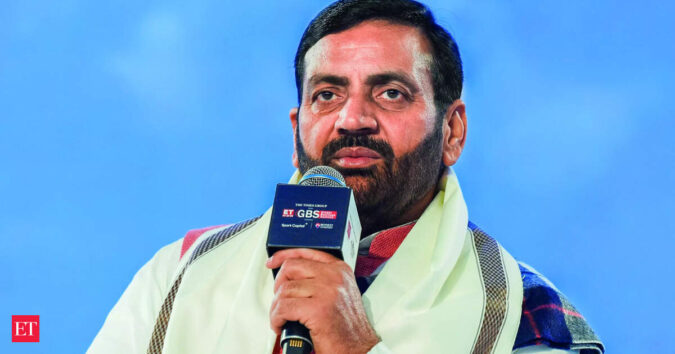
Work has already commenced on six of the proposed townships announced in the last state budget, Saini said at the ET Now Global Business Summit.
A new policy framework for the IMTs will soon be unveiled, under which industries will not be required to obtain Change of Land Use (CLU) approvals separately. “All approvals will be granted online to ensure ease of doing business,” he said.
“Once Haryana was called the poor cousin of Punjab. Today, it has carved out a strong identity in multiple industrial sectors,” he said, noting it’s now among the leading states in goods and services tax (GST) collection. He cited the rapid development of areas such as Kharkhoda as examples of the state’s industrial expansion.
Saini also underlined Haryana’s contribution to national service and sports, noting that nearly 10% of India’s armed forces personnel hail from the state and that it produces the highest number of international medal-winning sportspersons.
Infrastructure Push
Emphasising Haryana’s strategic advantage, Saini said the state boasts superior connectivity. “From Indira Gandhi International Airport, any part of Haryana can be reached in less than four hours,” he said.
The government has prioritised road upgrades and drainage systems. To address recurring waterlogging in low-lying areas of Gurgaon, a new drainage system is being planned, he said.
After the recent monsoon season, six agencies handling road networks across the state were convened to review infrastructure gaps.
An allocation of ₹4,500 crore has been earmarked to improve the road network. The government would ensure “not a single pothole” remains on any state road, the chief minister promised.
Measures are also underway to ensure there is no shortage of drinking water in the state for the next 50 years.
New initiatives have been introduced to strengthen garbage collection and sanitation systems in Gurgaon, he said.
Addressing environmental concerns, Saini said Haryana “has done fabulous work in managing stubble burning.” He said 95% of farmers in the state are not involved in stubble burning.
He noted that textile manufacturers in Panipat had expressed concern over the 50% US tariff. However, subsequent agreements have eased their apprehensions, he said, adding that the state government is actively engaging with stakeholders to safeguard industrial interests.
The chief minister said the state budget was prepared after extensive consultations with industrialists, women self-help groups, farmers, professionals and other stakeholders. “People feel this budget is theirs,” he said, describing it as a participatory exercise reflecting grassroots inputs.
Responding to Congress leader Rahul Gandhi’s reported remarks describing India as a “dead economy,” Saini said the opposition should play a constructive role in national development.