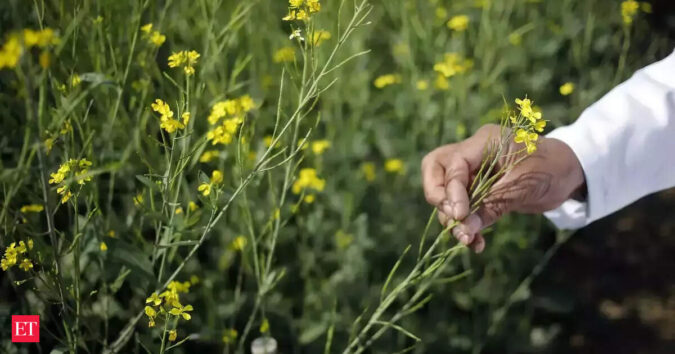
The officials will discuss field trials of a GM variety of rapeseed, known locally as mustard, according to a person with direct knowledge of the matter. The rollout of the crop has been stalled for years due to a lengthy court process after activists challenged its commercial release.
The panel’s decision could strengthen the government’s position as soon as the Supreme Court returns its attention to the case, the person said, asking not to be identified as the process is not yet public.
The debate over GM crops in India has heated up in recent months during trade talks with the US, which ultimately resulted in a deal that will lower import duties on US agricultural products, some derived from engineered seeds. India is also eager to improve farm productivity, as the rural economy comes under increasing strain and the population swells.
India does not currently allow cultivation or import of GM food crops, which are grown widely in places like the US, Brazil and Argentina. The country is self-sufficient in many key food staples, and ranks as the No. 1 rice exporter. However, vegetable oil — which can be made from rapeseed — remains a major exception, with India leading global imports at a cost of over $17 billion annually.
Spokespersons for the farm and environment ministries did not immediately reply to requests for comment.
Among the farm goods impacted by the trade deal agreed this month are distillers dried grains (DDGS) and soybean oil. Import of DDGS — largely produced from genetically-modified corn — effectively allows a GM by-product into the domestic market. Soybean oil processed from GM varieties in the US and South America is already permitted.The deal sparked protests by major farmer groups, who fear imports could flood in and hurt the small producers that dominate India’s agricultural sector.
Domestic efforts to raise farm productivity have so far relied on hybrid seeds, which have helped lift output of corn, wheat and rice without triggering the policy roadblocks and legal challenges associated with GM technology.
However, rapeseed is a staple oilseed in the local diet, and proponents of a modified variety say it could lift yields and make more efficient use of scarce arable land. If approved, that could open the door to other food crops, marking a potential shift in India’s historically cautious approach.
In 2010, the government halted the commercial release of genetically-modified brinjal — or eggplant — that would have been the country’s first GM food crop, citing the absence of an immediate food security imperative.
The Supreme Court has yet to deliver a final ruling on mustard, with a two-judge bench issuing split opinions in 2024 on whether cultivation should be permitted. The divergence required the matter to be referred to a three-judge bench.
India’s only approved GM crop, Bt cotton, transformed the country into one of the world’s top producers two decades ago.