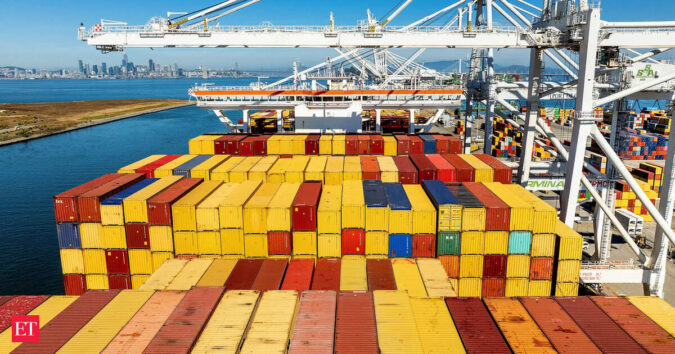
Exporters, however, are adopting a wait-and-watch approach, fearing that Washington may reimpose similar levies under some other provision, even while they seek more clarity from their buyers and legal circles. Trump has already said he will sign a new executive order to impose a 10% global tariff under Section 122. Section 122 tariffs last up to 150 days unless Congress votes to extend them. He also said he will initiate investigations under Section 301, which could ultimately be used to levy tariffs. This section allows the US government to investigate unfair trade practices and impose tariffs accordingly.
Also read: $175 billion refund? SC flags ‘messy’ process as Trump & Co may have to give the money back
“We’re immediately instituting the 10% provision,” he said.
Earlier in the day, the US Supreme Court ruled that Trump exceeded his authority by imposing tariffs under the International Emergency Economic Powers Act (IEEPA), invalidating country-specific “reciprocal tariffs” and fentanyl-linked duties imposed on imports from major trading partners.

However, Section 232 tariffs on steel, aluminium, and certain auto components remain in force.
Exporters of gems and jewellery, textile and marine products said they expect a clear picture to emerge only next week.
“There is no clarity as of now. Things will become clearer on Monday. It is expected that there will be a protracted legal battle over tariff,” said Kirit Bhansali, chairman of Gem & Jewellery Export Promotion Council.
Seafood exporters, too, are waiting for more clarity. “The US Supreme Court ruling about the tariffs is good news for us. However, we have no idea how it is going to impact our exports till we get to know the details,” said Pawan Kumar G, president of Seafood Exporters‘ Association of India.
Exporters also said the development is unlikely to change the export order situation as a change in tariffs can only be brought about through an executive order.
“Importers may seek refunds of duties paid under the invalidated regime, which could provide near-term liquidity support,” said SC Ralhan, president of Federation of Indian Export Organisations (FIEO). “The decision also opens space for more stable and constructive India-US trade engagement,” he said.
FUTURE TRADE IMPLICATIONS
Confederation of Indian Textile Industry secretary general Chandrima Chatterjee said the body is trying to assess the implications of the judgement for future trade.
Less than 5% of exporters were under the Delivered Duty Paid (DDP) contracts and will be eligible for refunds. DDP is an international shipping agreement where the seller assumes all responsibility for transporting goods until they reach the destination. Clauses on goodwill basis are present in trading contracts considering the possibility of reversal of tariffs by the courts of some exporters, and they could stand to benefit.
Some exporters said New Delhi should now review its concessions to the US in its trade deal and not show any urgency to ink a pact.
As per the joint statement issued by the two sides on the framework for an interim trade agreement on February 7: “In the event of any changes to the agreed upon tariffs of either country, the United States and India agree that the other country may modify its commitments.”
Pankaj Chadha, chairman of engineering goods’ exports promotion body EEPC, said India has an advantage over other countries that have already signed trade deals with the US. “We should wait and understand what Korea, the EU, Canada and Indonesia do before taking a call,” he said. Think tank Global Trade Research Initiative (GTRI) said following this ruling, the US should remove the 25% reciprocal tariffs on India, then about 55% of India’s exports to the US would be subject to only the existing customs duties.
The ruling should prompt India to re-examine its trade deal with the US, GTRI said. Under the interim trade deal, tariffs on $30.94 billion of Indian exports have been reduced from 50% to 18%, while tariffs on another $10.03 billion have been reduced from 50% to zero.
The Indian gem and jewellery industry was allowed zero-duty access for diamonds and coloured gemstones exports to the US – a decisive turning point that breathed new life into the sector. The tariff on jewellery was lowered to 18% from 25%.
TWO SCENARIOS
Exporters feel there could be two scenarios now – either everything returns to the pre-July 2025 period, which would be the same for every country, or the current tariff scenario, in which India has a slight tariff advantage.
Lalit Thukral, president of Noida Apparel Export Cluster, said there is no clarity on what happens to the goods that have already been exported to the US.
The diamond sector had taken a severe hit over the past year, with India’s cut and polished diamond exports to the US – the largest export market – declined by over 60%, from $3.64 billion in April-December 2024 to $ 1.45 billion in April-December 2025, as tariffs eroded competitiveness.
US imports of textile and apparel from India declined by 16.2% year-on-year in December. India’s performance in the US textiles and apparel market in 2025 was effectively flat with imports rising just 0.9% year-on-year to $9.68 billion.