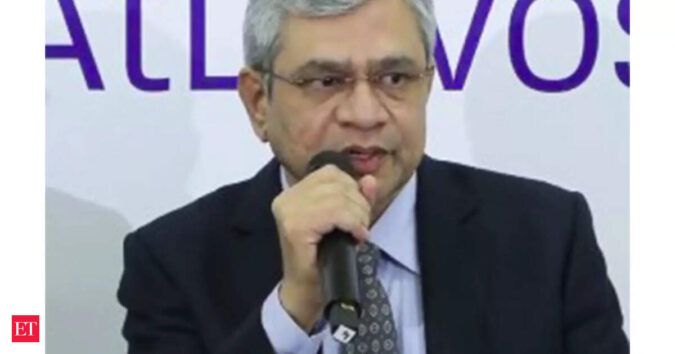
“It is not a question of if India will become the third-largest economy. It is a certainty,” Vaishnaw said, adding that the country’s growth trajectory is anchored in a decade of “transformational change” marked by focused execution and institutional reform.
Also Read: Davos 2026: Global interest grows in India’s approach to AI, says Vaishnaw
The pillars of India’s growth
Vaishnaw primarily highlighted four pillars of India’s growth strategy: sustained public investment in physical, digital and social infrastructure; inclusive growth that ensures the benefits of expansion reach the poorest; a renewed push on manufacturing and innovation; and sweeping simplification of laws and procedures enabled by technology.
He said inclusivity has been central to India’s economic transformation, pointing to 540 million new bank accounts, over 130 million toilets built, and monthly food rations for nearly 800 million people. These measures, Vaishnaw said, have helped lift around 250 million people out of poverty, reinforcing social stability alongside growth.
While expressing confidence in India’s domestic fundamentals, the minister flagged rising global debt levels — particularly in advanced economies — as a key external risk. “The mountains of debt in the rich world, and how that unravels, is a matter of concern,” he said, citing recent volatility in Japan’s bond markets as a warning signal.
Economic resilience
Vaishnaw also underlined India’s resilience to global trade disruptions and tariffs, noting that exports have continued to grow despite protectionist pressures. Indian producers, he said, are finding new markets and expanding into new geographies, with electronics now emerging as the country’s third-largest export category — a shift that would have seemed “unbelievable” even a decade ago.India, he said, is simultaneously deepening engagement through balanced trade agreements, including with the UAE, Australia, New Zealand, Switzerland and the UK, while talks with Europe are underway.
Also Read: Hemant Soren pitches sustainable development agenda at Davos
Crucially, Vaishnaw argued that India has evolved from being a mere supply-chain participant to a trusted “value-chain partner” — collaborating not just on manufacturing but also on design and innovation. He pointed to semiconductors as a case in point, noting that global scepticism about India’s chip ambitions has given way to recognition of its strategic role.
Policy reforms
The minister said reforms driven by cooperative federalism — including GST, labour reforms and the opening of sectors such as nuclear energy to private participation — have been critical to this shift. Over the past decade, the government has scrapped 1,600 obsolete laws and removed 35,000 compliances, while rewriting colonial-era statutes across sectors.
“Practically every sector is getting a modern legal and procedural framework, built on our technology stack,” Vaishnaw said, adding that the government remains open to feedback from investors on remaining bottlenecks.
As global economic uncertainty deepens, Vaishnaw said India’s strong fundamentals, both macro and micro, have positioned it to weather turbulence while sustaining long-term growth.
India and AI
Finally, Vaishnaw highlighted India is making rapid strides across what he described as a “five-layer AI stack”, spanning compute, data, models, applications and talent, with the country already emerging as one of the world’s largest providers of AI-driven services.
“We don’t need a trillion-parameter model to do what we want to do,” he said, signalling a focus on efficiency, use-case relevance and deployment at scale rather than sheer model size. The minister added India’s AI push is closely linked to its semiconductor and energy strategy, with the government committing nearly $70 billion in AI and digital infrastructure investment.