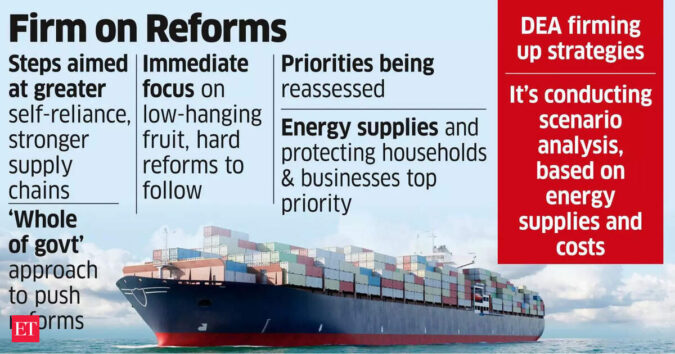
In a communication earlier this month, the Prime Minister’s Office asked various ministries and departments to submit reform plans, with an emphasis on actionable measures and low-hanging fruit, they said.
The move aims to use the current crisis to push reforms across sectors, with a sharper focus on self-reliance and strengthening domestic supply chains, similar to the approach adopted during the pandemic, the people said.
“It involves a ‘whole-of-government’ approach because any such crisis demands coordinated action across ministries,” one of them said.
Ministries told to submit plans to cushion economy as focus shifts to supply chains, energy security & self-reliance
The proposals for short, medium and long-term reforms will be reviewed at senior levels in the government before being taken forward.

The Department of Economic Affairs is working on strategies to cushion the impact on the economy, including scenario analysis of energy supplies and costs. Other finance ministry departments are undertaking similar exercises within their respective mandates, the people said.
Before the West Asia conflict, the government had last year set up high-level committees led by Niti Aayog member Rajiv Gauba to drive implementation of Viksit Bharat goals and non-financial regulatory reforms.Separately, cabinet secretary TV Somanathan has been leading efforts to push states towards reforms, particularly deregulation.
The war has added urgency, with global supply chains-especially in energy-disrupted and no clarity on when normal supplies will resume, the people said.
The situation has also prompted a reassessment of reform priorities, with immediate focus on ensuring energy and fertiliser supplies and limiting the impact on households, businesses and the broader economy.
While the broader reform agenda will continue, strengthening domestic supply chains to withstand global shocks will be a key priority alongside longer-term measures.
Chief economic adviser V Anantha Nageswaran on Saturday warned that India faces “considerable downside” risk to its projected growth of 7-7.4% for 2026-27 due to the conflict. He flagged risks to inflation, the fiscal deficit and external balances if the war persists or escalates. India has remained the world’s fastest-growing major economy since 2021-22.