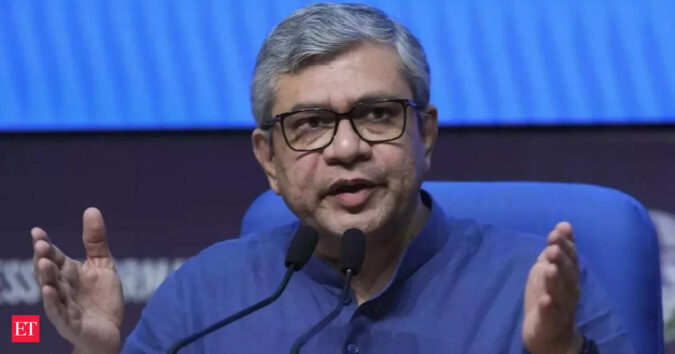
Addressing a press briefing after the Cabinet meeting, Union Minister Ashwini Vaishnaw said the next phase of the Jal Jeevan Mission will shift its focus from infrastructure creation to ensuring reliable service delivery and long-term sustainability of rural water supply systems.
The Jal Jeevan Mission 2.0 will introduce a uniform national digital framework called “Sujalam Bharat”, enabling digital mapping of water supply assets and improving monitoring of service delivery. The programme will also provide technical and financial support to Gram Panchayats, empowering them to manage water utilities at the local level.
Under the new framework, Gram Panchayats and Village Water & Sanitation Committees will play a central role in commissioning water infrastructure and formal handover through a programme called “Jal Arpan.” The government will also strengthen water quality testing systems and surveillance mechanisms to ensure safe drinking water in rural areas.
To encourage community ownership, the government plans to promote an annual community-led “Jal Utsav”, aimed at reinforcing participation in water management and conservation.
Santragachi – Kharagpur 4th line & Sainthia – Pakur 4th line
The Cabinet Committee has also approved two projects of Ministry of Railways with total cost of approximately Rs 4,474 crore. These projects include, Sainthia – Pakur 4th line and Santragachi – Kharagpur 4th line.
The Santragachi–Kharagpur 4th line will significantly enhance regional rail infrastructure by improving connectivity to the Syama Prasad Mukerjee Port and the Haldia Dock Complex, facilitating smoother and faster movement of long-distance, suburban, and freight trains.
It will also support key economic and industrial hubs, including cement clusters, goods sheds at Shalimar and Sankrail, the Kolaghat Thermal Power Plant, and the Vidyasagar Industrial Park, thereby boosting both passenger convenience and freight efficiency while strengthening the region’s overall industrial and port-linked growth.
Four laning of Badnawar – Thandla – Timarwani (NH 752 D)
The four-laning of the Badnawar–Thandla–Timarwani stretch of NH-752D, and the development of an elevated road corridor connecting the upcoming Jewar airport with the Faridabad section, aimed at improving connectivity in the National Capital Region. The NH-752D highway is a crucial segment of the Delhi–Mumbai Expressway, providing a strategic link between central India and the western trade corridor by connecting NH-52 with the expressway. The four-laning of the Ujjain–Badnawar section has been completed, and the Cabinet has approved the construction of the four-lane Badnawar–Petlawad–Thandla–Timarwani stretch, covering a total length of 80.5 km at an estimated cost of Rs 3,839 crore, further enhancing regional connectivity and trade efficiency.
Madurai Aiport
The Cabinet also approved the declaration of Madurai airport as an International Airport, a move expected to strengthen connectivity and economic activity in southern Tamil Nadu.
Madurai is already a customs-notified airport, with international flights currently operating to Dubai, Abu Dhabi and Colombo, and multiple airlines have shown interest in expanding international services from the city. Officials said the airport already has the essential infrastructure required for international operations, including immigration check facilities, customs systems, and health and quarantine services.
The government said the upgrade is expected to improve connectivity to major pilgrimage destinations such as the Meenakshi Amman Temple, Koodal Azhagar Temple, Thirupparankundram Murugan Temple, Palamudhircholai Murugan Temple and Rameswaram.
The move is also likely to boost regional economic activity, particularly in sectors such as automobiles, rubber, chemicals and granite, while further strengthening Madurai’s role as a key education and healthcare hub in the region.
Elevated road connecting Jewar airport – Faridabad section
According to the government, the 7.8-km alignment passes through notified urban limits under the Faridabad Master Plan 2031 and intersects key infrastructure corridors including the Eastern Peripheral Expressway, the Yamuna Expressway and the Dedicated Freight Corridor (DFC). The Cabinet approved a revised project cost of Rs 3,631 crore for the development of the elevated road, which is expected to significantly improve regional connectivity to the upcoming Jewar International Airport.