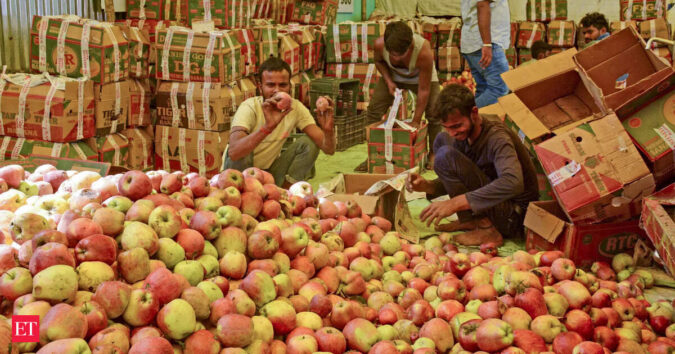
If you buy apples in a city supermarket, chances are a growing share of them are imported. And that trend could accelerate.
Imports now equal 22% of domestic output
According to a report by think tank GTRI, India produces about 2.5 million metric tonnes of apples annually, making it one of the world’s major producers. Output is concentrated in the northern states, with Jammu and Kashmir accounting for 70–75% of total production, Himachal Pradesh contributing around 20%, and Uttarakhand about 2%. Smaller volumes are grown in Arunachal Pradesh and Nagaland.
Also Read: India-US trade deal: The apple math triggers anxiety among farmers in Kashmir, Himachal
Nearly 50 lakh people in Jammu & Kashmir and about 5 lakh families in Himachal Pradesh depend on apples for their livelihoods.
“Despite strong domestic output, India imported about 558 thousand tonnes of apples in FY2025, equivalent to roughly 22% of domestic production. Import dependence has grown steadily. In value terms, apple imports have increased more than fortyfold over two decades — from $9.9 million in 2004 to $417.6 million in 2024,” GTRI founder Ajay Srivastava said.
In other words, even as domestic orchards produce millions of tonnes, imports are steadily expanding their share of the Indian market.
The US deal: Lower tariffs, limited safeguards
Currently, India imposes a 50% import duty on apples and permits imports only when the declared value exceeds ₹50 per kilogram.
Based on FY2025 prices, landed costs at a 50% duty are approximately:
₹77/kg for Iranian apples
₹99/kg for Turkish apples
₹120/kg for South African apples
₹125/kg for U.S. apples
₹129–131/kg for New Zealand and Afghan apples
Despite this high tariff wall, imports have continued to grow.
Now, under the trade deal reportedly being negotiated with the United States, India has agreed to reduce tariffs on a limited quantity of U.S. apples from 50% to 25%, while raising the minimum import price (MIP) to ₹80 per kg.
The higher MIP is unlikely to restrain imports because U.S. apples already enter India at prices above that level. The tariff cut, however, would significantly lower landed costs — from about ₹125/kg to ₹103.7/kg.
With a 30% retail markup, U.S. apples could be sold in major city malls at around ₹135/kg. With a 40% markup, they could reach tier-two city shelves at roughly ₹145/kg.
If similar concessions are extended to other free trade agreement (FTA) partners, imports could increasingly penetrate the mid-premium segments that domestic growers rely on for better returns.
Why imports compete so effectively
The challenge is not just tariffs. It is structure.
Domestic apples often lose competitiveness not in orchards but along the road to retail shelves.
Farmers typically receive ₹30–₹60 per kg, sometimes less in distress years. Wholesale prices range between ₹60–₹120 per kg, while retail prices often reach ₹120–₹220 per kg.
That roughly fourfold increase reflects cumulative costs: grading, packaging, commission agent fees, mandi charges, mountain transport, cold storage, trader margins, retailer overheads and post-harvest losses that can reach 30–40%.
“This roughly fourfold increase reflects multiple structural costs and bottlenecks. Domestic apples from Kashmir and Himachal Pradesh must travel long distances over fragile mountain roads, often facing weather disruptions and delays. Along the way, costs accumulate through grading and packaging, commission agent fees, mandi charges, transport from hill regions, cold storage expenses and wastage losses that can reach 30–40%. Trader margins, retailer overheads, seasonal gluts, weak cold-chain infrastructure and multiple intermediaries further depress farm-gate prices while pushing up retail prices,” the report said.
Imported apples, by contrast, move efficiently from ports to urban markets, typically incurring only 30–40% logistics and distribution costs. Domestic apples can experience cost escalations exceeding 400% from orchard to retail.
So even when Indian apples are cheaper at the farm gate, they can be less competitive on store shelves.
Off-season advantage
Imports also fill supply gaps.
Apples from the United States, New Zealand, South Africa and Chile arrive during months when domestic stocks decline and storage capacity is inadequate. If tariffs fall further, imported fruit could dominate retail shelves in off-season months, eroding traditional seasonal price advantages enjoyed by Indian growers.
Low-cost imports from Iran and Turkey pressure lower-grade segments. Tariff-reduced imports from FTA partners could compete directly in mid-premium categories.
The biosecurity question
Plant health adds another layer of concern.
India maintains strict sanitary and phytosanitary (SPS) checks to prevent the entry of pests such as fruit flies, codling moth and fungal infections. Consignments showing signs of quarantine organisms may be rejected or treated.
There is apprehension that trade negotiations could include pressure to waive domestic inspections once consignments are cleared under exporting-country rules — an approach reportedly accepted by Malaysia in similar contexts.
Any dilution of quarantine standards could pose risks to orchards and ecosystems.
A long history of tariff pressure
Western economies have long pushed India to lower apple tariffs. During GATT Article XXVIII renegotiations in 1999–2000, India reduced the bound tariff rate on apples from 55% to 50%. Article XXVIII permits WTO members to renegotiate previously bound tariff commitments.
The current US deal represents the next phase in that evolution.
Structural problems at home
Indian apple growers also face climate shocks, erratic snowfall, heavy rains and disease outbreaks that reduce yields and fruit quality. Damaged hill roads and poor cold chains contribute to 30–40% post-harvest losses.
Productivity remains low — about 7–8 tonnes per hectare in Himachal Pradesh — compared with 40–70 tonnes in leading producing countries.
Volatile prices and market gluts often mean farmers receive far less even when retail prices remain high.
Without improvements in storage, transport and marketing systems, tariff protection alone may not prevent rising imports from steadily eroding farmer incomes.
The way forward
Policy recommendations include:
Maintaining import safeguards so FTA concessions do not displace domestic growers
Preserving strong SPS and quarantine checks
Expanding cold storage, refrigerated transport, pack-houses and grading facilities
Promoting farmer producer organisations, direct retail linkages and digital marketplaces to reduce middlemen costs
Upgrading rural hill roads and logistics
Raising productivity through high-density planting, improved varieties, mechanisation support, extension services, crop insurance and better inputs
Providing targeted financial support and climate-resilient orchard programmes
At a crossroads
India’s apple economy now stands at a crossroads.
Imports — already equal to roughly one-fifth of domestic production — are likely to expand further. Year-round imported fruit may increasingly replace domestic apples in premium and off-season markets.
For consumers, that could mean steady supply and competitive pricing. For growers in the Himalayan states, it raises a harder question: can domestic supply chains and productivity improve fast enough to compete?
“Without reforms, rising imports will continue to erode the market share and earnings of Himalayan apple growers, even as consumers pay high prices for fruit that travels thousands of miles to reach their plates,” Srivastava said.