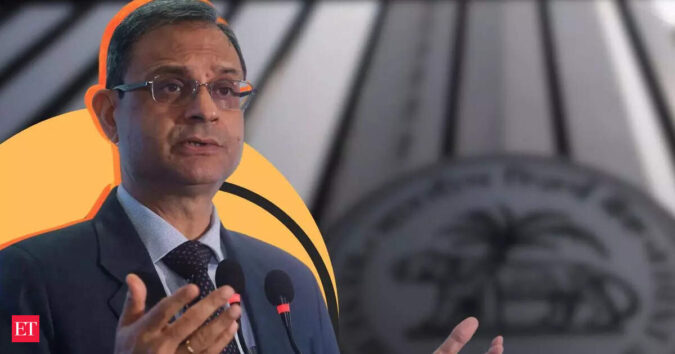
The rate-setting panel headed by Governor Sanjay Malhotra lowered the borrowing costs from 6.50% in February to 5.25% by December, after brief pauses in August and October, marking the central bank’s most aggressive year of rate cuts since 2019.
Since taking office last year, Malhotra has pivoted to a more growth-friendly approach than his predecessor, Shaktikanta Das.
The Indian economy is in a “rare goldilocks” period of brisk growth with low inflation, the RBI chief said in his video address at the last Monetary Policy Committee (MPC) meeting. The country’s retail inflation hit an all-time low of 0.25% in October and has stayed below the central bank’s 4% target since February 2025.
On the growth front, the world’s fifth-largest economy expanded at a sharper-than-expected clip of 8.2% in the July-September quarter, underscoring its resilience even as US President Donald Trump’s steep tariffs cloud the outlook. The economy had expanded 7.8% in the April–June quarter.
Although many economists do not expect the momentum to last through the remaining quarters, if uncertainty over a trade deal with the US lingers. The rupee bore the brunt of these tensions with the US, falling to record lows and moving past the psychologically important Rs 91 per dollar barrier before recovering some ground, in the process becoming Asia’s worst-performing currency this year.
It was against this mix of strong data, external risks and currency pressure that Malhotra and Co charted its policy path through the year.
February
April was Malhotra’s debut policy meeting, and he definitely did not disappoint. All six members of the rate-setting panel voted unanimously to lower the benchmark repurchase rate by 25 basis points, the first cut in nearly five years, to 6.25%.
India’s policymakers expressed concerns over economic growth getting hit by an excessively restrictive monetary policy, which led them to make a reduction in borrowing cost, minutes of the RBI’s MPC showed.
At that time, the RBI chief said a lower policy rate was “more appropriate at the current juncture,” as inflation was on a path to align with the central bank’s target of 4%.
April
RBI lowered its benchmark interest rate for a second straight meeting to bolster growth in Asia’s third-largest economy. Malhotra and Co. voted unanimously to lower the repurchase rate by 25 basis points to 6%.
By this time, the Indian economy was expected to take a hit from US tariffs. “The year has begun on an anxious note for the global economy,” Malhotra said, adding that the Indian economy has made steady “progress” but we remain “vigilant.”
June
The central bank this time brought rates out of restrictive territory into neutral with June’s cut, and it went big, at last. The MPC cut its key repo rate by a larger-than-expected 50 basis points to 5.5%. Tensions fuelled by Trump’s trade tariffs and the prospect of an economic slowdown in the United States and elsewhere fuelled global uncertainty and prompted central banks to act.
“Certainty in the uncertain environment was necessary; hence the front-loading of rate cuts,” Malhotra had said after announcing the decision.
August
RBI decided to hit the pause button in August, keeping its key repo rate steady at 5.50% to assess the impact of Trump’s sweeping tariffs on the Indian economy. With tariff-related uncertainties still evolving and the effects of previous reductions still playing out, “monetary policy needs to remain watchful,” the RBI chief said.
Global trade challenges continue to linger but prospects for the Indian economy remain “bright”, he stated. Trump doubled the levies on Indian exports to the US from 25% to 50% in August.
October
India’s interest-rate panel members pressed another pause in October and held the key repo rate steady at 5.50%. “The benign outlook for headline and core inflation as a result of the downward revision of projections opens up policy space to further support growth,” Malhotra said.
While the intent is to continue to facilitate growth-enabling conditions, policy uncertainty, rapidly evolving developments and the foggy outlook suggest that the panel should take a view for each policy based on the prevailing macroeconomic conditions, he said.
December
The central bank in December delivered one final rate cut for the year and slashed the repurchase rate by 25 basis points. Given the benign inflation outlook both for headline and core inflation, “real interest rates need to be lower,” Malhotra said, adding that retaining a neutral stance “gives the requisite flexibility to remain data-dependent and act according to the evolving macroeconomic conditions and outlook.”