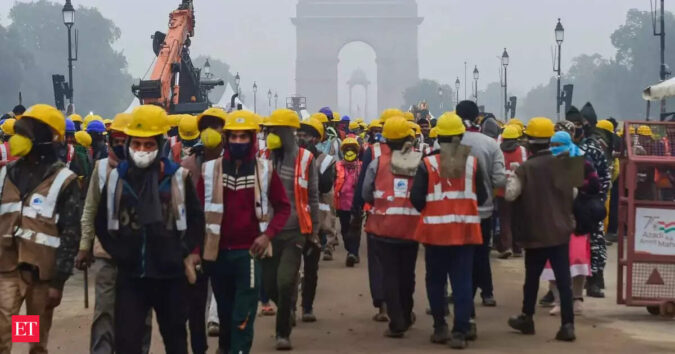
The codes consolidate 29 existing labour laws into a single, streamlined framework, replacing decades-old legislation with a structure meant to reflect current economic realities.
The labour ministry is also preparing to roll out EPFO 3.0 in 2026, a major upgrade aimed at faster provident fund withdrawals, smoother pension fixation under the Employees’ Pension Scheme, 1995 and quicker settlement of insurance claims under the Employees’ Deposit Linked Insurance Scheme, 1976.
A critical moment
Together, these steps mark a critical moment in India’s effort to reshape its labour and employment framework.
Union Labour and Employment Minister Mansukh Mandaviya has described 2025 as a turning point. He said the year had been “truly transformative” for the labour ecosystem, with reforms that place workers at the centre of governance, PTI reported.
A key milestone, Mandaviya said, was the coming into effect of the four labour codes on November 21, 2025.
The next phase will be decisive, he told PTI. In 2026, the focus will shift to technology-driven service delivery, effective implementation on the ground and the operationalisation of rules under the codes, he said.These rules, the minister argued, will turn legislative intent into outcomes at the workplace, offering clarity and predictability for both workers and employers.
“Most comprehensive reform in India labour law history”
Once in force, the government believes the codes will accelerate India’s transition towards a more formal and inclusive labour market. Mandaviya has called them the most comprehensive reforms in the country’s labour history, aimed at improving worker welfare, encouraging formalisation, and boosting employment.
The labour reforms come alongside a broader employment push. The Pradhan Mantri Viksit Bharat Rozgar Yojana, with an outlay of nearly Rs 1 lakh crore, is designed to incentivise the creation of 3.5 crore jobs over the next two years.
Social security, reimagined: How the new labour code reshapes PF and worker rights
The government sees this scheme as a bridge between policy reform and job creation.
There has also been a measurable expansion of social protection. According to Mandaviya, coverage has risen from 19 per cent a decade ago to more than 64 per cent today, a development recognised by the International Social Security Association.
This expansion, Mandaviya said, reflects sustained policy focus rather than isolated interventions.
Operational changes within the Employees’ Provident Fund Organisation have been a central part of this shift. Simplified withdrawal processes have reduced delays and improved access to savings for crores of members, easing a long-standing source of frustration for workers.
At the same time, India’s digital public infrastructure for labour has expanded at a significant pace. Platforms such as the e-Shram portal and the National Career Service have achieved scale, strengthening the delivery of social security and employment services.
These systems have also attracted international attention for their use of technology to reach workers across sectors.
The next step in this digital transition is EPFO 3.0. The planned upgrade aims to modernise internal systems and further simplify eligible provident fund withdrawals, with the stated goal of improving member convenience and service speed.
“Roll ’em back”: Trade unions resist
The reform agenda, however, is far from uncontested. Several central trade unions have opposed the labour codes, describing them as anti-worker and calling for their rollback. The resistance has now moved from statements to mobilisation.
At a key meeting on December 22, 2025, a Joint Platform of Central Trade Unions and sectoral federations resolved to call a nationwide general strike on February 12, 2026. The protest is directed against the labour codes and what the unions describe as a broader attack on workers’ rights and entitlements.
The strike call will be formally ratified at a National Workers’ Convention scheduled for January 9, 2026, in New Delhi. In a joint statement issued on December 23, the unions accused the government of using its institutional machinery, the media and public sector managements to build support for the codes.
The unions have made their position clear. They argue that the codes have been notified without adequate consultation and amount to a unilateral imposition. They have warned that if the government proceeds with notifying the rules and does not repeal the codes, they will escalate their response, including the possibility of multi-day general strikes and sector-specific resistance.
Industry counters, calls new codes a milestone
Industry bodies, however, see the reforms differently. Arvind Goel, Co-Chair of the CII National Committee on Industrial Relations and Labour, President of the Employers’ Federation of India, and Vice Chairman of Tata AutoComp Systems, has called 2025 a watershed year for labour reform.
He said the implementation of the four labour codes marked a milestone, arguing that the consolidation of 29 legacy laws has modernised regulation while strengthening workforce well-being and advancing ease of doing business.
According to him, the combination of labour codes, social security expansion and employment-linked schemes points to steady progress towards a future-ready labour ecosystem.
Goel emphasised reduced compliance burdens, modern work arrangements, and stronger protection as key outcomes of the reforms. He also noted that continued collaboration between industry bodies and the labour ministry would be crucial in translating policy changes into real-world impact.
As 2026 approaches, India’s labour reforms stand at a crossroads. The government is pressing ahead with implementation, backed by digital systems and employment incentives. Trade unions are preparing for confrontation, arguing that the changes weaken worker protections.
With PTI inputs