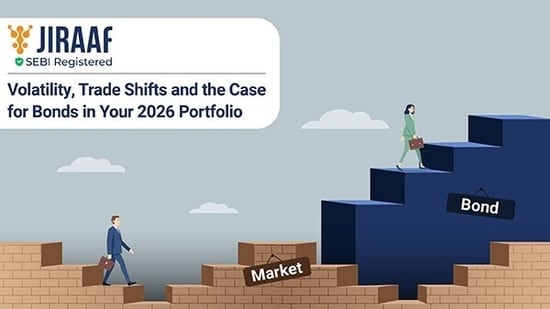
As we head into 2026, one thing is clear for investors: the world is entering a phase of realignment. Global trade equations are shifting, supply chains are being reworked, and geopolitical priorities are evolving faster than markets can price in. While these changes open up long-term opportunities for India, they also make the near-term investment landscape far more volatile and unpredictable.
This is precisely why bonds deserve a sharper focus in the investment playbook for 2026.
Volatility is the new normal
Global markets are currently grappling with uncertainty stemming from changing trade dynamics. Countries are moving away from over-dependence on a single trading partner and towards diversified, regional supply chains. Tariff structures, export incentives, and trade barriers are all being reassessed. These transitions rarely happen smoothly.
For India, this phase comes with optimism and noise. The much-awaited India–US trade deal and the mammoth India–EU trade agreement has the potential to significantly reshape India’s export landscape, manufacturing base, and global economic integration. Over the long run, these deals could enhance competitiveness, attract capital, and strengthen India’s position in global value chains.
However, trade agreements are not overnight triggers. They take years to negotiate fully, ratify, implement, and translate into actual corporate earnings and economic growth. Markets, on the other hand, react instantly to headlines, expectations, and disappointments. This mismatch is one of the biggest reasons why Indian equity markets remain volatile despite positive long-term developments.
Why Equities Feel Unsettled Despite Good News
Indian equities are currently caught in a strange crosscurrent. On one side, there is optimism about India’s growth story, demographic dividend, and rising global relevance. On the other side, there is uncertainty around global demand, currency movements, interest rates, and the pace at which trade benefits will materialize.
For retail investors, this environment can feel confusing. Good news does not always lead to steady market gains. In fact, markets often turn volatile when expectations run ahead of reality. This is not a sign that long-term growth is broken. It is simply how transition phases behave.
The mistake many investors make is treating their entire portfolio as one bucket. In volatile phases, this approach exposes short-term goals to unnecessary risk and emotional stress.
Time Horizon is the Most Underrated Strategy
One of the most important principles retail investors should adopt in 2026 is portfolio segregation based on time horizons. Not all money should chase growth, and not all money should play safe. Each rupee must have a role.
Short-term and medium-term goals, such as buying a car, funding a child’s education in the next few years, building an emergency fund, or planning a down payment, require predictability. These goals cannot afford market swings driven by global trade headlines or policy uncertainty.
This is where stable, predictable asset classes come in.
The Role of Bonds and Fixed Income in 2026
For short and medium-term corpus, instruments such as fixed deposits and corporate bonds play a critical role. They offer visibility on returns, regular income, and capital protection when held appropriately. In a volatile equity environment, this stability becomes invaluable.
Corporate bonds, especially investment-grade bonds, allow investors to earn better yields than traditional savings instruments while still maintaining a fixed-income structure. They remove day-to-day market noise from the portfolio and ensure that essential goals are met on time.
Platforms such as SEBI-registered online bond platforms have made this asset class more accessible to retail investors. With lower minimum investment amounts, transparent disclosures, and a wide range of issuers, bonds are no longer reserved for institutions or high-net-worth individuals. Subtle shifts like these are changing how Indians think about fixed income, and platforms like Jiraaf.
are part of this broader democratization.
By allocating short and medium-term money to bonds and similar instruments, investors create a buffer in their portfolio. This ensures that near-term needs are met without disturbing long-term investments during market corrections.
Let Long-Term Money Do the Heavy Lifting
While bonds bring stability, equities remain essential for long-term wealth creation. Goals that are more than five years away, such as retirement or long-term wealth accumulation, can comfortably ride through periods of volatility.
Equities benefit from economic growth, corporate earnings expansion, and productivity gains that trade deals aim to unlock over time. Short-term market fluctuations, driven by negotiations or global uncertainty, have limited impact when the investment horizon is long enough.
By separating long-term capital from short-term needs, investors avoid panic-driven decisions. They do not have to sell equities at the wrong time to fund near-term expenses. This discipline alone can significantly improve long-term outcomes.
A Balanced Playbook for an Uncertain World
The investment playbook for 2026 is not about choosing between bonds and equities. It is about using both wisely. Global trade realignment will continue to create headlines, volatility, and opportunities. India stands to gain structurally, but the journey will not be linear.
Bonds provide calm in the chaos. They bring predictability, income, and confidence that short-term goals are protected. Equities, on the other hand, fuel long-term growth and wealth creation.
For retail investors navigating an increasingly complex global environment, this balance is not optional. It is essential. In a world where change is constant, the smartest strategy is one that aligns money with time, risk, and purpose.
Note to the Reader: This article is part of Hindustan Times’ promotional consumer connect initiative and is independently created by the brand. Hindustan Times assumes no editorial responsibility for the content.