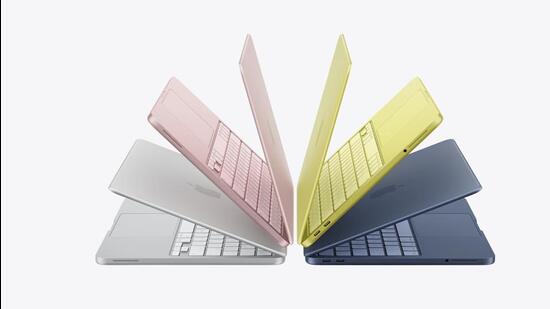
Tech Tonic | Apple MacBook Neo is something Windows PCs may never be

Buying behaviour in this segment is rarely governed by processor name preferences.


Parting with 69,900 now gets you a new Apple MacBook Neo, which benchmark scores suggest is closer to the M4 chip in the MacBook Air than the M1 chip in the same MacBook Air form factor. For a much lesser monetary outlay, mind you. That is exactly what Apple intended to achieve by making an A18 Pro chip, previously used in the iPhone, the beating heart of its latest laptop. As someone who started out many, many years ago on an Intel chip-powered MacBook Pro with a spinning hard drive, I have a fair view of how far an ‘iPhone chip” has come. A paradigm shift in the world of laptops.

Buying behaviour in this segment is rarely governed by processor name preferences.

Here’s a gist of the benchmark scores I mentioned earlier — the Geekbench 6 tests peg single-core performance at 3461 (MacBook Neo) versus 3696 (MacBook Air with M4) and 2346 (MacBook Air with M1), multi-core performance at 8668 (MacBook Neo) as against 14730 (MacBook Air with M4) and 8342 (MacBook Air with M1). While you wouldn’t find me obsessing over synthetic benchmark scores as a barometer of any level of performance (or a lack of it), this illustration was important to give you a placement of where this chip sits alongside the M-series hierarchy.

That really is the main story here, shooting down any arguments about “just 8GB memory” from the very outset. Truth be told, most of those memory arguments come from Windows laptop users. But macOS and Apple Silicon operate differently. Real-world usage—including my own multi-year experience with an M1 MacBook Air paired with 8GB—demonstrates zero performance degradation for typical workflows, including web browsing with dozens of tabs, document editing, media consumption, light photo editing, and even moderate video work.

The unified memory architecture, where RAM is shared seamlessly between the CPU and GPU on the same chip, eliminates the inefficiencies inherent in traditional PC memory configurations. What Apple has done is prove that efficient architecture matters more than raw specifications.

Do not for a second imagine the A18 Pro in the MacBook Neo is the same as the chip powering the iPhone 16 Pro. The iPhone version uses a 6-core CPU and a 6-core GPU, while the MacBook Neo has a 6-core CPU and a 5-core GPU. Apple says the MacBook Neo with A18 Pro is up to 50 percent faster for everyday tasks than the bestselling PC with the latest shipping Intel Core Ultra 5 chips.

At this point, let us take stock of what the Windows PC ecosystem gets you for close to 69,900. There’s an Acer Aspire 7 with an Intel Core i5-13420H, 16GB memory, and a 512GB SSD priced at 69,990. There’s a Lenovo IdeaPad Slim 5 with an AMD Ryzen AI 5 330 chip, 16GB of memory, and 512GB of storage. And there’s an Asus Vivobook 15 with an AMD Ryzen 7 170, 16GB memory, and 512GB storage. All these are competent machines on paper, but largely forgettable laptops. Mostly nondescript design and specs purely designed to match the competition’s.

All of this matters because consumer buying behaviour in this segment is rarely governed by processor name preferences or a search for the most cores per rupee. They are looking for a machine that feels modern, travels well, lasts long, looks good in a meeting, doesn’t have annoying fan noise, shouldn’t have mediocre battery life, and the software should work smoothly. For first-time laptop buyers, for students, for frequent travellers, or even for those looking for a second machine that is lighter and easier to live with, the MacBook Neo will appear not just relevant but aspirational.

They serve as delivery vehicles for Microsoft’s Windows 11, an operating system that continues to frustrate users even after years, with inconsistent performance, mandatory updates that tend to arrive at inopportune moments, and broader system stability issues often stemming from broken updates shipped by Microsoft. It simply doesn’t feel as refined as macOS, and even if a change were to get underway today, it’ll take years to get to the same level.

Apple understands something Windows OEMs perpetually miss — first impressions matter enormously. The one thing Apple has done very well with the MacBook Neo is optics, the first perception. Silver, Blush, Citrus, and Indigo, with their metal chassis design, will have a lot more people walk into physical stores to check out what’s essentially a laptop. I foresee a lot of potential buyers who need to upgrade an existing laptop, buy their first laptop, or even a second laptop geared more for travel, will consider the MacBook Neo.

The MacBook Neo’s significance extends beyond its individual appeal. It establishes a new performance and experiential baseline for mid-range laptops—one that Windows PC manufacturers have never approached, let alone matched. The fact that the listed benchmark scores confirm the performance we all expected from an iterative A18 Pro chip is certainly much higher than any Windows PC maker has managed till now. Intel’s chips aren’t the problem. It is a combination of Windows 11, unoptimized firmware, and weak components.

When what was till now known as an iPhone chip can deliver laptop-class performance at this price point, with this build quality, and with this software ecosystem integration, it immediately exposes the fundamental inadequacies of the Windows PC business model—hardware curated for the weakest component in the chain, running generic software, and racing to the bottom on price while sacrificing everything that makes computing delightful. Apple has once again demonstrated that the future of computing isn’t about the spec sheet. It’s about how well the hardware and the OS come together, efficiency, and stability.

The MacBook Neo isn’t just shaping up to be a good laptop at a good price. It’s a laptop that Windows PCs, constrained by architectural legacy and ecosystem fragmentation, will truly struggle to compete with—no matter what their spec sheets claim. Apple has exposed Windows PCs with a clarity of purpose. And being a Copilot PC or an AI PC is certainly not it.

Vishal Mathur is the Technology Editor at HT. Tech Tonic is a weekly column that looks at the impact of personal technology on the way we live, and vice versa. The views expressed are personal.


Source link

Leave a Reply

Your email address will not be published. Required fields are marked *