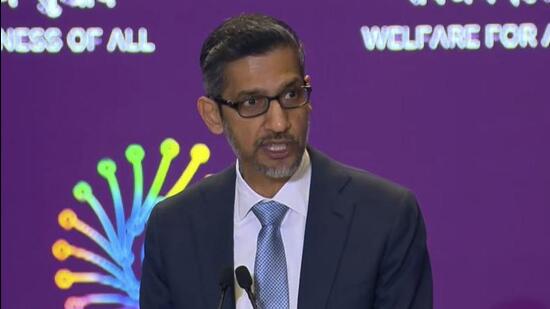
Sundar Pichai, CEO of Google, drew a virtual timeline between his time as a student travelling the Coromandel Express, to investing $15 billion on infrastructure in India including an AI hub in Visakhapatnam, and framed India not as just a market for AI but as a co-architect of its infrastructure, science and workforce future. In his keynote at the India AI Impact Summit 2026, Pichai noted Google’s latest initiatives including a new international subsea cable as part of the America-India Connect Subsea Cable, as well as Google DeepMind partnership to advance AI-powered science and education in the country.
“The progress shows what’s possible when humanity dreams big, and no technology has me dreaming bigger than AI. It is the biggest platform shift of a lifetime. We are on the cusp of hyper progress and new discoveries that can help emerging economies leapfrog legacy gaps,” Pichai said, in his keynote. But that came with a warning too. “That outcome is neither guaranteed nor automatic. To build AI that is truly helpful for everyone, we must pursue it boldly, approach it responsibly, and work through this defining moment together,” he says. Pichai noted the efforts of Sir Demis Hassabis at Google DeepMind to develop the AlphaFold 4, an advanced AI system for predicting protein structures at speed and with accuracy. “This breakthrough didn’t just win a Nobel Prize. It compressed decades of research into a database that is now open to the world,” Pichai noted.
Also Read: Google to establish full-stack AI hub in Vizag as part of $15-billion India push: Sundar Pichai
Official figures suggest more than 30,00,000 researchers in more than 190 countries are using it to develop malaria vaccines, fight antibiotic resistance, and more. Pichai wants to keep asking bold questions from scientific staff worldwide, spanning from cataloguing DNA disease markers to building AI agents that act as true partners in the scientific method. “We must be bold in tackling problems in regions that have lacked access to technology,” he states in the mission.
Google, Pichai noted, worked with farmers to protect their livelihoods in the monsoon season last year, by sending forecasts to a million farmers, drawing insights from their NeuralGCM model — this is focused on fast and accurate climate modelling and predictions. He also noted efforts in El Salvador with the government, to provide AI diagnosis and treatment to thousands of citizens who couldn’t access a doctor.
“We cannot allow the digital divide to become an AI divide. That means investing in compute infrastructure and connectivity. I mentioned our Vizag investment, and we have others in Thailand, Malaysia, and more,” Pichai warns. He again underlines the importance of the America-India Connect Subsea Cable, alongside a broader network of subsea cables for global connectivity. “Responsibility also means navigating profound economic hardships,” he notes.
Pichai called on companies of all sizes to think about ways to bring AI to public services and therefore improve the lives of citizens. “We have an opportunity to improve lives at a once in a generation scale,” as he calls it.