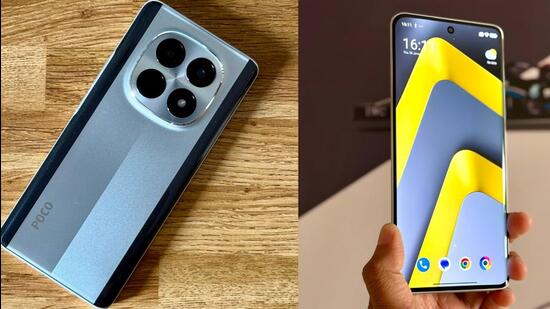
For Poco, this year must mean more. This may, in the bigger picture be a sub-brand within the larger Xiaomi footprint in the country, but Poco must be seen pulling its weight in a year that’ll see the smartphone space deal with external challenges as well — one of them being more expensive components, that’d also drive up phone prices, and therefore revisiting value proposition. If I am to use an automotive analogy, the Maruti Suzuki India strategy, a product portfolio may look like its cannibalising each other (at least from the outside), but works beautifully to provide multiple choices within the same price band for consumers. Hence, market share. With Realme also expected to return as an Oppo group sub-brand, this has to work. The Poco M8 is the first piece in a new puzzle that has to succeed from the get go, if Xiaomi and Poco have to replicate that with Redmi and Poco synergies.
The fact that the Poco M8 (starting ₹18,999; with some launch discounts) is priced lower than its newest sibling, the Xiaomi Redmi Note 15 (that’s ₹22,999 onwards), makes this for a fantastic proposition . There are some similarities as far as the specs go, but largely, there is enough difference to deploy the benefits of a distinct personality. You, as a consumer, have a choice of this or that, within the same family. Three memory and storage combinations go on sale, and I would strongly recommend the 8GB+256GB spec for most performance headroom as time passes. As interesting as the pricing is, you’d probably hold the Poco M8 once and realise the really slim 7.35mm profile is the real visual highlight. Phones are getting thinner, as we’ve seen with the Motorola Edge 70 and the Redmi Note 15 already. To have this design trend trickle down the price bands as substantially as we bear witness, is good news for consumers.
The Poco M8 Qualcomm’s Snapdragon 6 Gen3 chip, and the version tested is the top tier 8GB+256GB spec. Honestly? This setup never felt like it was struggling. Apps loaded smoothly, switching between them was seamless, and multitasking just worked without any annoying stutters or lag. Certainly a big step forward compared with the M7 and the Snapdragon 4 Gen 2 chip, and it shows when loading apps and just how responsive everything felt. The smooth transitions, snappy response to app switching and a general level of smoothness remains the foundation, which is a good starting point for anyone looking at the Poco M8 as a primary phone or even a second, task focused phone.
Now, if you’re really into heavy gaming, you might bump up against some theoretical limits with frame rates on visually demanding games. But let’s be real — for most people using the Poco M8 as their everyday phone, there is very little to complain about. And here’s that proverbial cherry on top which I always search for — this phone stays impressively cool even when you’re really pushing it.
The other big reason everything feels so snappy is Xiaomi’s HyperOS 2. They’ll probably roll out HyperOS 3 in the next few months, which should make things even better. HyperOS is super smooth, doesn’t take up much space, and honestly looks pretty polished. The one thing that hasn’t changed is all the preloaded apps you’ll find on the Poco M8 — but to be fair, most of its competitors do the same thing, except maybe the Lava Agni 4. PhonePe’s Indus App Store is the Google Play Store alternative, if you’re searching for one.
Battery life is impressive, with the Poco M8 keeping parity with the Redmi sibling. Two things to note here. First, squeezing in a 5520mAh battery into a phone this slim is no mean feat and secondly, using the more efficient silicon carbon (Si/C) composition means the real-world use you’re looking at is easily a day and a half on a single charge translating to roughly 6 hours and a bit more of screen time.
There’s an important distinction on the camera front, which is perhaps indicative of why the pricing hierarchy between the Poco M8 and the Xiaomi Redmi Note 15 is how it is finally panning out. Xiaomi has kept it simple — the Redmi Note 15 becomes the world’s first phone with Samsung’s ISOCELL HM9 sensor, a 108-megapixel hardware. The Poco M8 gets a 50-megapixel main wide sensor, the Light Fusion 800 developed by Xiaomi. The weakness will be the secondary 2-megapixel sensor (it was 8-megapixel in the Redmi), and at the risk of being repetitive, I’ll re-emphasise the need to stick to the primary sensor for all photos. Impressive photos on that front, underlined by lively colours, good contrast and a lot of detail when zooming in. AI processing does become apparent at higher zoom levels, in an attempt to keep details, but that intervention doesn’t seem heavy handed.
The Poco M8 definitely makes a compelling case for itself, and perhaps more importantly, validates Xiaomi’s strategy of having Poco and Redmi play in the same price bands without worrying about stepping on each other’s toes. At ₹18,999, it’s not trying to be everything to everyone, the M7 has picked its battles wisely. The slimness, long battery life, stable performance that doesn’t stutter when it matters, and a primary camera that punches well above expectation, all add up to a phone that knows exactly what it is. Sure, you’re not getting the Redmi Note 15’s flashy 108-megapixel camera or some of the feature bulk that comes with spending a few thousand rupees more, but here’s the thing — people generally don’t miss what they don’t need.
If Poco’s plan is to give consumers a reason to choose this over similarly priced competition while keeping the Redmi option open for those who want a bit more, they’ve nailed the brief. The M8 isn’t just a good start to 2026 for Poco; it’s proof that the brand’s still got what it takes to think clearly.