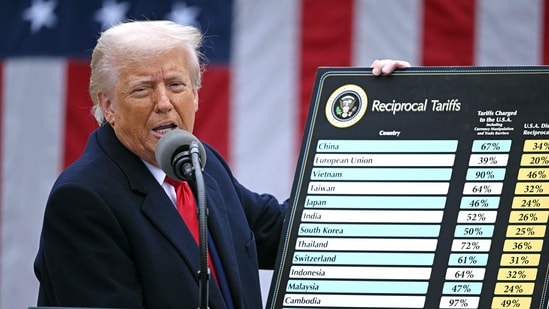
Tariff refunds for companies that paid tens of billions were left unresolved by the Supreme Court, which ruled on Friday that President Donald Trump didn’t have legal authority to impose the duties under an emergency law.
The ruling will kick off what can be a prolonged battle for importers and retailers to try to recoup as much as $170 billion in tariffs they have already paid to the US government.
Among the major questions left unanswered for US importers are the prospects and the process for recouping the money the government collected over the past year under the International Emergency Economic Powers Act. The vote was 6-3 against the Trump administration, with Justice Brett Kavanaugh writing in dissent.
“The court says nothing today about whether, and if so how, the government should go about returning the billions of dollars that it has collected from importers,” Kavanaugh wrote. “But that process is likely to be a ‘mess,’ as was acknowledged” during the court’s oral arguments in November.
US Customs and Border Protection so far has collected an estimated $170 billion in tariffs imposed by Trump using the International Emergency Economic Powers Act, the law at the center of the case, as of 14 December.
The court ruled that using IEEPA to impose tariffs wasn’t lawful, but the justices didn’t address whether importers are entitled to refunds, leaving it to a lower court to sort out those issues. The litigation will return to the US Court of International Trade for the next round of legal wrangling.
While waiting for the justices to rule, more than 1,500 companies have filed their own tariff lawsuits in the trade court to put themselves in line for tariff refunds, according to a Bloomberg analysis.
The trade court in recent months has pressed the Justice Department for at least a hint of how it plans to handle the refund issue if it lost at the Supreme Court.
In written submissions, government lawyers have said that the administration won’t fight the court’s authority to order officials to recalculate tariffs, but left open the possibility that it might try to limit which importers are eligible.
The US trade court has experience managing a mass refund process. After the Supreme Court struck down a harbour maintenance tax on exporters in 1998, the court created a claims process. That fight involved approximately 4,000 cases and $750 million in taxes paid, according to court records and reports at the time.
The scale of Trump’s contested tariffs is far larger—by the end of 2025, the govt told the trade court that more than 300,000 importers had paid the contested tariffs so far.
“For importers, it means that there is a refund potential,” said Ted Murphy, a partner at Sidley Austin LLP. What the refund process will be and how long it will take “is a big issue,” he added.
The 1977 emergency powers law doesn’t mention tariffs, and had never before been used to impose the duties. Companies are still subject to other tariff measures.
With nearly $774 billion cash on hand, the US Treasury has more than enough cash on hand to return IEEPA revenue if ordered to, according to Secretary Scott Bessent, though that could happen over weeks or months and “may take over a year,” he said in a Reuters interview last week.
Bessent also suggested that refunds may amount to a “corporate boondoggle” for companies that passed on the tariff burden. “Costco, who’s suing the U.S. government, are they going to give the money back to their clients?”
Some industries stand to receive a bigger share of the duties collected under IEEPA as of Dec. 14. According to an analysis from Bloomberg Economics, textiles, toys and food and beverages industries top the list of industries that import final goods, including wholesalers, retailers and manufacturers with factories outside the US. For those that import tariff-hit components needed to manufacture goods domestically, it’s machinery, electronics and autos that stand out.
“The construction industry—from its purchases of electrical equipment and appliances, possibly to be fitted in new buildings—also appears particularly exposed,” BE’s Nicole Gorton-Caratelli and Chris Kennedy wrote.
Firm size will also play a role in who sees the biggest refunds, they said. Because any refunds would go to the importers-of-record who paid the duties, larger companies that import goods themselves are more likely to receive refunds directly than smaller firms that buy from wholesale importers.
Customs brokers and lawyers are advising companies that the administration could make it difficult to obtain refunds, potentially requiring proof that they didn’t pass the cost on, or demanding extensive paperwork for each shipment. For now, importers are being told to at least have their import records in order for a refund push, even if they don’t know what it’ll look like yet.
CBP recently announced that starting 6 February, the US Treasury would no longer issue CBP refunds via paper check, instead moving to electronic payments.