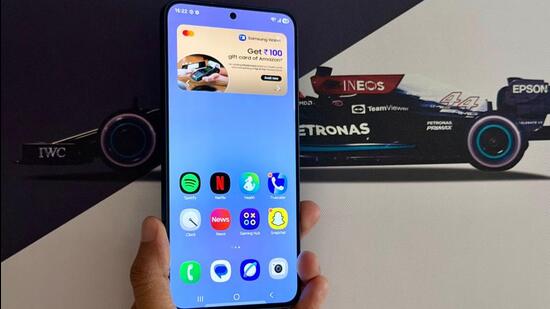
There comes a moment in a journey, when it is imperative to grow up. To evolve. To take the next step. It surely mustn’t have been easy for Samsung to retrain its guns in the newly reconfigured upper-mid-range Android smartphone price band, a where rivals including Xiaomi, OnePlus and Vivo have done well enough in recent years (also because of comparatively more bets, a strategy that gives better chances at finding success). Samsung’s Galaxy A56, launched early last year, has been succeeded right on cue with the Galaxy A57. More than a generational step forward, irrespective of what the naming or spec sheet comparisons may lead you to believe. At the core is the software, One UI 8.5 and everything it brings to the table.
Of course, in that evolution, prices have also seen an uptick. While the Galaxy A56 launched in India with a tag of ₹41,999 onwards, the Galaxy A57 is priced ₹56,999 onwards. There’s generational inflation, as well as the spectre of more expensive storage and memory hardware (you can thank the AI bros for that), which Samsung has to calculate for. The broad competition landscape for the Galaxy A57 is in itself a unique challenge. The new OnePlus Nord 6, as well as the Nothing Phone (4a) Pro, a significantly price corrected OnePlus 13R and the Google Pixel 10a will all be in the reckoning.
There is a definite step up with aesthetics. The mix of glass and metal, in a much slimmer and lighter (almost 20 grams shaved off compared with the Galaxy A56), is right down the alternate flagship expectation alley. But then again, the ring around the camera island feels a bit out of place when aspirations aren’t exactly at par with other A-series phones. That observation aside, the Galaxy A57 is fantastic to hold and use, with the slimness noticeable more often than not. The finer details are an evolution instead of a ground-up redesign, but it’s still a fair step forward nonetheless.
The display upgrade isn’t on the core specs, because it’s the same 6.7-inch Super AMOLED display with 120Hz refresh rate, as its predecessor. However, Samsung has significantly slimmed down the bezels, and that provides the biggest experience refresh. It all feels significantly better, and next in line should be slimming the chin part of the bezel further.
I’d pointed out the importance of One UI 8.5 earlier as a key to the overall progress the Galaxy A57 has made with performance. It is good to see Samsung putting forward the efforts of their in-house Exynos chip development, with a lot of confidence. The Exynos 1680 is certainly powerful enough for the aspirations that the Galaxy A57 users would have, and that is further aided by significant improvements that One UI 8.5 brings to the table in terms of smoothness, refinement and overall fluidity.
The Galaxy A57 remains very responsive even under a fair multitasking load, and there is very little experience gap to be felt between this and a typical Android flagship phone. As a primary phone, you’d not be complaining about any stutters or dropped frames. That said, gaming will have some level of performance ceiling for the more visually intensive titles, and don’t expect this to hold 60fps for long. There’s a reason for that—certain amount of heating perceptibly filters through to the back of the phone at times, but not always (the Galaxy A57 has a 13% larger vapour cooling chamber). That will impact performance when it happens.
While the triple camera setup is a 50-megapixel wide, a 12-megapixel ultra wide and a 5-megapixel macro sensor, one would recommend sticking to the main wide sensor for photos as much as possible, particularly if you wish to run photos through Lightroom or Google Photos edits. There is a certain uptick in image processing as it handles complex lighting scenarios fairly well. Colours are really likeable and there is a fair amount of headroom available if you wish to do some gentle edits. Samsung’s approach to image processing does involve a fair amount of artificial intelligence (AI), but it’s only serving to accentuate realism, and not overbearing.
Speaking of which, unlike Samsung’s flagships, the Galaxy A57 doesn’t get the Galaxy AI suite but instead something called Awesome Intelligence. It’s a collective nonetheless, including photography focused object eraser and Edit Suggestions, as well as voice transcriptions in the recorder app, or AI Select to extract text from a photo. Mileage will vary, because though Samsung would have tried to refine this as close as possible to Galaxy AI, the very fact that it’s a different package suggests there won’t be parity at all times.
It is also important to point out a few things in the Galaxy A57 proposition. These aren’t defining an otherwise impressive smartphone, but more a matter of approach.
The intent to push a number of ‘recommended apps’ that download when setting up the phone (this includes Samsung’s Smart Tutor, Galaxy Wearable, Samsung News, Samsung Members), needs to be toned down. These can remain optional within Samsung’s own App Store. Nevertheless, most of these are to be found (you’ll notice News, Members, Gaming Hub and Wearable for sure) in your app drawer, irrespective of whether you uncheck the list at this stage or not.
Secondly, there is something called the Unity experience that prompts you during the setup stage, and indicates an intent to install new apps and also make recommendations. I wouldn’t want to lose control of my phone’s experience that easily, and while easy to miss, I’d recommend looking for that X at the top right of the screen to exit before ticking the checkbox and tapping on continue. Funnily enough, there seems to be no reference of this service later in the phone—either in Settings or as an app.
It is perhaps a losing battle to point out the habit of pre-installing Meta’s Facebook and Instagram apps, as well as Snap, Spotify and Netflix. And perhaps even having a widget placed on the Home Screen by default, which is essentially a billboard for scrolling advertisements. It is brave and right for Samsung to harbour alternative flagship phone positioning with the Galaxy A57, and it has done most things right with the hardware and software optimisations. But these little things need to be ironed out too.