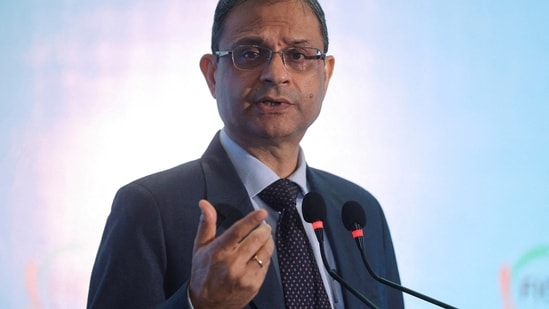
The Reserve Bank of India’s last repo rate decision of the year is proving to be one of its trickiest, with the Monetary Policy Committee members having to weigh India’s record-low inflation against a plunging rupee and 8%-plus GDP growth rate.
A majority of the 44 economists surveyed by Bloomberg expect the RBI to cut its benchmark repurchase rate by a quarter point to 5.25% on Friday, given inflation is well below the 4% target. But with the economy expanding at a rapid clip and the rupee dropping to a record low below 90 to the dollar, there are plenty of reasons for the RBI to pause as well—as forecast by Citigroup Inc., Standard Charted Plc and State Bank of India.
After keeping the repo rate unchanged in the past two policy meetings, RBI Governor Sanjay Malhotra opened the door to rate cuts last month, saying there was “definitely scope” for them to come down. Since then, however, official data showed that the Indian economy is proving resilient in the face of 50% US tariffs, while the rupee has plummeted.
As a result, the expectations of an RBI repo rate cut “appear to have faded,” and the central bank seems to be entering a phase of prolonged pause, said Soumya Kanti Ghosh, chief economic adviser at the State Bank of India and a member of the Prime Minister’s Economic Advisory Council.
The rupee’s slide since the last MPC meeting is making Friday’s decision more difficult to predict. The RBI has gone from vigorous defence of the currency to allowing it to breach 90 to the dollar this week amid uncertainty about a India-US trade deal. That makes this week’s policy decision a “nail biter”, Nomura Holdings economists wrote in a note.
Some analysts like Kunal Sodhani, head of treasury at Shinhan Bank in Mumbai, argue that an interest rate cut would potentially add further pressure on the currency and may prompt the RBI to keep interest rates steady. Others like Pranjul Bhandari at HSBC Plc, say a gradually weakening rupee is “the best shock absorber for high tariffs.”
Here are some of the key things to watch out for in Malhotra’s televised speech at 10 am local time on Friday:
Growth, Inflation Forecasts
The RBI will likely revise both its inflation and growth forecasts for the current financial year through March, economists said.
Inflation projections may be lowered to about 1.8%-2% to reflect softer-than-expected prints recently, according to Indranil Pan, an economist at Yes Bank Ltd. Inflation slid to 0.25% in October, the lowest since the current series began in 2012. The RBI has consistently overestimated inflation this year, with its projections well above market consensus as well, putting its forecasting model under scrutiny. GDP forecasts may be raised by around 20-40 basis points from the current 6.8% estimate, Pan said.
Rupee’s Plunge
The rupee is Asia’s worst performer this year, having borne the brunt of the punitive US tariffs and equity outflows. Traders will watch for the governor’s comments on the currency and any steps to boost inflows.
The RBI governor may call for calm and stress that the central bank is not opposed to market forces and acts only to curb volatility, said Dhiraj Nim, a currency strategist at Australia and New Zealand Banking Group in Mumbai. Malhotra is also likely to signal that foreign exchange reserves are adequate to protect the currency.
Bonds and Liquidity
The bond market is pricing in about 19 basis points of further easing over the next two meetings in December and February, according to Nomura.
“Given current pricing and market positioning, we believe risks are skewed towards higher front-end rates this week and following the RBI decision,” said Nathan Sribalasundaram, a rates strategist at Nomura. “Either way, we expect the market to move towards the view that the easing cycle is over.”
Yields, specially at the long end, have risen in recent weeks amid weak demand from long-term investors such as insurance and pension funds. The yield on the 30-year paper is up over 25 basis points since mid-October, while the 10-year yield has risen about 5 basis points.
Traders are also watching for comments on liquidity and potential open market bond purchases. Banking system liquidity has moderated notably since September, thanks to sizable currency intervention by the RBI.
Liquidity could fall as low as 0.2%-0.3% of net deposits by end-March in the absence of any new primary infusion by the RBI, said Madhavi Arora, lead economist at Emkay Global Financial Services Ltd.
The RBI may need to inject 2 trillion rupees of liquidity, primarily via OMO purchases over the rest of the fiscal year, she said.