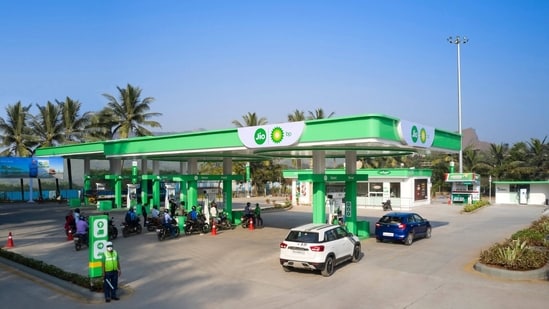
Reliance Industries Ltd. has capped fuel purchases across its petrol pumps as the Iran war continues to choke off supplies despite a tentative ceasefire.
The country’s largest private-sector oil refiner is restricting individual purchases to ₹1,000 per visit at fuel stations it operates with partner BP Plc, according to people familiar with the matter. The joint venture has more than 2,000 fuel pumps across the country.
While the company has issued no formal directive, operators of Jio-BP petrol pumps have begun enforcing the caps to curb panic buying and prevent its stations from running dry as demand surges, the people said, asking not to be named because the information isn’t public.
The rationing comes as India, the world’s third-largest oil consumer, grapples with the fallout of the weeks-long near-closure of the Strait of Hormuz—a vital lane for global shipments of crude, petroleum and natural gas. While a fragile US-Iran truce is in place, tanker traffic remains disrupted and insurers continue to classify the area as high-risk.
A spokesperson for Reliance Industries said there’s no directive restricting how much fuel customers can purchase, while acknowledging that such instances may have been the result of a “localised” situation.
Ripple Effect
While Reliance runs only 2% of the more than 102,000 fuel stations in India, it’s the first operator to go beyond price hikes to rationing supply, reflecting an escalation of the uncertainty rippling through India’s energy market.
State-run companies—Indian Oil Corp. Ltd., Bharat Petroleum Corp. Ltd. and Hindustan Petroleum Corp. Ltd.—that control the vast majority of fuel stations have not officially announced price hikes or purchase caps, but drivers have anecdotally reported similar ₹1,000 limits being enforced at some pumps.
Nayara Energy, another private-sector fuel retailer, raised diesel and petrol prices last month in an effort to narrow losses on retail sales and temper consumption, local media reported. The company, with about 7% share of the market, is partly owned by Russian energy giant Rosneft PJSC.
India imports more than 90% of its oil requirements, leaving it particularly vulnerable to disruptions in the Persian Gulf. Oil prices have remained volatile as traders weighed the duration of the Hormuz blockade against global inventories and the risk that the ceasefire could falter.
Brent crude extended gains in early Asian trade Friday after Saudi Arabia said its production capacity has been reduced due to attacks on energy infrastructure.
State-owned refiners had last cut pump prices in March 2024 under government intervention. Fuel retailers are currently losing ₹24.40 on every litre of gasoline sold and ₹104.99 per litre on diesel, the federal oil ministry said in a post on X on 1 April.