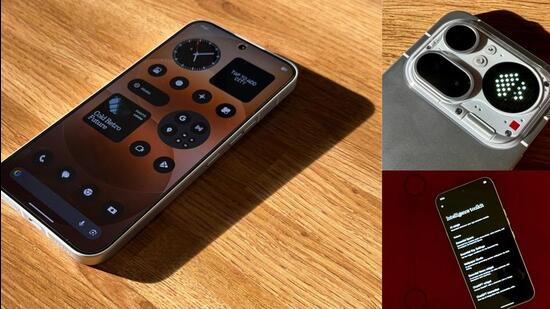
It had been a while, and the design language is finally changing. Not that the transparent, industrial and retro-futuristic aesthetic on Nothing’s phones till now was looking dated, but this switch to a metal unibody indicates an intent to refresh, to evolve, to appeal across a wider audience. For the UK based tech company, the Nothing Phone (4a) Pro becomes their first phone with an aluminium unibody design, though frame and camera surrounds have previously been dabbled with to good effect. There is still familiarity to the broader Nothing experience, relevant for existing users who’d like to upgrade to a newer phone.
The Nothing Phone (4a) Pro gives you three spec choices and three colour options, but it is worth noting that the troika is packed rather closely in terms of the pricing — ₹39,999 for the 8GB+128GB spec, ₹42,999 for 8GB+256GB, and ₹45,999 for 12GB+256GB. For a potential buyer, stepping up becomes easier. There may have been a case for some more colour options, beyond the rather conventional black and silver shades, alongside a pink that looks more sand pink, just in case you’re interested. This is their thinnest phone till now, at 7.95mm — though the Phone (3a) Pro from last year wasn’t much thicker at 8.4mm. But well, even slightest shaving off does matter when this slips into your trouser pocket.
The aluminium unibody, which Nothing says is aircraft-grade, looks good and feels equally as good to hold. The camera island with the Glyph Matrix that was first seen on the Phone (3) genuinely is well laid out. The Glyph Matrix is larger in comparison, and brighter as well — Nothing rates this at 3,000 nits with 137 mini-LEDs. The utility for this is with notifications, such as customisable symbols for calls from important contacts, volume indicator, battery level guidance and so on. Everything in terms of ergonomics is in place, and falls to hand. The only learning curve is the placement and the exact same design of the volume up, volume down and power key, which is easy to mix up if you aren’t looking (or the muscle memory isn’t locked in yet).
The Nothing Phone (4a) Pro grows up in terms of screen size too. It is now a 6.83-inch AMOLED display with a much higher 2800×1260 pixel resolution — compared with the Nothing Phone (3a) Pro’s 6.77-inch AMOLED with the 2392×1080 resolution. Signifiant step forward with the protective layer as well, now a Corning Gorilla Glass 7i that current generation phones are adopting fast. This is visually a really bright screen, also compared with its elder sibling, and to my eyes the colours look a bit more vibrant too. There is definite improvement with Nothing’s OS theming too, in terms of legibility and contrast. That said, I’d prefer the dark mode to be darker still because there are times when it feels more akin to a darker shade of grey, and not entirely black.
One could have opinions about Nothing’s choice of using the Qualcomm Snapdragon 7 Gen 4 chip for the Phone (4a) Pro, at this price. The looming shadow of the Xiaomi Redmi Note 15 Pro+ 5G (prices start ₹37,999 for 8GB+256GB) which is powered by the Snapdragon 7s Gen 4, does lend credence to Nothing’s choice. Between the two, albeit to degrees varying between mildly and incrementally, the Snapdragon 7 Gen 4 has a higher frequency GPU, improved memory bandwidth and faster CPU. However, if you are considering the highest spec version of the Nothing Phone (4a) Pro, you may well consider the entry-spec proposition of the OnePlus 15R (that’s 12GB_256GB) for ₹47,999 with a flagship Snapdragon 8 Gen 5 chip. Preferences galore.
That said, performance isn’t a problem for the Nothing Phone (4a) Pro. The combination of the faster UFS 3.1 storage standard, a better memory type, as well as Nothing’s efforts with a larger vapor chamber, all come together well enough to deliver smooth usability as an everyday phone. Results do show, because apart from extensive camera usage, the back doesn’t really heat up — not even under multitasking load.
I’m not entirely sure the camera is fully up to the mark, as Nothing may have themselves envisioned with the Phone (4a) Pro. It works well enough to deliver vibrant, detailed and easy on the eye photos for the most part, but will often find itself stumbling in slightly complex lighting scenarios. Such as, if you aim the camera to take a photo and it is looking at a light source somewhere in the frame, exposure will be compromised and there will be a flare perceptible on a certain part of the photo. The positive trend I’ve always seen with Nothing is that they will actively listen to feedback and subsequent software updates iron these niggles almost completely.
This is after all a very capable camera system with a 50-megapixel Sony LYT-700 wide sensor, a 50-megapixel telephoto camera and an 8-megapixel ultra wide camera. The latter is perhaps the weakest link in the chain, and you’d be better off sticking to the main camera for zoom-in requirements as well (the 2x lossless in-sensor, 3.5x optical, and 7x lossless) help in that regard. The wide and the telephoto both have optical image stabilisation (OIS) and the main camera does have a lot of potential with the 1/1.56-inch sensor which is 24% bigger than the predecessor’s camera. The positive for folks such as myself is, Nothing’s TrueLens Engine 4 image processing makes use of AI as minimally as it should, for noise reduction and for Night Mode photos — but it doesn’t alter the detailing, tonality or the sense of place, as some of its rivals tend to do.
The Nothing Phone (4a) Pro has a much larger battery than its predecessor, at least in the Indian version — it is now 5,400mAh compared with 5,000mAh in last year’s phone. The genuineness of the upgrades is underlined by the continuity of 50-watt wired charging, which should juice up an almost drained battery to 50% in about 20 minutes or a bit more. In our experience, this easily lasts a day and a half under a typical primary phone workload interspersed with some camera usage, but without gaming. I often say this, you’ll still charge your phone every night before reaching for the pillow, or in the morning before heading out for work, but it’ll be a much shorter journey to 100% when the Nothing Phone (4a) Pro’s intrinsic frugality is very much a reality.
More than anything else, the Nothing Phone (4a) Pro is perhaps the biggest hint yet of a brand that’s approach product lines a lot more confidently. The design has greater conviction, just the right upgrades on the spec sheet have had the desired impact on performance and consistency, while the battery stamina adds meaningful everyday reassurance. The camera still leaves some room for improvement, particularly before software updates inevitably smoothen those edges. This is perhaps Nothing’s most complete expression yet of a phone that wants to look different, feel premium, and still deliver value as a serious daily driver.