Pernod Ricard India has opened a new front in its premiumisation journey with the launch of Seagram’s Xclamation, a unified five-spirit portfolio comprising whisky, brandy, vodka, rum and gin, all priced at the same premium entry level. This multi-category, single-brand launch is a global first for the company. In Haryana, a 750 ml bottle will be priced at about ₹700.
The idea came from a clear white space between Royal Stag and Blenders Pride, where consumers were eager to trade up but found limited choice.
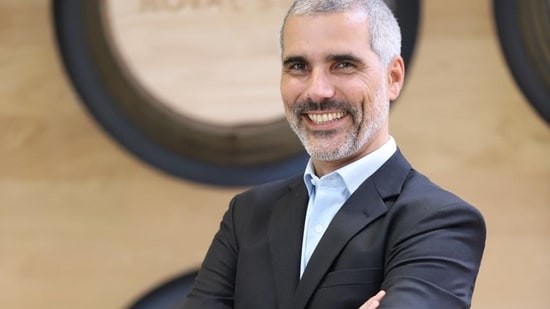
“Consumers today want to move across categories without compromising on quality or lifestyle cues. Xclamation allows them to do that with one brand,” said Jean Touboul, chief executive officer at Pernod Ricard India.
Xclamation will be rolled out in phases, starting with Haryana, Uttar Pradesh, Goa, Daman and Telangana by the end of this year.
As part of its broader India strategy, the company—which is setting up a malt distillery in Nagpur—sees continued momentum in premium spirits as volumes shift upward through the market pyramid. In this interview, he discusses the consumer insights behind Xclamation, Jameson’s remarkable surge in India, and the company’s broader premiumisation strategy.
What were the consumer insights behind the launch of Xclamation?
The first one is repertoire drinking. Traditionally, a consumer 20 years ago was drinking only whisky. Then it gradually became 1.1 spirits. Now, because consumption occasions are expanding, it’s 1.5 or 1.6. So people are drinking different things on different occasions, and this behaviour is growing, including among the female cohort.
The second insight is the appetite for more premium brands. Between Royal Stag and Blenders Pride the price difference is large, and the offering is limited. That’s a sweet spot for consumers who want to trade up but may not be ready to go as high as Blenders Pride.
And another behaviour: when a consumer wanted to switch from whisky to vodka for a certain occasion, the available price points were either much higher or much lower. Much higher, the wallet may not allow it. Much lower, the experience and the lifestyle cues are not the same. We are addressing that gap.
For brandy, South India is a major opportunity. In some states, brandy represents up to 50% of total spirits consumption. Until now, because we addressed only whisky in those markets, we were missing half the opportunity. This portfolio allows us to participate meaningfully. Rum, on the other hand, has strong consumption in North India as well, particularly in winter. With Xclamation, we can now enter these occasions.
Jameson is now among the biggest imported bottled spirits in India, and the country is its second-largest global market. Did you expect this level of success?
I think Indians love the taste of Jameson. The triple distillation brings a smoothness that resonates very well with Indian palates. We also associated the brand with the right festivals and the right consumption moments. But yes, part of the success is not controllable, and we have been positively surprised.
There’s something else: before coming to India, I was in Singapore. The brand we sold most among Indians in Singapore was Jameson. So there is a natural connection between Indian consumers and this liquid. There are still massive opportunities with regular Jameson. We are premiumising with Black Barrel, which uses charred oak and brings a more smoky profile. Soon we will launch Triple Triple, still triple-distilled but triple-cask matured, which adds a layer of flavour on top of the smoothness.
India now contributes 13% of Pernod Ricard’s global revenue and is among your most consistent growth engines. What explains this resilience?
It’s the fundamentals of the economy. GDP growth is high. India has a young population; the number of legal drinking age consumers increases every year. Alcohol is less and less a taboo in society. And premiumisation pushes consumers upward into the segments where we operate. These structural tailwinds explain why we continue to grow.
You recently exited Imperial Blue. How does that fit into your premiumisation strategy?
It’s about resource allocation. Imperial Blue was profitable for us. But these segments at higher price points grow faster and the margins are better. For each case of Exclamation that we sell, we create more value.
Premiumisation is driving value, but core volumes still sit in the affordable segment. How do you view that balance?
Yes, that’s correct. If you look at the total market in India, the segment we play in—from premium entry-levels up to high-end whiskies—is roughly 130 to 135 million cases a year. Below that, in country liqour and more regular-priced segments, the volume is almost twice as large. As disposable income grows, many of those customers naturally aspire to move upward into our categories. So the pyramid does not change overnight, but the base gradually shifts upwards. As affordability improves, more consumers trade up, and that is what drives long term value in this industry.
You launched Longitude 77, your Indian single malt, in December 2023. What’s the next milestone there?
For Longitude 77, the next important step is availability in the CSD channel. Today, CSD accounts for almost half of the Indian single malt volumes in the country. We expect that to happen during the course of 2026.
You’re already bottling 100 Pipers in India. You’ve now begun bottling Ballantine’s Finest here as well. What’s the strategy?
Ballantine’s Finest is partly bottled here depending on the state and the logistics. Sometimes it makes more sense to bottle in India, sometimes at origin. Yes, part of the volume is bottled in Nashik. We are exploring similar opportunities for other brands at similar price points, but it has not been approved internally yet, so I cannot name them.