Opening thoughts. Eternal Ltd.’s Zomato and Amazon Pay have announced something interesting, particularly for those deal hunters who also like to double dip for credit cards or spend rewards.
Zomato says that any food delivery orders done on Zomato and paid for using the linked Amazon Pay Balance, will earn some cashback—in this case, called Zomato Money. Orders placed on weekdays will earn 3% Zomato Money return, while weekend food orders will return 5% as cashback.
The idea here is clear: curate a loyal demographic of users—not just for Amazon but also for Zomato—because if a cashback is sitting in the digital wallet, you are likely to not let that go.
As of now there doesn’t seem to be a per order or per month capping on these returns, but if misused for bulk orders, expect platforms to crack down eventually. If you are able to double-dip Amazon Pay returns by buying vouchers from the American Express Rewards Multiplier or the ICICI iShop platforms, for instance, using credit cards, that’s really good value.
EDITOR’S CORNER: NUUK HOT BLOX
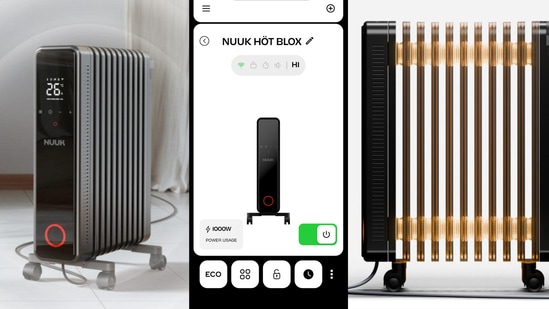
You may be wondering why we are having a conversation about a room heater, an oil-filled radiator to be precise. But this one deserves it. And it is the middle of winter, for those who feel cold.
Nuuk’s foray into the consumer electronics space, in a category that’s very relevant for this season for a large part of the country, sees the larger HOT BLOX smart oil-filled radiator heater alongside a smaller PTC—or positive temperature coefficient ceramic rod-based heater, called HOT BAR.
The 11-fin NUUK HOT BLOX, with a price tag of ₹13,999, puts it squarely in the typical oil-filled radiator price range—some examples being Philips’s new CX3011 (that’s around ₹14,720; also 11 fins) and the Havells Hestio ( ₹12,999 for the 13-fin model).
One of things Nuuk has done rather well is the smartphone app connectivity. The Nuuk app is very easy to set up and navigate, with a full array of controls that replicate the touch keys on the heater itself, as well as the very uniquely designed red-coloured remote with a soft-touch finish.
One of the advantages of the HOT BLOX is its power efficiency, at least in terms of how Nuuk has designed this. The peak consumption is rated at 2,200 Watts, while dynamic management as part of the Eco mode brings this down to about 500 Watts for most intents and purposes.
By default, Nuuk has three presets that you can work with—H1, H2 and H3. For each of these, the app also displays the current power consumption—a rather neat feature to have amid increasing awareness on ways to reduce wastage of electricity and, therefore, money. If you want manual temperature control—between 15 and 35 degrees Celsius—you must switch to the Eco mode.
The effectiveness in a living room hall is pristine, even in Eco mode set at 23 degrees Celsius, something we had the chance to check on one of the coldest evenings in New Delhi. The HOT BLOX managed to warm the living room in about 15 minutes.
Depending on the room size and the modes, you will be able to find the right pick with some experimentation. However, it must be noted that the HOT BLOX does not remember the last used setting if you completely power it down after use. It will resume duties in the highest power H3 mode—something to be careful of if you intend to use the Eco mode more often.
The display also turns off after a while, and while that’s ideal for a bedroom at night, you may not want that in a living room—as of now, there is no option to either change this behaviour, or reduce display illumination levels either.
The HOT BLOX is well-made, and attention to detail is very clear. The use of diathermic oil—a high-quality mineral oil that’s more resistant to chemical oxidation and has high thermal conductivity—should give it definite longevity.
The Acrylonitrile Butadiene Styrene (ABS) thermoplastic polymer used in the chassis is strong, has a nice look to it and also durable enough to be used in car parts as well as LEGO bricks. And it perfectly does what is asked of it—beat the cold, so that a winter sufferer such as yours truly can live a little more comfortably.
ANALYSIS: TOP TECH OF 2025
It’s been a good year all round, as far as genuine gadget evolution is concerned. Smartphones, generationally, were a big leap forward all things considered. So were tablets. And across the board, we saw evolution which adds value and a new set of capabilities to a user’s experience.
Apple iPhone 17 Pro Max
This year’s iPhone 17 Pro series caught the world’s attention with the Cosmic Orange colour (expect many an Android phone next year to discover the visual charm of orange too), but there was a significant step forward in terms of the performance, cameras as well as battery stamina. The combination of the A19 Pro chip and the new vapour cooling system has delivered its magic. As I had noted in the review, the new image processing pipeline means “results are perceptibly better in more complex scenarios”.
Notable mention: Apple iPhone Air
Samsung Galaxy Z Fold7
By the time any other foldable phone makers had the chance to react to the Samsung Galaxy Z Fold7, it was already too late—at least in the context of the 2025 launches. This is the most refined foldable by far, the learnings underlined by how slim Samsung managed to make this. Rest of the specs, and therefore performance, left no cards on the table—a top-of-the-line Snapdragon 8 Elite chip specifically customised for Samsung, the 200-megapixel primary camera, and a new, wider display format which makes the cover screen significantly more usable.
Notable mention: Google Pixel 10 Pro Fold
Xiaomi 15 Ultra
If you ask for my personal recommendation on the top Android camera phone (Quad Camera setup—50 MP wide camera, 50 MP telephoto, 200 MP periscope, and 50 MP ultrawide), it’d be this—the Xiaomi 15 Ultra.
Albeit about to be succeeded in the coming months, it still sets a smartphone photography benchmark with its Leica foundations. The overall tonality of the photos is closest to my preferences, and there’s a likeable warmth to the results. I’m a fan of the design too, with a faux black leather complimenting the silver metal.
Oppo Find X9 Pro
What a massive step up for Oppo’s flagship phones, particularly with the teleconverter kit that I came away extremely impressed with. Within the family, this now holds the Hasselblad optimisation exclusivity, and the results show. As far as that goes, I had noted in my review, the Oppo Find X9 Pro is an “elite photography-focused Android flagship that delivers with cold-hearted swagger”.
Notable mention: OnePlus 15
HP OmniBook 7 Aero
Being reminded of HP’s really compact, ultra-slim and impressive Dragonfly laptops from a few years ago is never a bad thing! HP has done well to realign this OmniBook series on the Dragonfly’s footsteps in more ways than one, making it consumer-focused and in line with AI demands Microsoft places on PC makers (whether consumers agree or not). That’s thanks to the AMD Ryzen AI neural processing unit capable of 50 TOPS, or trillion operations per second. Everything came together well, including a slim design, consistent performance and impressive battery life.
BenQ ScreenBar Pro
This is a personal favourite, for more reasons than one. Simple to set up, incredibly useful, and good for eye health (little do we realise that beforehand). I had noted in the review that the peak illumination is rated at just above 1,000 lux, and this evenly illuminates (with flicker-free lighting, mind you) the work desk and a large area around it too. You’ll be able to adjust colour temperature in an eight-step setting between warm yellow and cold white (2,700K to 6,500K; I prefer it two or three steps from the warmer side) and also an 16-step setting for illumination level. The smartest desk accessory, in a really long time.
Sonos Arc Ultra
There are plain soundbars, and then there are those that rework physics.
Most traditional speakers use a single cone or dome-shaped diaphragm to displace air and produce sound. The diaphragm is typically attached to a voice coil that moves within a magnetic field created by a single magnet—the coil and magnet assembly (that is, the motor) is positioned at the centre of diaphragm, driving its motion.
Sonos’ idea is called Sound Motion. Here, two opposing diaphragms powered by four compact motors (each with dual voice coils) move in opposite directions, canceling mechanical vibrations that could distort sound or rattle the enclosure. “Pristine performance”, as I had noted.
Xiaomi Pad 7
Before this, the idea of a reflection eliminating nano texture display on a tablet meant you spent upwards of ₹1,69,900 on an Apple iPad Pro. For Xiaomi to introduce this with the Pad 7, priced ₹32,999 at launch, tells me two clear things—Xiaomi’s tech prowess to manage the costs as much as they did, and the company’s thinking ‘premium’ as far as its product experience goes (and not just the price tag). Great for reading in particular.
OnePlus 15R
Hear me out. The latest “R” phone from OnePlus has a lot of strong points working in its favour. The first phone powered by Qualcomm’s Snapdragon 8 Gen 5 chip, before others arrive in early 2026. Also, at 7,400mAh, the largest battery capacity ever in a OnePlus phone. And with IP66, IP68, IP69 and IP69K ratings, the highest dust and water resistance capabilities in a OnePlus phone. Overall, as an experience, this simply works.
Noise Master Buds Max
First, when Noise X Bose happened, it was a collaboration that was largely unexpected till it happened. Yet, not exactly unsurprising, considering how I’d regularly pointed out Noise’s trajectory towards a premium portfolio. Secondly, for the results to be this impressive in the first go, creditable. The Noise Master Buds Max launched at ₹9,999 has everything going for it in terms of not just the pristine sound tuning, but also the looks, codec capabilities and noise cancellation effectiveness. To the question whether this partnership had worked, I’d said “resoundingly” in my analysis.