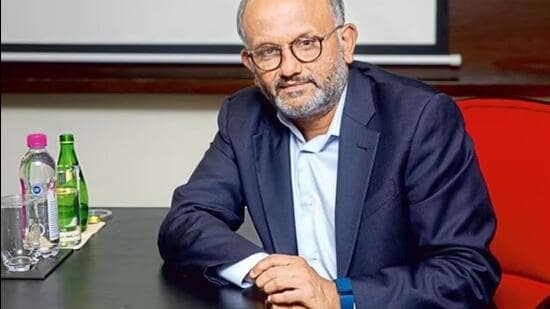
After 18 years at the helm, leading nearly 100 earnings calls in the time and transforming Adobe in more ways than one, CEO Shantanu Narayen is ready to hand over the reins. The longtime CEO has announced his decision to step down, in a memo to employees earlier today, with the onus now on the Board of Directors to identify a successor. Post the transition at a future date, Narayen says he will stay on as Chair of the Board to help the new CEO — he remembers the past, noting Adobe co-founders John Warnock and Chuck Geschke supported him with the transition.
Narayen is confident about Adobe’s journey. “The opportunity in front of us is extraordinary. Together, we are uniquely positioned to lead it — and I remain deeply committed to doing so as we look ahead and prepare to name Adobe’s next CEO. I am more confident than ever that Adobe’s best days are still to come,” he told employees. Narayen joined Adobe in 1998 and became CEO in 2007.
The revenue story is the strongest part of Narayen’s legacy at Adobe. When he took over in late 2007, Adobe closed the final year with $3.16 billion in annual revenue. As he exits, Adobe’s most recent fiscal year clocked at $23.8 billion revenue, with 10.5% year-over-year growth. That’s a roughly 7.5x growth over 18 years, with no meaningful dips.
Narayen inherited the leadership of a company that made excellent software but sold it the old-fashioned way — boxed discs, as a one-time-purchase, and that’s the customer done for a few years. What he saw, and what most of the industry was still figuring out at the time, was that the future belonged to subscriptions. While Adobe didn’t invent SaaS, or software as a service model, Narayen ensured it became one of the first major software companies to go all-in on the model. Risks were high, considering its most loved and used products such as Photoshop, Illustrator, Premiere, Lightroom, were at stake. On the agenda was a recurring revenue bet that looked risky at the time.
Adobe’s biggest milestone in the past couple of decades is the Creative Cloud, launched in 2013. Creatives were unhappy, forums (which were a rage, before social media) erupted in anger, and complaints were loud. After initial inertia, the product got better precisely because Adobe focused on continuous, periodic updates rather than saving everything for the next big release.
Adobe Creative Cloud has over 41 million paid subscribers as of late 2025, nearly doubling its user base in five years. The platform adds over 1 million new subscribers per quarter, with total monthly active users including individual consumers, students, and business professionals across Creative Cloud, Acrobat, and Firefly, now exceeding 850 million. These numbers cite how a cloud-based subscription pivot is central to Narayen’s transformation of the company.
In the past few years, Adobe has leaned heavily towards enabling artificial intelligence (AI) in creative and document workflows. At the core of these experiences is the company’s own Firefly model, their answer to the generative AI competition. Some recent moves include the agentic AI vision across popular apps including Photoshop and Express, integration with OpenAI’s ChatGPT, significant improvements to the Firefly Video Model, and the push to add a broader spectrum of models within their apps toad value for users. The strategy is clear, to build AI that is commercially safe, trained on licensed content, and deeply integrated into existing products in a human-driven approach.
Then there’s a deal that didn’t happen. In 2022, Adobe announced a $20 billion bid for Figma — a browser-based design tool that had become the de facto standard for product and UX (user experience) teams, and a genuine threat to Adobe’s core business. By late 2023 the deal was scrapped, after regulators pushed back. The European Commission said its preliminary view was that the acquisition could reduce competition in global markets for interactive product design software and other creative design software. The UK CMA’s provisional findings said the deal would likely harm innovation in software used by the vast majority of UK digital designers. A rare swing-and-miss for Narayen.
At this time, there is no confirmation on when the new CEO will be announced by Adobe. However, the obvious internal frontrunner could be David Wadhwani, President for the Creativity & Productivity Business, which includes Adobe’s crown jewels—Photoshop, Illustrator, Premiere, Acrobat, Express and Firefly.
Another name in the fray could be Dan Durn, Adobe’s Chief Financial Officer overseeing finance, technology, security and operations, which gives him company-wide visibility on the direction. The board may also weigh Anil Chakravarthy, who is President of the Customer Experience Orchestration Business, and is responsible for the company’s worldwide field operations—including enterprise sales, professional services and customer success.