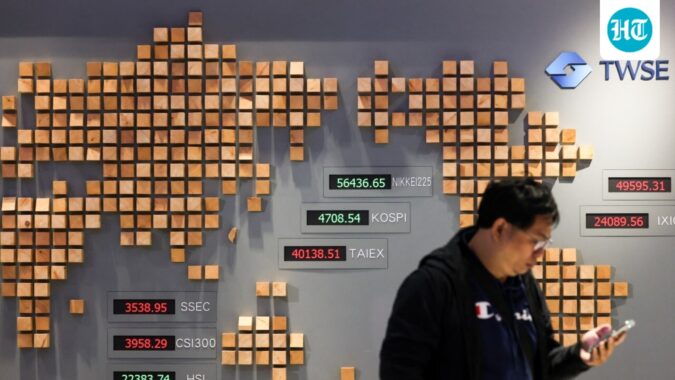
TOKYO—Panic and euphoria swept global stock markets as the Jensen Huang drama unfolded, showing just how angsty investors have become over the durability of the artificial-intelligence boom.
Dig into the economic data coming out of Asia, however, and for now at least the economic burst from the technology is still going strong, even as worries deepen about the risk of a pullback and how bad an AI slump could get.
The U.S. economy is also still feeling the AI wind in its sails. Revised figures showed the economy grew at an inflation-adjusted, annual rate of 4.3% in the third quarter, faster than the 3.4% first reported. Investment in nonresidential buildings, which includes data centers, grew at a 16% rate.
The data-center build-out in the U.S. and around the world leans heavily on exports of Taiwanese semiconductors, South Korean memory chips and high-tech equipment from countries including China, Japan and Singapore.
Export data give little indication that demand for these AI-linked products is slowing. If anything, order books suggest demand is still accelerating, especially for top-of-the-range chips such as those created by Nvidia.
“The data is still extraordinarily strong, particularly for Taiwan,” said Paul Cavey, who runs East Asia Econ, a consulting firm that provides data and analysis on the region’s economies.
The big beneficiaries of the export bonanza are the chip makers that manufacture the product at the center of the AI boom. Bumper profits at South Korea’s Samsung Electronics and SK Hynix, as well as Taiwan Semiconductor Manufacturing Co., show the critical role these companies play in bringing Silicon Valley’s AI dreams to life.
Growth in export earnings reflects not just a sharp rise in shipments of semiconductors and other components but a steep run-up in their price as demand spiraled.
Some economists say the recent leveling off in chip prices is an early sign the AI boom could be cresting. The worry for economists and institutions such as the International Monetary Fund is that Asia and the global economy more broadly are becoming too reliant on the AI industry to drive growth. That could leave the world vulnerable if and when the investment frenzy loses steam.
Asian economies aren’t just exporting the essential components of data centers to the U.S. and elsewhere. Increasingly, they are turning into data-center hubs themselves. That is especially true in Southeast Asia, where data centers are springing up in countries including Malaysia and Thailand.
That trend could soon be over, however, as the U.S. seeks to block Chinese AI labs from accessing U.S. computing power overseas. Nvidia ordered partners in the region to pause shipments to Malaysia, Thailand, Singapore and Indonesia. The U.S. also tightened export rules to throttle Chinese access to the most advanced chips. A pullback in data-center construction would kick away a key engine of regional growth.
Asian markets have been on a stomach-churning ride this year as AI’s fortunes have ebbed and flowed. The excitement has pulled in new investors and stoked stock-picking fever. The gains have helped prop up subdued domestic spending, but could magnify consumer restraint in a sustained stock slide, economists say.
Write to Jason Douglas at jason.douglas@wsj.com