Cognitive warmup. “We are a data center first company,” said AMD CEO Lisa Su, not long after everyone else seemed to be asking one simple question: What do the US mid-term results mean for data centres? Read the room? Never been a tech exec’s way. Turns out, everyone is concerned about data centres. An AP poll published over the weekend indicates that as many as 88% of Democrat voters, 61% of Republican voters and 80% of independent voters are opposed to data centres in their communities. That is a resounding message, one that clearly had a bearing on the mid-term results.
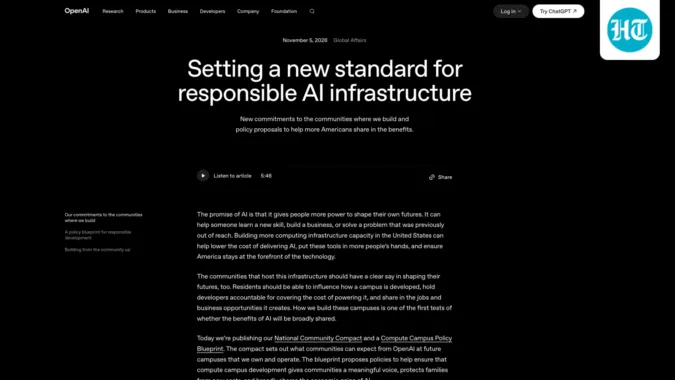
The biggest hints—though it’s difficult to draw a straight line between AI infrastructure and election results, there’s much more than coincidence—are the wins for Texas Democratic Governor-elect Gina Hinojosa and Michigan’s Democratic Senator-elect Abdul El-Sayed, both of whom support moratoriums on data centre developments. Ohio, Kansas, Florida, it is the same story. OpenAI perhaps read the trends of what was coming. They talked about better engagement with community residents in areas they want to establish data centres, and quietly introduced a new terminology for data centres: Compute Campuses. And a “Grid Protectors Program” that promises to free up to 1,000 megawatts of power for the grid in case of extreme weather, to keep thousands of homes lit up.
Previously, on Neural Dispatch: A stylish Google Pay discovery, Haiku from space, and Canva’s Brush model
UPGRADED META MUSE MODELS
Less than a month after unleashing its new Muse Wonder and Muse Wonder Full models in what they called “a major leap toward personal superintelligence” at the time, Meta has now upgraded the proposition with specialised models trained on Muse Wonder. Active Memory which remembers earlier information’s relevance, and Active Focus, which trains a model to navigate challenges while working on a task, are capabilities the new specialised models will also have.
Between generations, the Personal Superintelligence Index jumps from 38% to 47%, active memory evaluations increase from 76% to 90%, a 67% improvement at finishing a task despite encountering a problem along the way, and a 2.4x reduction in forgetting critical information—this gives the Muse, a personal intelligence-focused AI, a better foundation to work with.
“We’ve also developed our specialized models to leverage Muse Wonder’s performance on behaviors that are especially important to Muse. For example, they learned to be excellent multi-taskers that know when to push on your goals independently or collaborate live with you. They can also better adapt to steers and clarifications in the middle of running tasks without getting confused,” Meta explains in a research post.
Well, you and I wouldn’t officially be able to test any of these claims in the real world because Meta’s Muse is still not available in India (could be coming soon). Meta also says that their general-purpose conversational chatbot, Meta AI, is also getting the same set of improvements: breaking complex problems into clear steps and asking sharper follow-up questions. Meta AI is available in more regions, including India.
Another step: This week, Meta also announced the Muse Ember, which they say is the smallest model that delivers higher intelligence per dollar than others in its class. “Built for token-heavy work that agents repeat all day: tool calls, coding subtasks, routing, extraction, and long document parsing,” Meta CEO Mark Zuckerberg claims. It is now available on the Meta Model API and in Muse Code.
Spellbound: Catch up on the Frontier AI battles
Who will hold the lead in this close race, heading into 2027?
Google, AI, schools and a debacle
Turns out, Google was criticised for something last week, and they responded with something completely different. Or so it seems to be that way. Things sparked three weeks ago when an IT administrator from a middle school in the US, wrote on Google’s education forum asking for a way to turn off AI Overviews in Search for students—teachers are complaining that these overviews synthesise information students are supposed to be researching. No one from Google responded, but fellow administrators in other schools suggested workarounds.
A few days ago, Google talked about bringing Guided Learning capabilities to Search and Google Classroom, which they claim follows through on their belief that “schools should have control over AI in their classrooms and in providing administrators with controls to help them manage their approach”. This means they are changing their approach to controls for Gemini, Gemini Notebook, Gemini in Classroom, and Google Search. Access to these products will be entirely off for K-12 student accounts until school administrators explicitly turn them on.
Secondly, they are adding Guided Learning to Search and Gemini. “When our systems understand a student is looking for certain types of homework help, Search will walk them through the topic or problem step by step. For example, if a student pastes a complex physics problem or asks for help writing a book report in Search, they’ll see prompts to help them think critically and work through the concepts, without going directly to the answer,” is the explanation.
The issue the updates don’t tackle is one that embeds AI Overviews as well as AI Mode as part of the Search experience for students. Schools and teachers would prefer to have those de-linked (or at least be given a choice to), but that hasn’t happened. The way things are, if schools don’t want AI in search results, they’ll have to turn off Search completely. This may well be an opportunity for web browsers such as DuckDuckGo while Google pushes back on separating AI from its products for students. As a parent who doesn’t allow the child to use any AI for any homework or assignment, I completely agree with how the teachers see this.
🗒️ Scribbling in the notebook: It is not often that Google would begin flexing something they’re working on, before it is launched. This is therefore either prime confidence, or a reaction to the noise in the broader AI space, as to not be assumed as falling behind.
Pushmeet Kohli, Chief Scientist, Google Cloud and VP Science Google DeepMind, posted on X that “Across our projects @GoogleDeepMind, we are witnessing a genuine phase transition in the pace of scientific discovery. You will see a glimpse of this in our releases in the next few weeks.”
Could Google have achieved something big in the labs, which they’ll unveil to the world soon enough? The trajectory seems to suggest so. Just a few weeks between Gemini 4 Argon and Gemini 4 Carbon, is no mean feat.
Last time, on Wired Wisdom: Prepaid voice-only plans, reworked Flex by Google Pay, & analysing Kärcher AF30
Apple’s first agentic AI foray
Apple has released the first beta versions of iOS 18.3, iPadOS 18.3, macOS Sequoia 15.3, and visionOS 2.3, marking the initial rollout of its agentic AI capabilities by making an upgraded Siri AI available to developers for third-party app integration.
This means developers can leverage Siri AI’s personal context understanding, onscreen awareness, and natural language to bring content and actions into Siri AI using App Intents. Apple CEO John Ternus recently said Siri handles more than 2.5 billion daily requests from users.
There are also new skills for complex requests, which allow apps to integrate specific methodologies by which Siri AI can combine several actions into a single experience. In fact, Siri can find a user’s custom content and perform an app’s custom actions as required. Apple also confirms in its developer documentation that users don’t need to mention a specific app in their request if that app is in the foreground, if there is a Live Activity active, or when a user continues a conversation in the Siri app that includes a mention of that app.
For instance, you could mention the app name once in a Siri conversation or mention the command if that app is already active on the screen. Prompts could include multi-step tasks such as “Hey Siri, find me an economy class flight from New Delhi to Mumbai next Sunday” or “Hey Siri, are the sneakers I liked in XYZ app on sale?”.
In both cases, Siri can find custom content and even send it from one app to another—including looking up contacts in a different messaging app and sending it to them. However, Siri AI will not allow any autonomous task execution such as automated shopping or payments.