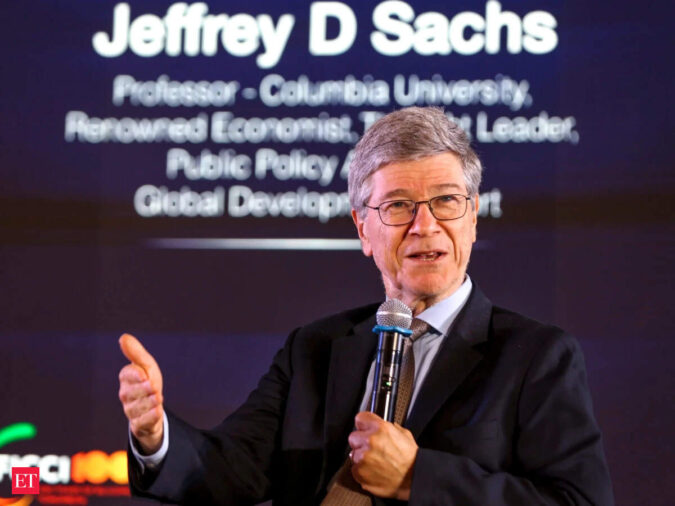
Speaking at the World Symposium on “Ancient Wisdom for Modern Challenges” in Varanasi, Sachs said the world had entered a multipolar era in which civilisations, ideas, histories and identities needed to be understood across regions. “No one region, no one country will dominate,” he stated.
ALSO READ | Finance ministry estimates India’s Q2 FY27 GDP growth at 7.35%
The Director of the Centre for Sustainable Development at Columbia University and president of the UN Sustainable Development Solutions Network also credited the Adani Group with playing a significant role in India’s infrastructure expansion and economic transformation, while underscoring the responsibilities that come with running family-led businesses and the need for companies to balance commercial interests with wider societal obligations.
ALSO READ | India’s growth momentum stays resilient despite global headwinds: RBI Deputy Governor Poonam Gupta
In subsequent interactions, Sachs described the Adani Group as one of the major drivers of change and progress in India, highlighting its contribution to the country’s infrastructure development.
He also drew attention to the distinctive responsibilities of family-owned and family-led enterprises, arguing that businesses carrying a family’s name represent more than commercial interests. They also carry their values, heritage and obligations towards society.Such businesses, he said, must consider what they give back to the communities in which they operate.
Expanding on the tension between corporate profitability and social responsibility, Sachs cited the experience of former Unilever chief executive Paul Polman, who sought to position the consumer goods company as a socially responsible enterprise but faced resistance from shareholders, investors and analysts focused on financial returns.
Sachs used the example to highlight the challenges of pursuing a broader corporate purpose within publicly listed companies, where management decisions are also shaped by shareholder expectations and the pressure to deliver financial performance.
He also raised concerns about the balance between commercial ambitions and public safety in the artificial intelligence industry, referring to Anthropic and the reported prospect of a major initial public offering.
Pointing to warnings from Anthropic’s chief executive about potentially catastrophic consequences associated with the technology, Sachs questioned whether the pursuit of a large public listing and commercial expansion was receiving greater attention than addressing the risks posed by advanced artificial intelligence.
His remarks connected two broader questions confronting businesses today: the responsibility of established enterprises towards the communities in which they operate, and the accountability of technology companies developing products with potentially far-reaching societal consequences.