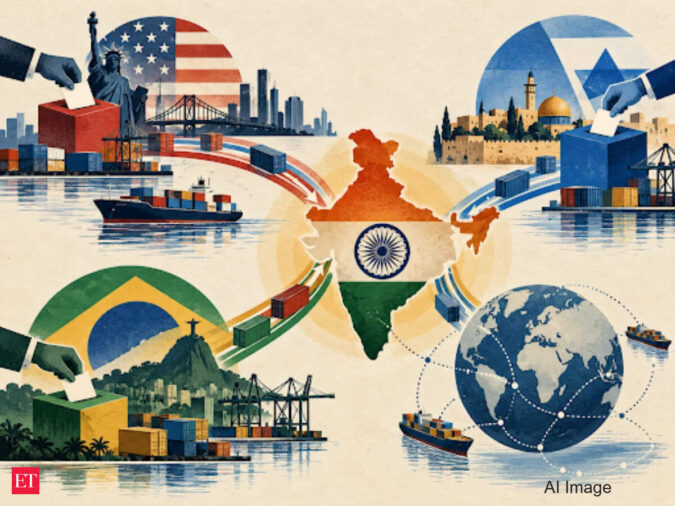
The priorities, however, are varied. India and the US are close to finalising a trade pact, Brazil is emerging as an increasingly important commercial partner, and negotiations for a free trade agreement with Israel are underway. Political changes in any of these countries could influence how quickly those plans move forward.
US: Trade pact in focus ahead of midterms
Americans head to the polls on November 3 for the midterm elections, with control of both chambers of Congress at stake. Republicans are looking to hold on to their majorities in the House of Representatives and the Senate, while Democrats are hoping to make gains.
A Reuters/Ipsos poll showed Democrats leading Republicans 47% to 36% among registered voters on the generic congressional ballot. A loss of either chamber would make it harder for President Donald Trump to push through his agenda during the remaining two years of his term.
For India, the timing is significant. New Delhi and Washington are in the final stages of discussions over a proposed trade agreement, with both sides trying to settle outstanding issues.
The two countries announced a framework for an interim trade agreement in February 2026, aimed at improving market access and bringing down trade barriers. On October 26, Commerce and Industry Minister Piyush Goyal said most of the discussions had been completed and that the two sides were fine-tuning the agreement.
The US remains one of India’s biggest export markets. According to Commerce Ministry data, India’s merchandise exports to the country stood at $87.31 billion in FY26, while imports were valued at $53.45 billion.US Ambassador to India Sergio Gor has said bilateral trade has crossed $240 billion, with both countries looking to push that figure beyond $500 billion over the next three years.
The proposed pact is particularly important for Indian exporters in sectors such as textiles, leather, engineering goods and pharmaceuticals, where tariff concessions could improve access to the American market.
Much, however, will depend on the final terms of the agreement and when it comes into effect.
The midterm results may not directly determine the fate of the negotiations, but a change in the balance of power in Congress could complicate Trump’s broader trade agenda. That makes the political developments in Washington worth watching for New Delhi.
Brazil: Trade ambitions gain momentum
India’s relationship with Brazil has grown steadily over the years, moving beyond conventional trade into a wider partnership covering energy, agriculture, technology and diplomacy.
Brazil is already India’s largest trading partner in Latin America and the Caribbean. And the numbers suggest there is room for further growth.
Bilateral trade reached $15.21 billion in 2025, an increase of more than 25% from $12.2 billion the previous year, according to the Ministry of External Affairs. The momentum continued into 2026, with trade touching $8.77 billion in the first six months, nearly 37% higher than in the corresponding period last year.
India exported goods worth $8.35 billion to Brazil in 2025, led by petroleum products, chemicals, pharmaceuticals and engineering goods. Imports, valued at $6.85 billion, included crude oil, soybean oil, raw sugar, cotton and iron ore.
Both governments now want to take the relationship further.
During his visit to India in February 2026, Brazilian President Luiz Inácio Lula da Silva proposed raising bilateral trade to $30 billion, going beyond the $20 billion target for 2030 that Prime Minister Narendra Modi had earlier announced.
The two countries also share common interests in groupings such as BRICS and the India-Brazil-South Africa Dialogue Forum, where they have often called for a greater voice for developing economies.
Lula has also suggested exploring the use of the Indian rupee and Brazilian real for bilateral trade settlements, although he has acknowledged that such a shift would not be easy.
On the commercial front, India and Brazil already have a framework for tariff concessions through the India-Mercosur Preferential Trade Agreement. Expanding that arrangement could open up more opportunities for exporters and investors.
The political direction Brazil takes after its election will therefore be important for India, particularly as the two countries look to turn ambitious trade targets into actual business.
Israel: Proposed FTA could expand market access
India’s ties with Israel have traditionally been driven by defence cooperation, but the relationship has widened considerably in recent years. Trade, technology, agriculture and innovation are now increasingly important parts of the partnership.
During Prime Minister Narendra Modi’s visit to Israel in February 2026, the two countries elevated their relationship to a Special Strategic Partnership for Peace, Innovation and Prosperity.
The October 27 election in Israel comes against this backdrop, with Prime Minister Benjamin Netanyahu’s political future in focus.
For New Delhi, the immediate concern is less about the electoral contest itself and more about what follows, particularly the continuity of defence projects, technology partnerships and ongoing trade negotiations.
Also Read: Israel votes today: What’s at stake for India as Bibi faces tough fight
India and Israel are currently negotiating a free trade agreement covering goods, services, rules of origin, intellectual property and customs procedures. If concluded, the deal could make it easier for businesses on both sides to access each other’s markets.
Bilateral merchandise trade stood at $3.93 billion in FY26. India’s exports to Israel include engineering goods, chemicals, textiles and machinery, while imports largely comprise chemicals, machinery, electronics and other industrial products.
The two countries have also established a bilateral investment agreement aimed at giving investors greater protection and certainty.
But trade is only one part of the relationship.
Israel remains an important defence and technology partner for India, with cooperation spanning defence platforms, joint manufacturing, research and development, and technology transfers. Both sides have also agreed to work more closely in emerging areas such as artificial intelligence, cybersecurity and semiconductors.
Agriculture, water management and space technology are other areas where the two countries see opportunities to expand cooperation.
A change in government could bring fresh priorities in some of these areas. For India, the challenge will be to keep negotiations moving and maintain the momentum of existing partnerships, irrespective of the election outcome.
What the elections mean for India
The three elections present different questions for New Delhi.
In Washington, attention is on whether the political balance after the midterms could affect Trump’s trade agenda as India and the US work towards an agreement. In Brazil, the focus is on sustaining a growing economic relationship and pushing bilateral trade towards the ambitious targets set by both governments. In Israel, continuity in defence cooperation and progress on the proposed FTA will remain important.