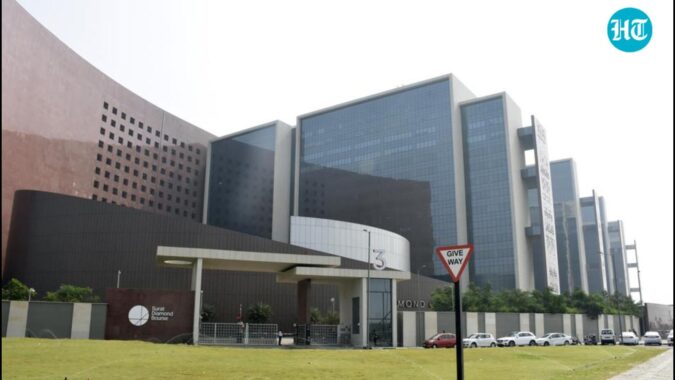
Surat Diamond Bourse (SDB) chairman Govind Dholakia has renewed his appeal to members to start operating from the complex, urging them to stop waiting for competitors to act and move into the building pitched as a one-stop shop for artisans and businessmen.
Dholakia, also a Rajya Sabha MP, said the bourse on the outskirts of Surat at Khajod represented their investment, fortune, pride, and future, and called on them to take responsibility for making it operational. Dholakia, who founded Shree Ram Krishna Exports and took over as SDB chairman in March 2024, said he would shift to the premises after Diwali.
“Whether others come or not, I will start my office. After Diwali, my office will be here,” the diamond baron said in his letter to members on October 20. He said the bourse could serve both the lab-grown diamond trade and natural diamonds, opening opportunities for businesses in both segments.
Prime Minister Narendra Modi inaugurated the bourse, part of the Diamond Research and Mercantile City, in December 2023. Counted as the world’s largest office complex, it spans 6.7 million square feet, has 4,700 offices ranging from 300 sq feet to 115,000 sq feet, and can accommodate 67,000 people. SDB was part of the Gujarat government’s DREAM City project, a planned business district developed on government-allotted land in Surat.
A SDB official said only 250 of the 4,700 offices were operational. “The industry has been through a difficult period over the past few years, starting with the Russia-Ukraine war, but the outlook has turned positive in recent months. The chairman’s message is that members should stop waiting for others to take the initiative. They must come together and start operations so that business confidence can return,” the official said on condition of anonymity.
It has nine interconnected towers, each with 15 floors, plus banking services, customs offices, secure vaults, and a jewellery mall. Nearly 90% of the offices are leased, and their occupants pay maintenance charges, according to the SDB official.
Surat makes, Mumbai trades
Surat is the world’s diamond manufacturing hub, where most of the global rough diamond supply is cut and polished. But trading, the business the bourse was built to capture, still largely happens in Mumbai 300km away, where international buyers, brokers and financial services are concentrated.
When it opened, SDB offered incentives, including a waiver of maintenance charges, to encourage businesses to shift out of the Bharat Diamond Bourse (BDB) in Mumbai. But it wasn’t enough to convince the firms.
In many diamond businesses, one family member manages manufacturing in Surat while another handles trading in Mumbai. Moving the trading office could disrupt an established network of customers and suppliers.
The shift was further hit when prominent firm Kiran Gems and Diamonds, which had shifted to SDB when Vallabhbhai Lakhani was the bourse’s chairman, reopened its Mumbai office in early 2024.
SDB officials at the time said the arrangement was temporary and that the company would maintain operations in both cities.
Location has also been a concern. The bourse is in Khajod, on the outskirts of Surat, away from established trading centres such as Mahidharpura, Varachha and Katargam. Businesses have cited the cost of shifting staff and operations, access to international buyers, and the need to maintain existing commercial relationships as reasons not to move.
Connectivity has also been a concern
Businesses have cited inadequate public transport to the bourse in Khajod, on Surat’s outskirts, and the cost and time involved in travelling from established diamond markets. SDB officials said bus services now connect traders to the complex. For companies that continue to operate from their existing premises, shifting to SDB also means bearing the cost of maintaining two offices, including staff.
Mumbai’s established business ecosystem is another hurdle. International buyers have access to a network of traders, brokers, financial services and facilities for business meetings, making it difficult for a new trading centre to draw them away.
Downturn deepens the challenge
The bourse’s launch coincided with a severe global slump. Driven by sanctions on Russian rough diamonds, weak demand in China, and US tariffs in 2025, India’s cut and polished diamond exports fell from $15.97 billion in 2023-24 to $12.16 billion in 2025-26, according to Gem and Jewellery Export Promotion Council (GJEPC) data.
The Gujarat government attempted to cushion the fallout in 2025 and rolled out a relief package in 2025 for artisans and micro-units. The Centre also introduced the Diamond Imprest Authorisation scheme, allowing duty-free imports of small-cut diamonds.
Outlook better, but will businesses move in
The industry’s outlook has improved in recent months but a recovery in demand for diamonds alone may not be enough to draw traders and companies.
The challenge is to create a concentration of buyers, sellers, and brokers that makes the bourse useful to its members. With only about 250 of 4,700 offices operating, management is trying to break the cycle in which traders wait for others to move before shifting their own businesses.