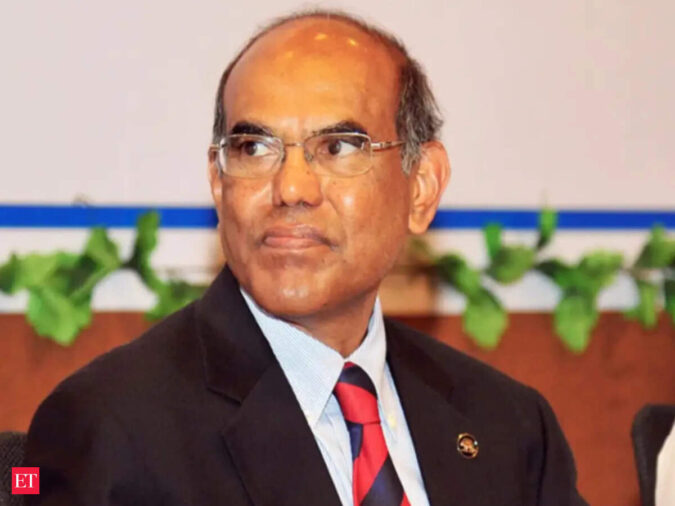
Sustaining growth of 7% or more will require stronger private investment, labour-intensive manufacturing, improved human capital and deeper integration into global value chains, Subbarao told PTI. He said the pace of expansion alone would not determine the economy’s success, with the nature of growth equally important for employment generation and economic resilience.
Also read: IMF applauds India’s GDP data revamp, says currency pain is no sign of failure as country entered energy shock with strong fundamentals
“India’s 7.8 per cent growth in the first quarter suggests that the economy is more resilient than many expected…I am optimistic about India’s medium-term prospects, but not complacent,” he was quoted as saying.
The World Bank recently raised India’s GDP growth forecast for the current fiscal year to 7.1%, an increase of 0.5 percentage points from its April projection, citing robust domestic demand and strong exports despite global headwinds. The Asian Development Bank, the Organisation for Economic Cooperation and Development (OECD), and rating agencies S&P and Fitch have also raised their growth projections for India to around 7% for FY27. The OECD increased its forecast by 80 basis points to 7.1%.
Growth must translate into jobs and incomes
Subbarao attributed the strong first-quarter performance to resilient domestic consumption, public investment in infrastructure and healthy activity in manufacturing and services, particularly financial, real estate and professional services.
“Domestic consumption has remained resilient; public investment in infrastructure has supported demand and helped crowd in private investment in some sectors; and manufacturing and services, particularly financial, real estate and professional services, have performed well.”However, he said the economy’s ability to sustain high growth would depend on whether it could generate enough employment to support broader income growth and consumption.
“An economy can grow rapidly through capital-intensive industries, automation and sectors that employ relatively few people. Output rises, but employment does not increase proportionately. That is a central concern for India,” Subbarao said.
The former RBI chief, who served from 2008 to 2013, pointed to underemployment among agricultural workers, informal and poorly paid jobs across parts of the services sector, and the difficulty educated young people face in finding work that matches their qualifications.
He described the employment challenge as a broader macroeconomic concern, arguing that weak income growth among large sections of the population can constrain consumption, discourage businesses from investing and expanding, and ultimately weigh on economic growth.
“We need to encourage labour-intensive manufacturing, including textiles, garments, footwear and food processing. We must also expand productive services employment, improve vocational training and make it easier for small businesses to grow into larger, more productive enterprises,” Subbarao said.
He told PTI that India’s economic priorities must include creating jobs that raise productivity rather than relying on output growth alone.
“India needs growth that creates jobs, and jobs that raise productivity. Otherwise, our demographic dividend could become a demographic disappointment,” he said.
Also read: ‘India needs 8-9% growth to become a developed nation by 2047’
GDP estimates need greater transparency
Subbarao also addressed questions about changes to India’s GDP estimation methodology and whether the resulting figures accurately reflect economic activity on the ground.
He said the issue required distinguishing between the soundness of the methodology and the accuracy of the estimates produced using it. Updating statistical methods is necessary as the structure of the economy changes, he said, identifying four areas for improvement: revising the base year, strengthening estimates of the informal sector, adopting double deflation for manufacturing, and improving producer-price measures.
Updating the base year can provide a more representative picture of the economy’s changing composition, while better estimates of informal activity can help capture output that may not be fully reflected in the accounts of organised businesses.
Double deflation measures real manufacturing growth by accounting separately for changes in input and output prices. Better producer-price measures, meanwhile, can help distinguish changes in actual output from price movements.
Subbarao said these changes would improve GDP measurement in principle, but would not automatically ensure that every estimate was accurate.
“There are legitimate questions about some estimates, including the manufacturing deflator and differences between GDP figures and other indicators of economic activity,” Subbarao said.
He called for transparent technical scrutiny of these differences, with statistical authorities explaining the underlying data, assumptions and apparent divergences.
The broader challenge, Subbarao added, is to ensure that India’s economic expansion is not judged only by headline growth figures, but also by its ability to create productive employment and improve living standards.
(With inputs from PTI)