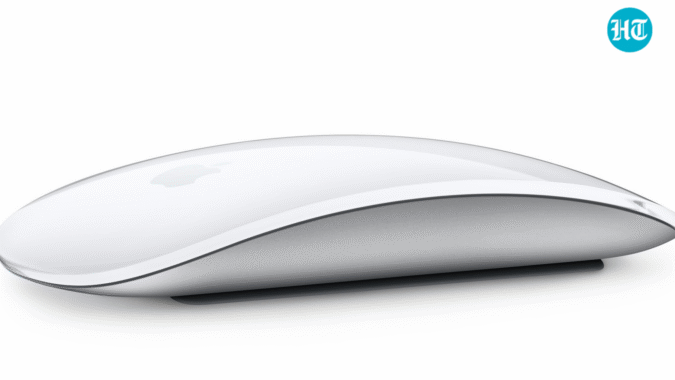
Today, October 20, marks the 17th year of the existence of one of Apple’s most debated, paradoxical products. The Magic Mouse, first unveiled in 2009, was a big deal at the time for being the ‘world’s first multi-touch mouse’. Wireless, a solid-state laser tracking sensor, battery-powered and unlike its predecessor the Mighty Mouse (which had four programable buttons), also supported secondary click. The Magic Mouse belongs to a much longer Apple story of computing. The Lisa, introduced in 1983, brought a mouse to Apple’s graphical-computing line. The Macintosh helped make mouse-reliant computing interfaces familiar to a much wider audience the next year.
To be fair, not many PC peripheral makers have been able to replicate this level of precision generation after generation on a computing mouse device. For instance, the brilliant Logitech MX Master 3S does side scrolling too but via hardware keys and not finger swipe gestures which the Magic Mouse works with. Microsoft’s Arc Touch Mouse from 2010 and the Surface Arc Mouse generation from 2017 have tried, but neither caught on even within the Windows PC ecosystem. It is no surprise that Apple hasn’t been pushed to do more than three generational refreshes in all these years, of which one was a mandatory switch to the USB-C port from the Lightning port. It simply works.
While the original Magic Mouse generation was on sale for many years with two AA batteries to provide power (Apple also bundled rechargeable AA batteries for a considerable amount of time, including the charger), the 2015 update (dubbed Magic Mouse 2) added built-in lithium-ion batteries that made the mouse lighter, sturdier and more balanced. That also meant a smoother glide across the mouse pad, and it was charged via the Lightning port.
That port placement draws differing opinions even today. It is on the underside, and the swap from Lightning to USB-C in 2024, retains that placement. Unlike most mouse accessories that can be recharged while they are being used, the Magic Mouse must be kept upside down or on its side for the duration of the charging. This persistent design controversy is unlikely to go away anytime soon.
Between 2017 and 2022, Apple offered multiple colour options for the Magic Mouse, to align the symmetry of colour-matched accessories for the broader Mac lineup. Such as the 2021 iMac. These were simply appearance changes, and didn’t alter the functionality in any way. An important milestone was in 2020, when iPadOS 13.4 added noise and trackpad support which meant the Magic Mouse 2 could be used with the more productivity-focused iPad and iPad Pro portfolios as well.
It was the multi-touch functionality that allowed Apple to add quick features such as Exposé and Spaces to macOS in the years ahead. The flexibility of a finger swipe across a glass interface is more receptive to these fine gestures rather than a physical scroll wheel for horizontal or vertical scrolling. And the longevity of this design is itself a success story. The shape is recognisable and has hardly changed over the years. The battery lasts weeks between charges, and somewhat renders the port placement debates to a little less important plinth than what critics might want to suggest.
The clean, low-slung profile with a continuous metal chassis and glass layer has been an ergonomic win for Apple in a way that no other mouse has managed. There will of course be subjective preferences, with some preferring a higher-profile design that cups the palm in a curved hand rather than one that sits flatter on the mouse. Each has its advantages, and you get used to either.
Seventeen years later, the Magic Mouse is a paradox for some, while Apple would consider this a win. The friction has become part of its identity. The Magic Mouse doesn’t need to look magical, because it still does something no competitor is able to replicate in all these years. The simplicity of multi-touch, which once you get used to, makes it very difficult to get back to scroll wheels and buttons.