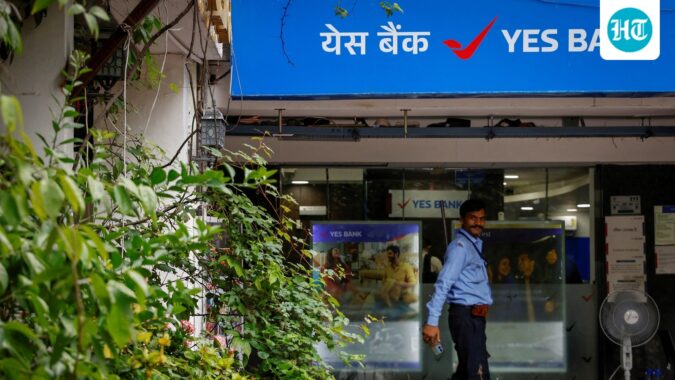
Yes Bank Ltd’s bondholders scored a landmark win over India’s central bank and the government on Thursday, with the Supreme Court striking down a six-year-old decision to cancel their investments.
The Reserve Bank of India had seized the wobbly private lender in 2020 to facilitate a bailout, appointing an administrator who wrote off the bank’s additional tier-1 (AT-1) bonds worth ₹8,415 crore. The Bombay High Court quashed the write-off in 2023, and the apex court on Thursday said it found no reason to reverse that.
“The question is not whether the AT-1 bonds could have been or ought to have been written down off. The question is the manner in which it was done,” the judgment penned by justices Dipankar Datta and Augustine George Masih said. The administrator could not exercise a power reserved for the RBI, the court said, noting the write-down was contrary to the RBI’s own master circular on Basel-III capital regulations and the terms governing the bonds.
Also Read I How emerging cities are reshaping business mobility
Yes Bank shares plunged 14.5% to ₹18.12 on the NSE, turning the worst-performer in the Nifty Bank index, as investors fretted about the ruling’s financial impact.
The impact on Yes Bank’s balance sheet may not be immediate.
Investors bear consequences
According to the former chief financial officer of a private sector bank, since AT-1 bonds do not have a maturity date, lenders only need to pay coupon every year. However, most AT-1 bonds have a call option under which banks repay investors in full after five or 10 years. Therefore, unless the verdict is overturned, Yes Bank will have to restart making yearly coupon payments to bondholders, the banker said on the condition of anonymity. The fate of the past dues—from 2020 to now— could not be immediately ascertained.
The court made withering criticism of the central bank—“the RBI was a mere bystander, allowing the CET-1 ratio of Yes Bank to drop to an astonishing low of 0.6% while the business of Yes Bank was being carried out in a clandestine manner,” the judgment said. The court added that making investors bear the consequences of administrative lapses is “highly unfair”.
The court was not persuaded that the write-down was necessary to revive Yes Bank before the State Bank of India (SBI) infused capital into the lender. It said the need to rescue the bank could not override procedure. The court termed the conduct of Yes Bank, the RBI and the administrator in handling the investor money as “questionable”.
“Payment of annual coupon rate shall remain unaffected by the outcome of these appeals and must be made in terms of the information memorandum,” the bench said.
Yes Bank sank into a liquidity crisis in March 2020 as bad loans swelled, prompting the RBI to seize the lender and freeze withdrawals. A consortium of lenders led by SBI was assembled to orchestrate a massive bailout by injecting fresh equity capital. The administrator wrote down around ₹8,415 crore worth of AT-1 bonds as part of this exercise, prompting Axis Trustee Services and other bondholders to move court.
The bench also questioned if SBI, the RBI, the administrator and the government were aware that the Yes Bank reconstruction scheme did not have the bond write-down provision. It said the government’s decision to remove the clause from the draft scheme appeared to favour bondholders, but the administrator subsequently wrote down the bonds.
The court slammed Yes Bank for offering high-risk AT-1 bonds to individual investors, noting that RBI rules required these instruments to be offered only to institutional investors. “A tighter scrutiny ought to have been exercised before luring individual investors to such high-risk securities”, it said.
Queries emailed to Yes Bank remained unanswered.
“If the ruling is implemented and the AT-1 bonds are fully restored, Yes Bank’s common equity tier-1 (CET-1) capital ratio will be impacted,” Venkatkrishnan Srinivasan, founder of Rockfort Fincap said. In the June quarter, Yes Bank reported a 34% increase in net profit to ₹1,071 crore, and remained well-capitalized with a capital adequacy ratio of 15.1% and CET-1 ratio of 14.0%.
Also Read I India weathered global storm better than its peers, says IMF
“The ruling could improve investor protection, but also increase uncertainty about future AT-1 write-offs. Investors may become more cautious, particularly towards lower-rated banks, potentially increasing their borrowing costs,” Srinivasan said.
“Stronger banks may continue issuing AT-1 bonds, while others may prefer equity-raising if the cost or availability of AT1 funding becomes less attractive,” he said, adding the bond market may require greater clarity on the legal process for writing down such bonds to boost investor confidence. DP Singh, former joint CEO of SBI Funds Management, said the latest developments could kill the AT1 bond market in India. “Institutional buyers are aware about AT-1 bonds and their risks. They cannot say that these bonds were mis-sold to them,” Singh said.