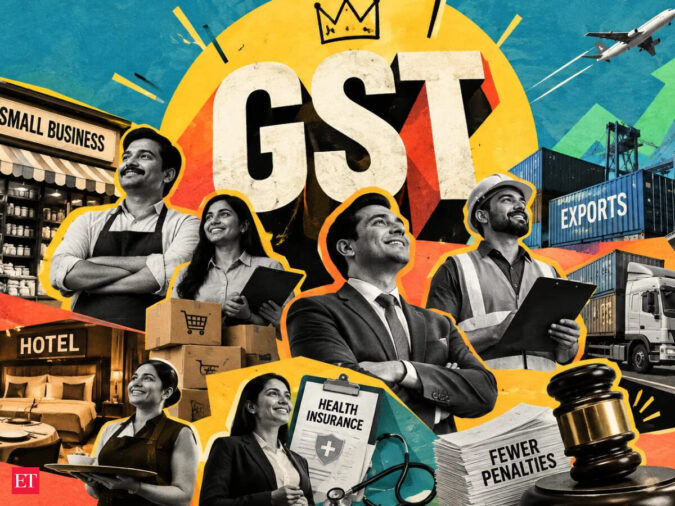
At its 57th meeting, the Council approved removing GST tax officers’ arrest powers, raising the prosecution threshold fivefold from Rs 1 crore to Rs 5 crore, introducing simpler filing requirements for eligible small businesses and accelerating tax refunds. GST rates were left unchanged.
Also Read: GST Council Meeting 2026: Tax officers’ arrest powers scrapped, prosecution threshold raised to Rs 5 crore; no rate changes
Finance Minister Nirmala Sitharaman said the reforms announced on Thursday would be implemented from April 1, 2027, although the Finance Ministry specifies separate eligibility dates for certain refund provisions.
The decisions could benefit businesses across manufacturing, exports, e-commerce, hospitality and logistics, while consumers may see indirect gains if lower compliance costs are passed on. Here is who stands to benefit and how.
Small businesses and MSMEs
Businesses with turnover of up to Rs 5 crore supplying exclusively to consumers could benefit from an optional scheme allowing them to file one GST return annually while paying tax quarterly.
According to the Finance Ministry, around 16.66 lakh taxpayers fall within the proposed turnover and consumer-supply criteria. Together, they account for less than 1% of the tax liability reported under GST.The scheme has been approved in principle, with the detailed framework and necessary amendments to be considered at the next Council meeting.
The Council also approved a Rs 10,000 minimum threshold for issuing show-cause notices and reduced the general penalty from Rs 25,000 to Rs 10,000.
Taxpayers facing GST proceedings
Taxpayers facing enforcement proceedings could benefit from the Council’s decision to remove GST tax officers’ powers to arrest individuals under the GST law and raise the monetary threshold for prosecution from Rs 1 crore to Rs 5 crore.
The Council also removed the provision for minimum punishment, leaving courts to decide whether fines, imprisonment or both are appropriate in individual cases.
Taxpayers who file returns late, make mistakes or delay payments will face tax recovery, interest and proportionate penalties, without additional punitive action for such defaults.
Also Read: One GST return a year? New scheme could ease compliance for 16 lakh small businesses
Exporters and manufacturers
Exporters stand to benefit from faster GST refunds, with the acknowledgement deadline reduced from 15 days to 10 days.
Under the approved mechanism, the system will sanction 90% of the refund amount claimed, subject to risk assessment, with orders issued within three working days of acknowledgement instead of the existing seven days.
Refund eligibility under the inverted duty structure will also extend to input services for credit availed on or after November 1, 2026.
Exporters and eligible manufacturers will be able to claim refunds on plant and machinery, calculated at one-sixtieth of the eligible credit each month over five years. This will apply to credit availed on or after April 1, 2027.
The changes could improve working capital availability, particularly for businesses in sectors such as pharmaceuticals and FMCG.
Small e-commerce sellers
Small businesses selling through e-commerce platforms will be able to expand into other states without establishing their own physical premises in each location.
Under the approved framework, eligible sellers can declare an e-commerce operator’s warehouse in another state as their principal place of business, with the operator’s consent processed automatically.
Sellers must maintain a physical presence in at least one state, while the simplified registration will be limited to supplies made through e-commerce platforms.
Employers and businesses
Companies purchasing health and life insurance for employees will be eligible to claim input tax credit on those expenses.
The Council also approved ITC on telecommunications towers, pipelines laid outside factory premises, free samples and expired stock where the law requires the goods to be destroyed.
These changes will allow eligible businesses to recover tax paid on additional categories of expenditure.
Hotels, restaurants and passenger transport
Hotels, restaurants, caterers and passenger transport operators could benefit from measures aimed at preventing double taxation when services are purchased and resold in the same line of business.
The changes cover hotel accommodation costing up to Rs 7,500 per night booked through agents, restaurant and catering services, and passenger transport.
The measure allows input tax credit to flow through eligible transactions that were previously subject to restrictions under the 5% GST framework.
Logistics and transport companies
Transporters could face fewer interruptions during interstate movement of goods under changes restricting physical inspections.
Vehicles may be stopped only on specific intelligence, with prior authorisation from an officer not below the rank of Joint Commissioner.
Only the originating and destination states will be permitted to inspect goods in transit, reducing repeated checks along transport routes.
What about consumers?
Consumers will not receive direct GST rate cuts from Thursday’s decisions, as the Council left the existing rate structure unchanged.
However, simpler compliance for small businesses, easier interstate e-commerce selling and measures addressing double taxation could indirectly benefit consumers if businesses pass on any resulting savings.
Meanwhile, relief for genuine buyers facing ITC reversals because of supplier defaults remains pending. The Council has decided to constitute a committee of officers to examine the issue within three months, with recommendations to be placed before the next meeting.