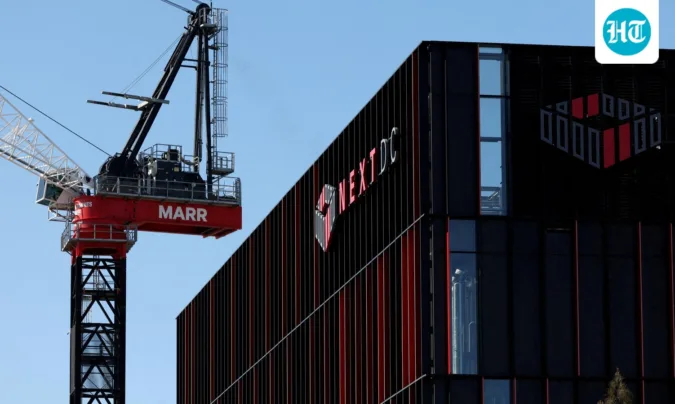
Astralia gets by with a fair dose of luck. Now it wants intelligence, too. It has set about building data centres, the engine rooms of the global drive for artificial-intelligence. Investors have plans to pour some $156bn into computing clusters there—eclipsed only by the United States at $1.8trn and China at $295bn. The reasons for this are, as with Australia’s mineral riches, mostly the result of good fortune. But its government wants to make sure that this boom lasts.
This month senior Australian officials stopped off in San Francisco to woo American AI labs. Chastened by a growing public backlash over data-centre investment in America and feeling competitive pressure to expand their computing power, AI bosses are looking elsewhere. On September 16th it was reported that Anthropic had signed a deal to lease a 2.16 gigawatt facility in Australia’s north-east, on par with the largest in the world.
Some of the reasons for the boom down under are obvious. Australia is sunny and has lots of space. It is among the lowest-cost producers of renewable energy anywhere, according to the country’s science agency. The huge amounts of electricity sucked up by chips training and serving AI models is less of a concern if facilities can generate their own solar and wind power. And big sheds emitting strange noises can be kept far away from the population.
Other motives are less intuitive. India is Anthropic’s second-largest market by usage, and Singapore and South Korea (alongside Australia) have high AI adoption rates. But American companies prefer to avoid running expensive subsea internet cables through the South China Sea, where they could be vulnerable to sabotage in a potential conflict involving China. So most new cables running from America to Asia first stop off in Australia, making it a natural home for compute serving Asia.
It helps considerably that the “lucky country” is friends with America and enjoys the rule of law. AI labs worry about their model weights being nicked by adversaries. Australia is a member of the Five Eyes alliance of Anglophone spooks. Its cyber agencies are capable and used to protecting sensitive American data. And Australia enforces American export controls, limiting the risk of sought-after Nvidia chips being siphoned off to competitor countries, namely China.
Australia’s pitch comes with some “ground rules”, says Andrew Charlton, the minister responsible for AI. Its government is eager to head off any possible populist backlash, so it plans to introduce a set of basic standards for new data centres: they must generate more electricity than they take from the grid, pay for the costs of grid connection, be kept away from homes and schools, and minimise water use. Such standards are “tough but in the long-term interest of the companies themselves,” says Mr Charlton.
The government is also keen to ensure that the income from operating data centres does not only flow to Silicon Valley. Unlike iron-ore mines, data centres create few continuing jobs once construction is complete and are therefore unlikely to be a big source of tax revenue. Mr Charlton wants AI labs to set aside some compute resources for Australian firms and researchers, but this attempt at industrial ladder-climbing is currently framed as an “expectation” rather than a requirement.
To ensure that the planned investment does indeed arrive, Australia will need to move quickly to clarify how its copyright laws may limit AI training on proprietary information. Officials in Canberra want Australian businesses and creatives to be paid for their data. If AI labs agree to fork out, it may create legal headaches for them in America, where they have been freely scraping books and vast swathes of the internet. Other attractive destinations are also vying for American compute, including Canada and the United Arab Emirates. If it gets too prescriptive, Australia risks pushing its luck.