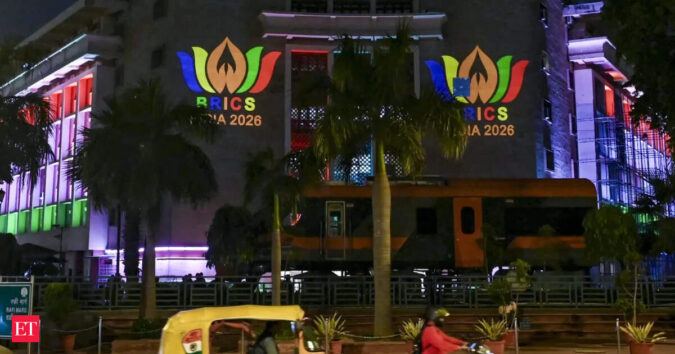
As leaders of major energy powers, manufacturing economies, consumer markets and developing nations converge at Bharat Mandapam on September 12-13, India will try to turn a much-expanded BRICS from a forum with growing heft into one capable of delivering practical cooperation.
Also read: BRICS Summit in New Delhi: The grande finale is India’s moment to navigate a bigger, and more divided bloc
The stakes are unusually high. BRICS now spans Brazil, Russia, India, China, South Africa, Egypt, Ethiopia, Iran, Saudi Arabia, the UAE and Indonesia, after its expansion in 2024 and 2025. The grouping also has 10 partner countries. Collectively, its members account for nearly half the world’s population and a substantial share of global output and trade, giving the bloc considerable potential influence over trade, energy, finance and technology.
India’s 2026 chairship, built around “Building for Resilience, Innovation, Cooperation and Sustainability” and the broader vision of “Humanity First”, is therefore expected to push BRICS beyond political coordination towards practical cooperation in startups, resilient supply chains, green energy, digital technology, trade and development finance.
But there is a catch: the bigger BRICS gets, the harder consensus becomes.
That tension will hang over the summit as Prime Minister Narendra Modi hosts Russian President Vladimir Putin and a visit by Chinese President Xi Jinping. The summit will also bring together Gulf energy powers, Iran and other members whose strategic interests do not always align.
Trade without the tariff headache
For India, one of the clearest priorities is likely to be making trade between BRICS economies easier, cheaper and more resilient.
The bloc is working on a BRICS Global Value Chains Action Plan for 2026-30, with New Delhi looking at ways to strengthen trade corridors, reduce transaction costs and make customs procedures easier. India has also proposed an invoice-discounting mechanism aimed at easing trade-finance constraints for micro, small and medium enterprises, along with a BRICS MSME Cooperation Portal connecting technology centres, financial institutions, training bodies and policymakers.
Supply chains are likely to get particular attention as tariffs, wars and energy disruptions put pressure on global commerce. A BRICS Logistics Supply-Chain Cooperation Framework could emerge as one of the summit’s practical outcomes, aimed at improving the resilience, efficiency and sustainability of transport logistics and supply chains across member economies.
The logic is straightforward: the expanded grouping contains both major energy exporters and huge energy-consuming economies, alongside manufacturing hubs and fast-growing markets. That creates scope for deeper intra-BRICS trade and investment, even if members remain competitors in several sectors.
India is also expected to push for greater use of national currencies in bilateral trade. But New Delhi has drawn a line between making cross-border payments more efficient and pursuing an explicitly anti-dollar project.
Also read: BRICS by BRICS: India’s journey from seeking reforms to shaping global order
India does not favour a common BRICS currency. Instead, its focus is on local-currency settlement, payment interoperability and reducing dependence on costly dollar-based intermediaries. The RBI has also proposed linking the digital currencies of BRICS countries to facilitate cross-border trade and tourism payments.
The issue is politically sensitive. Russia has said it does not seek “de-dollarisation”, even as Kremlin spokesperson Dmitry Peskov said around 90% of transactions between Russia and BRICS countries are conducted in national currencies.
Startups, AI and the technology race
If trade is one pillar, technology is emerging as another.
India wants the summit to give greater institutional shape to cooperation on startups, artificial intelligence, financial technology and digital public infrastructure. A proposed BRICS Startup Innovation Fund could mobilise voluntary public and private financing for scalable startup-led solutions, while a digital interface could connect national nodal agencies, incubators and startups across member countries.
India has also proposed a BRICS Incubator Network to link startup incubators across member economies. On the digital side, the agenda includes a proposed BRICS Digital Public Infrastructure Repository to share knowledge and test scalable DPI solutions.
Artificial intelligence could become an especially important part of the conversation. Amitabh Kant, former G20 Sherpa and former NITI Aayog chief, said ahead of the summit that BRICS must confront AI as a major driver of global growth while establishing frameworks for its responsible use.
Kant has also argued that India should use its engagement with China to press for greater transfer of clean-energy technologies to other BRICS partners, amid concerns over concentration in technologies such as batteries and other clean-energy supply chains.
That makes technology a bridge between several strands of India’s BRICS agenda: trade, energy security, climate action, manufacturing and development.
Also read: India set to host expanded BRICS summit as global trade, finance and governance take centre stage
Green energy, critical minerals and the finance gap
Energy may offer the enlarged BRICS one of its clearest areas of common interest.
The grouping now includes Russia, Saudi Arabia, the UAE and Iran, alongside India and China, creating an unusual combination of major energy producers and some of the world’s largest consumers. India’s energy agenda has consequently sought to combine security and affordability with the transition towards cleaner sources.
The BRICS Energy Ministers’ Meeting in June advanced cooperation on smart grids, energy storage and hydrogen, while discussions also covered renewable energy, biofuels, carbon capture, digitalisation, energy efficiency and critical minerals. A BRICS Digital Centre of Excellence for Smart Grids and Energy Storage was launched.
Critical minerals could become particularly important because they sit at the intersection of climate policy, energy security and economic sovereignty. The 2025 Rio de Janeiro Declaration recognised their importance to low-emission technologies and called for reliable, diversified and resilient supply chains, while stressing value addition and economic diversification in resource-rich countries.
Climate finance is the other half of that conversation.
India’s chairship is seeking greater attention to green finance, climate resilience and sustainable development, with the broader BRICS climate agenda covering adaptation, technology, critical-mineral supply chains and affordable energy. The New Development Bank could consequently assume a larger role in financing climate-related development, according to the inputs reviewed.
The question for New Delhi is whether calls for greater climate finance can be translated into mechanisms that actually deliver affordable capital to developing economies.
The China-Russia-Gulf balancing act
And then there is the issue that no agenda document can quite contain: geopolitics.
Xi’s presence would make his meeting with PM Modi one of the most closely watched moments of the summit. It would be Xi’s first visit to India since the 2019 informal summit in Mamallapuram. Putin is also scheduled to attend, giving Modi an opportunity to engage simultaneously with two major powers with which India has complicated but consequential relationships.
The challenge is magnified by the grouping’s newer members. Iran, Saudi Arabia and the UAE sit within the same expanded BRICS framework even as the bloc confronts divisions over West Asia.
Those divisions have already tested consensus. The BRICS foreign ministers’ meeting in New Delhi in May failed to produce a joint statement because members could not agree on the conflict in West Asia; India subsequently issued a chair’s statement and outcome document.
Amitabh Kant has argued that India must help bridge those differences and ensure that the summit document is “progressive and forward-looking”. He has also stressed that consensus-building should be a hallmark of India’s presidency.
That may ultimately be India’s biggest test.
The September 12 opening will feature a closed-door leaders’ session on “Inclusive Global Governance and Strengthening Multilateralism”. On September 13, BRICS leaders and partner countries will meet in a joint session focused on “Resilience, Innovation, Cooperation and Sustainability: Shaping the Future for Inclusive Global Growth”.
The summit is expected to culminate in a joint Leaders’ Declaration, subject to consensus.
For a bloc that has spent the past two years getting bigger, Delhi now faces the harder question: can BRICS get better at acting together?
India’s answer will be tested across trade, payments, startups, AI, energy, climate finance and global governance. But the real measure of the 2026 summit may be simpler. If countries that disagree on wars, borders and strategic alignments can still build institutions, supply chains and financial mechanisms around shared interests, New Delhi could give the expanded BRICS a purpose beyond its size.
That is the bet India is bringing to Bharat Mandapam.
(With inputs from agencies)